Canola Seed Per Acre Calculator
Estimate canola seed per acre from field acres, hybrid or open-pollinated seed type, target stand, thousand seed weight, germination, field emergence, row spacing, planting date, placement method, and treatment loss.
Choose a real canola seeding starting point, then fine tune the seed tag, target final stand, planting date, row spacing, seeding method, and acreage for your field.
Works only when seed quality, seedbed, moisture, depth, and emergence are very dependable across the field.
A common target for drilled hybrid canola where plant survival and branch compensation are both expected.
Often seeded heavier because seed vigor, uniformity, and compensation may differ from hybrid seed lots.
Higher target stands help offset less exact seed placement, crusting, cool soils, or shortened fall growth time.
Your Canola Seed Plan
Results update from target plants, seed size, germination, emergence, losses, date timing, row spacing, method, and acreage.
Thousand seed weight has a large effect on pounds per acre because it changes how many canola seeds are in each pound.
| Planting situation | Typical target plants per sq ft | Usual row spacing | Calculator notes |
|---|---|---|---|
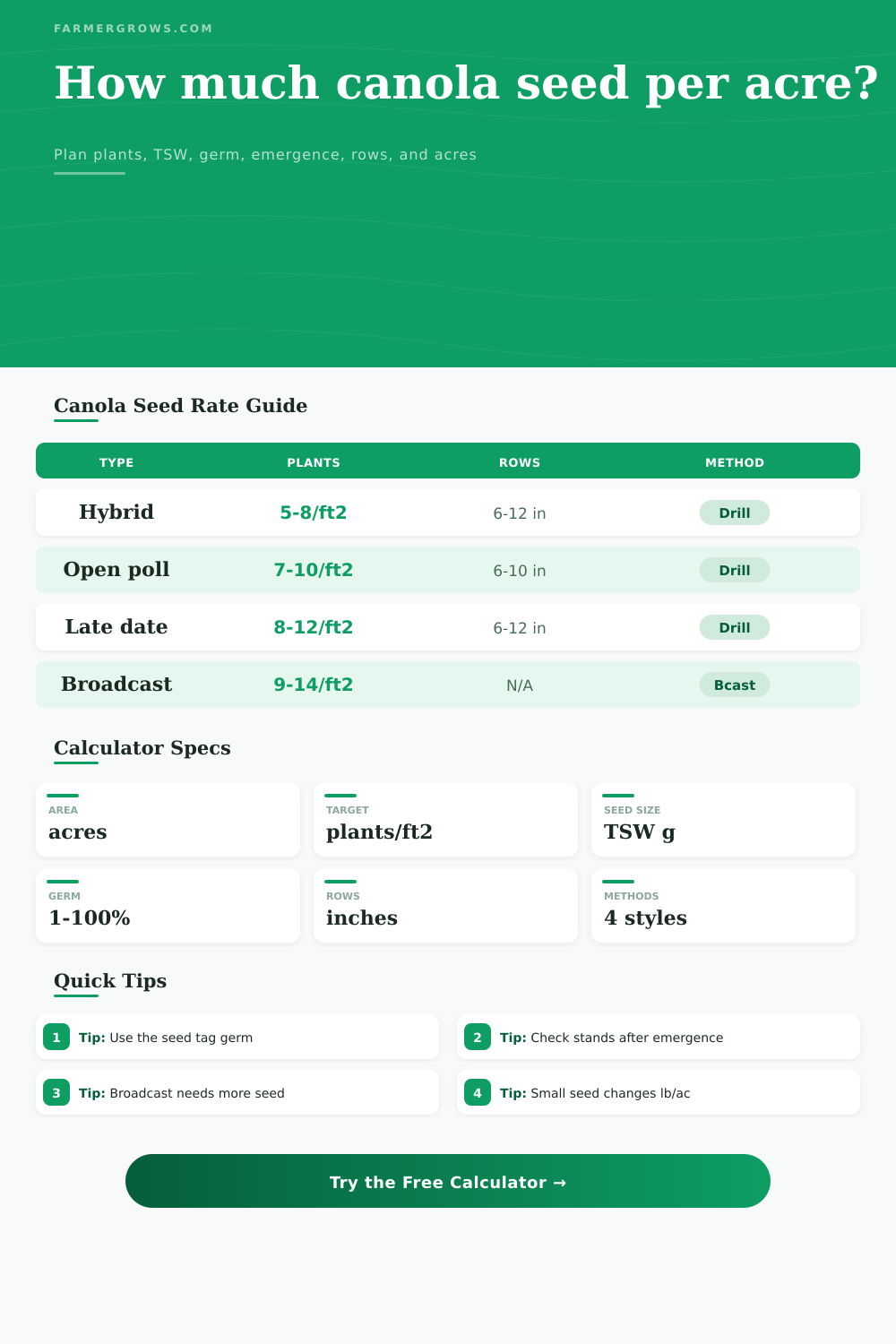
| Hybrid, early preferred window | 4.5 to 6.5 plants | 6 to 12 inches | Use only when emergence is reliable and seed depth is consistent. |
| Hybrid, normal local window | 5.5 to 8 plants | 6 to 12 inches | A balanced range for many drilled canola fields. |
| Open-pollinated canola | 7 to 10 plants | 6 to 10 inches | Often planned with a heavier target than hybrid canola. |
| Late planting or cool soil | 8 to 12 plants | 6 to 12 inches | Higher populations help offset slower emergence and less branching. |
| Broadcast then packed | 9 to 14 plants | Not row based | Use the row result only as an acre equivalent cross-check. |
| Thousand seed weight | Approx seeds per lb | Lb/ac at 6 plants sq ft* | Lb/ac at 9 plants sq ft* |
|---|---|---|---|
| 3.0 grams | 151000 | 2.9 lb/ac | 4.3 lb/ac |
| 3.5 grams | 129600 | 3.4 lb/ac | 5.0 lb/ac |
| 4.0 grams | 113400 | 3.8 lb/ac | 5.7 lb/ac |
| 4.5 grams | 100800 | 4.3 lb/ac | 6.4 lb/ac |
| 5.0 grams | 90700 | 4.8 lb/ac | 7.2 lb/ac |
| 6.0 grams | 75600 | 5.7 lb/ac | 8.6 lb/ac |
*Table examples assume 70% combined establishment before field buffers, so your calculated result can be higher or lower.
| Row spacing | 6 plants per sq ft | 8 plants per sq ft | 10 plants per sq ft |
|---|---|---|---|
| 6 inches | 3.0 plants per row ft | 4.0 plants per row ft | 5.0 plants per row ft |
| 7.5 inches | 3.8 plants per row ft | 5.0 plants per row ft | 6.3 plants per row ft |
| 10 inches | 5.0 plants per row ft | 6.7 plants per row ft | 8.3 plants per row ft |
| 12 inches | 6.0 plants per row ft | 8.0 plants per row ft | 10.0 plants per row ft |
| 15 inches | 7.5 plants per row ft | 10.0 plants per row ft | 12.5 plants per row ft |
| Factor | Low allowance | Normal allowance | High allowance |
|---|---|---|---|
| Planting date | Early window: no add | Normal window: no add | Late: 8% to 18% add |
| Placement method | Precision drill: no add | Grain drill: 4% add | Broadcast: 20% add |
| Canola type | Hybrid: no add | Open-pollinated: 6% add | Weak vigor lots: raise emergence loss |
| Treatment loss | 0% to 2% clean handling | 3% to 5% normal handling | 6%+ rough handling |
Use seed count math. Canola seed lots vary widely in thousand seed weight, so pounds per acre should come from seeds needed, not a fixed bag-rate guess.
Verify after emergence. Count plants in several row sections or square-foot frames, then compare actual stand to the target used in the calculator.
To plant canola you have to think in terms off biological probabilities, not just throw some seed out there and hope it gets into ground. After all, you’re depending on small seeds to make it through insect pressure, varying moisture conditions and other odds until those first leaves pushes up.
All growers understands the concept of achieving an adequate plant population, but the leap from that objective to the number of pounds of seed in the back of your drill hopper can be misjudged. The guess is simple, but backing it up with confidence are hard unless you understand the science behind germination, seed size and field emergence.
How to Calculate the Right Seeding Rate
Where people gets confused is in the thousand seed weight, which refers to how much actual mass you’re hauling around per acre. The bigger and heavier the seed, the lower the thousand-seed weight and fewer total seeds you have in a pound. You’ll need more pounds per acre or fewer plants then you thought, unless you adjust for seed size. You want to know how many to sow; the weight tells you nothing about this.
To turn pounds into numbers, do the math: You want to know how many seeds will yield X number of plants right? The other wrinkle is the germination rate on the seed tag. Because lab germination assume ideal conditions, it’s typically more than actual emergence in the field. So you need to adjust for difference between the clean and tidy test conditions versus a muddy mess out in the field. Plug those numbers into the calculator and it bridges that gap, accounting for the seed lot quality you actualy recieved and what sort of survival you can expects in the field. It avoids common mistake of over-estimating your survival-to-harvest rate with seeds.
The seeding rate you need is affected by not only what you plant but when and how you do it. If you have warm, moist soil early and can get things going, you’ll be able to go with a leaner stand because the crop will has had time to branch out and fill in some. When you late-plant that growth window gets compressed. You’ve got fewer days to develop lateral branches. You’ll want more main stems to reach up for sun and hold more yield potential.
Because of all this, broadcast seeding creates more variables like poor seed-to-soil contact. These situations calls for a big ol’ buffer in your math. It makes up for the imprecision by starting off denser.
The overall acres number isn’t hugely dependent upon row spacing, but determining whether the drill’s doing its job is. How many plants do you want per foot of row? Verify this with amount of seed being distributed. Whether you’re within the right rate or not, clumps and bare spots indicates something’s amiss with the machinery. By knowing the best spacing for any given row width, it converts a two-dimensional goal (spreading seed between rows) to a one-dimensional test that can be run from inside the cab.
Lastly, add some padding (a.k.a. “buffer”). This covers potential seed loss, headland overlap, or calibration drift. It’s insurance for that thin spot at the tail end of the field. It is easy to think of this as an additional expense, but it is actualy part of the plan. You want to have a uniformly planted field.
After running the numbers, you shouldn’t just know how many seeds to purchase but also why exactly that amount is right for you and your conditions. No more guesswork. You are just planning with an understanding of what the risk is, making sure each seed has the best chance possible to become a productive plant. Math tells you the rate. Understanding provide the confidence.