Calf Milk Replacer Calculator
Estimate daily mixed milk volume, quarts per feeding, powder pounds per day, replacer solids, total powder to weaning, bag use, and starter-based weaning readiness.
Use this worksheet for milk replacer planning and inventory checks. Calf health, weather, breed size, colostrum success, veterinary directions, and the milk replacer tag can change the final feeding program.
Calf Milk Replacer Results
Calculated from calf weight, liquid feeding rate, powder concentration, replacer solids, and the weaning target.
| Powder concentration | Approx mixed solids | Common use | Feeding note |
|---|---|---|---|
| 4.0 oz/qt | 11.0% to 11.8% | Light conventional feeding | Often paired with smaller calves or warm weather programs. |
| 4.8 oz/qt | 13.0% to 13.8% | Standard all-milk powder mix | Close to many tag directions when fed at 2 qt per meal. |
| 5.5 oz/qt | 14.5% to 15.5% | Moderate growth program | Check osmolality risk and calf manure if solids are pushed. |
| 6.0 oz/qt | 15.8% to 16.8% | Higher nutrient density | Use only when label, water intake, and calf health support it. |
| Mixed solids range | Program signal | What to watch | Calculator treatment |
|---|---|---|---|
| Below 11% | Dilute mix | Calves may not receive enough energy or protein. | Flags as low solids for most replacer programs. |
| 12% to 14% | Standard target | Good consistency still depends on weighing powder. | Marked as the preferred planning zone. |
| 14% to 16% | Higher growth | Needs excellent mixing, clean water, and starter transition. | Allowed, but caution appears if other risks stack up. |
| Above 16% | High solids | Osmolality and digestive upset risk can increase. | Warns the user to confirm with the milk replacer tag. |
| Calf age | Typical liquid rate | Starter goal | Management focus |
|---|---|---|---|
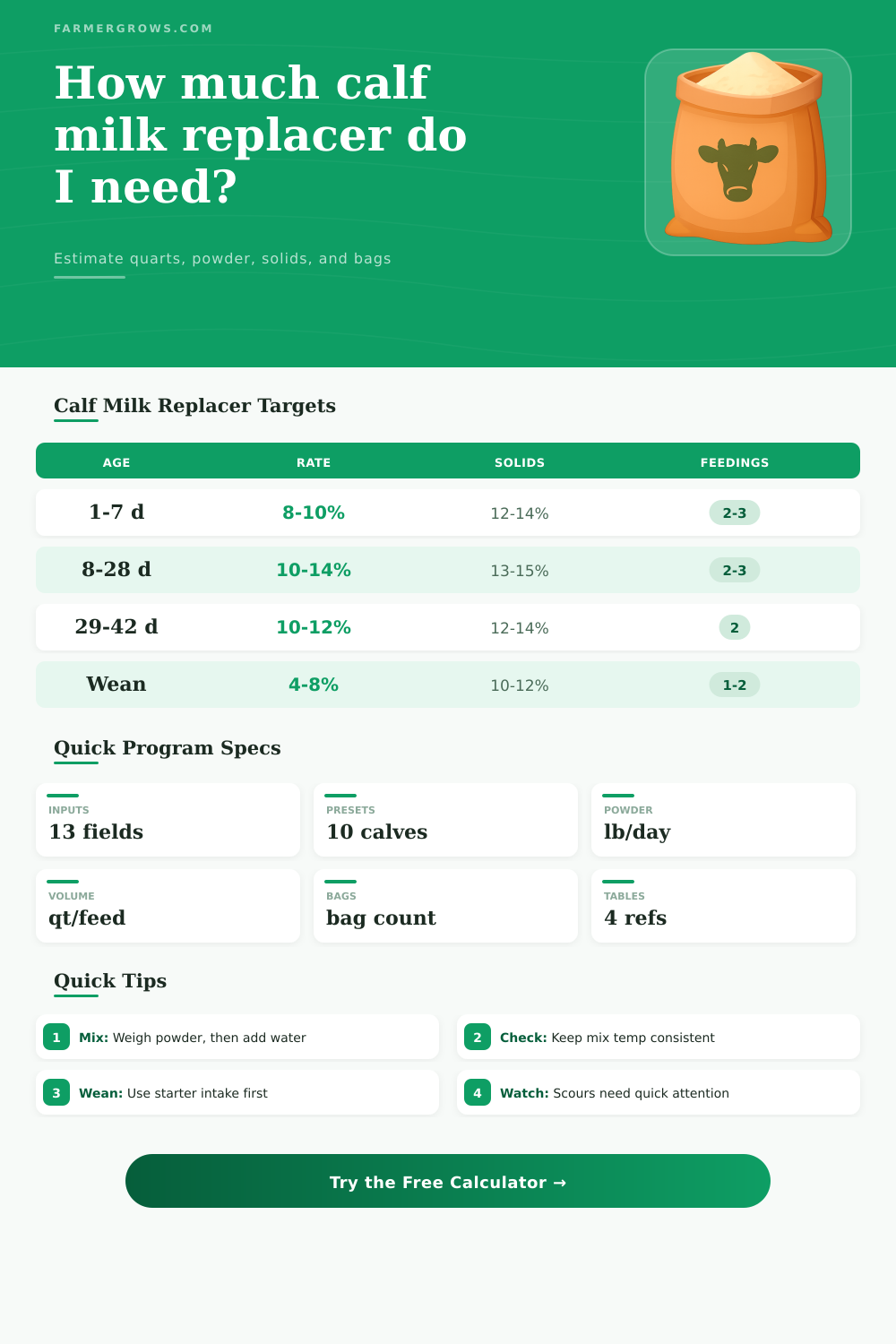
| Birth to 7 days | 8% to 10% of bodyweight | Taste starter and water | Colostrum success, navel care, and steady temperature matter most. |
| 8 to 28 days | 10% to 14% of bodyweight | Build starter habit | Keep bottles, nipples, pails, and hutches very consistent. |
| 29 to 42 days | 10% to 12% of bodyweight | Reach rising intake | Starter and water intake begin driving rumen development. |
| 43 days to weaning | 4% to 10% of bodyweight | Meet the weaning target | Step-down should follow intake, health, and weather, not age alone. |
| Weaning check | Target range | Why it matters | Practical note |
|---|---|---|---|
| Starter intake | 2.0 lb/day for 3 days | Shows rumen readiness before milk is removed. | Small breeds may use a lower target; follow farm protocol. |
| Age | 42 to 63 days | Very young calves may not handle a fast step-down. | Age is a checkpoint, not the only decision. |
| Health status | Bright and hydrated | Sick calves often lose starter intake first. | Delay reductions after scours, pneumonia, or heat stress. |
| Water access | Fresh water daily | Water supports starter intake and rumen fermentation. | Offer water even when calves are still on liquid feed. |
Tip: Weigh powder instead of trusting scoop volume. Settled powder, humidity, and scoop shape can move the true solids level enough to change calf intake.
Caution: Do not wean from age alone. If starter intake falls, manure changes, or the calf is fighting weather or illness, hold the step-down and reassess.
Milk replacer is a nutritional component for calves, and the way you mix the milk replacer will determine how the calf grow. To manage milk replacer effectively, you have to understand the relationship between the liquid being fed, the powder concentration, and the solids percentage. Many people begins to mix the milk replacer based on memory or sight.
However, mixing milk replacer by memory can cause error in the amount of nutrition that the calf will recieve. Using a calculator will help you to remove these errors in mixing the milk replacer. The calculator will ask for the calf’s weight, the feeding rate, and the powder concentration to determine the exact measurements for the amount of milk replacer that the calf should receive.
How to Mix and Feed Milk Replacer for Calves
The feeding rate determine the amount of liquid that the calf will receive as a percentage of its body weight. For example, a newborn calf will require a feeding rate of eight percent of its body weight. An older calf may require a feeding rate of twelve percent of its body weight.
Using the feeding rate, the calculator will tell you how many quart of milk replacer the calf requires per day. From that total number of quarts, you can divide the liquid into the number of feedings that you would like to provide to the calf throughout the day. The feeding rate is important to understand because it determine the total amount of energy and protein that the calf will receive from the milk replacer.
Powder concentration and the solids percentage are two different measurements for milk replacer that work together to define the calf’s milk replacer mix. The powder concentration is the number of ounces of powder that you will add to each quart of water. This determine the amount of dry matter that is in the milk replacer.
The solids percentage determine the amount of nutrition that is in the milk replacer. Increasing the powder concentration will increase the growth rate for the calf. However, too much powder concentration can lead to digestive upset in the calf if it dont drink enough free water.
The calculator will show you the resulting solids percentage of the milk replacer so that you can ensure that it remain in the common range of twelve to fifteen percent. Weaning readiness is a decision made according to the amount of starter feed that the calf consumes. Using the calculator, you can determine how much starter feed the calf consume and compare that to a target amount.
A calf that eats two pounds of starter feed daily will usually be ready to be weaned, but a calf that only eats half a pound of starter feed will not yet be ready to be weaned. The amount of starter feed that a calf consumes is one factor to consider when determining if a calf is ready to be weaned because the amount of starter feed that a calf eats determine if the calf can survive the reduction in milk replacer. Inventory planning is the process of determining how much milk replacer powder is needed to be purchased for the calves.
The calculator can be used to determine the number of bag of milk replacer powder that will be needed for calves based on the feeding rate, the powder concentration, and the number of days that the calves will be fed. An allowance for milk replacer powder loss due to mixing and refusal should also be made in the inventory planning process. The number of bags of milk replacer of powder will change if the feeding rate for the calves change or if the number of feedings per day change.
Thus, using the calculator to determine the inventory needed will allow for the supply of milk replacer powder to match the feeding program for the calves. The mixing temperature for milk replacer powder is one of the critical factors in the management of the milk replacer powder. If the water that is used to mix the milk replacer powder with is too cold, the powder will clump together when mixed with the water.
If the water that is used to mix the milk replacer powder with is too hot, the hot water may damage the nutrients in the milk replacer powder. By controlling the mixing temperature, the percentage of solids in the milk replacer powder can be made to remain the same for each batch of milk replacer powder that is prepared. Thus, by controlling the mixing temperature, the nutrition in the milk replacer powder can also be made to remain the same.
Monitoring the mixing temperature will ensure that the milk replacer powder consistenly provides the same nutrition to the calves. By testing out different scenarios with the calculator, the calf farmer can prepare for changes in the calf’s growth. By using the calculator, the farmer can calculate the amount of milk replacer powder that is required for the calf using the current weight of the calf.
Additionally, the farmer can calculate the amount of milk replacer powder that is required for the calf based on the projected weight of the calf. By testing these different scenarios, the calf farmer can determine if the current supply of milk replacer powder will be enough for the calf. Furthermore, by testing these scenarios, the farmer will also be able to determine if the amount of milk replacer powder per feeding will become too large to manage with bottles.
Thus, by using the calculator to plan the amount of milk replacer powder that will be fed to the calf according to different weights and feeding volumes, the milk replacer program for the calf can be ensured to be consistenly reliable.