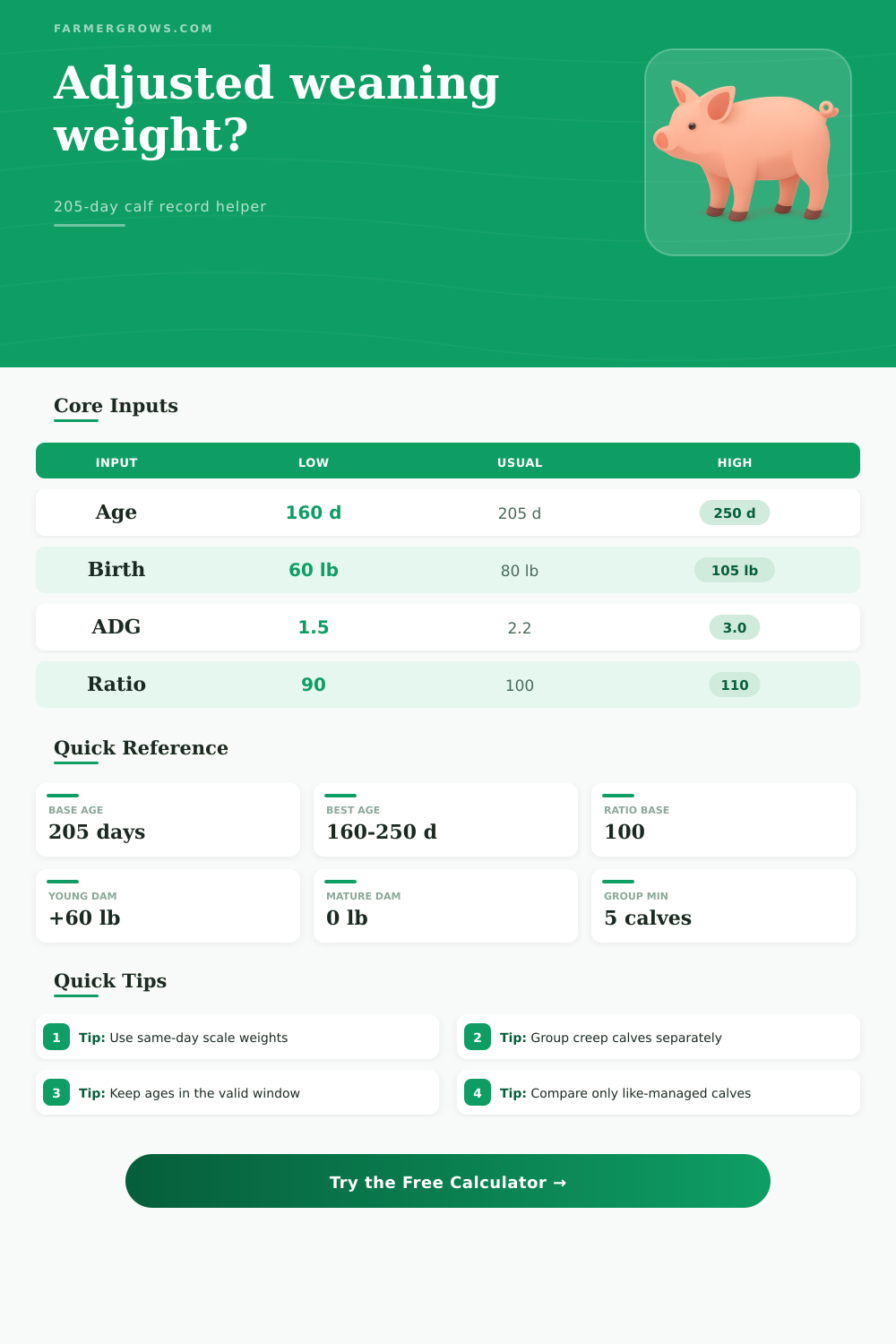
Adjusted Weaning Weight Calculator
Estimate 205-day adjusted calf weight with birth weight, age, dam age, sex, breed, creep feed, and contemporary group context.
| Dam age class | Typical adjustment | Why it matters | Use note |
|---|---|---|---|
| 2-year-old dam | +60 lb | First-calf females milk less | Commonly largest adjustment |
| 3-year-old dam | +40 lb | Still maturing | Keep separate from mature cows |
| 4-year-old dam | +20 lb | Near mature production | Moderate adjustment |
| 5-10-year-old dam | +0 lb | Baseline mature cow range | Standard comparison base |
| 11+ year-old dam | +15 lb | Production may taper | Check condition and teeth |
| Age at weighing | Record quality | Formula effect | Management note |
|---|---|---|---|
| Under 150 days | Early | Gain is stretched to 205 days | Use caution for rankings |
| 160-190 days | Good | Moderate forward adjustment | Useful for early groups |
| 191-220 days | Excellent | Near the standard age | Strong comparison window |
| 221-250 days | Good | Weight is scaled back | Useful for later groups |
| Over 250 days | Late | More correction needed | Review with herd rules |
| Selection | Calculator value | Purpose | Best practice |
|---|---|---|---|
| Bull calf | +0 lb | Baseline sex class | Compare with like sex when possible |
| Steer calf | +5 lb | Small management correction | Keep castration timing consistent |
| Heifer calf | +10 lb | Normalizes lighter class | Useful for replacement screens |
| Continental type | +10 lb | Breed-type comparison aid | Use only if herd policy calls for it |
| Brahman influence | -5 lb | Breed-type comparison aid | Keep heat-adapted groups fair |
| Dairy cross | +15 lb | Cross type comparison aid | Do not mix with straight beef groups |
| Group factor | Recommended handling | Calculator signal | Record note |
|---|---|---|---|
| Same sex and age season | Keep together | Stronger ratio | Primary comparison group |
| Creep-fed calves | Separate group | Creep flag appears | Feed access changes gain |
| Small group under 5 | Use caution | Low confidence warning | Ratios swing more easily |
| Different pasture or ration | Separate group | Manual review needed | Management changes performance |
| Group average ratio | 100 is average | Over 100 is above average | Use adjusted group average |
| Step | Calculation | What changes | Current value |
|---|---|---|---|
| Raw 205-day weight | ((WW - BW) / age) x 205 + BW | Standardizes age | 0 lb |
| Dam adjusted weight | Raw 205 + dam adjustment | Balances dam age | 0 lb |
| Final adjusted weight | Dam adjusted + sex + breed | Adds selected type adjustments | 0 lb |
| Contemporary ratio | Final adjusted / group average x 100 | Compares within group | 100 |
Ranch record are only useful if you read the ranch records correctly. The raw weaning weights for each calf are often misleading because raw weaning weights does not take into account the birth dates of the calves, the age of the dams of the calves, or the quality of the pasture that each calf consume. For instance, the calf born three week earlier than the others would have a raw weaning weight that makes it difficultly to compare the calf to the others in the herd.
Because of these difference, the raw weaning weights may provide the rancher with a false idea of the performance of that calf. The rancher must adjust the weaning weights to account for these factor to provide the rancher with accurate information regarding the performance of that calf. The goal of adjusting the weaning weights is to allow the rancher to compare each calf as if each calf reach 205 days of age.
How to Adjust Calf Weaning Weights
Each calf should also be adjusted as if a mature cow nursed each calf, calves of the same sex, and of the same breed. By adjusting the weights of the calves to these factors, any differences in the weights of the calves will reflect only the genetics and the management of each cow. While adjusting the weaning weights of the calves does not invent their performance, removing the noise created by the various factors will allow the rancher to see the true performance of each calf in the herd.
To adjust the weights of the calves, the birth weight of the calf and its actual weaning weight are utilized. Subtracting the birth weight of the calf from its actual weaning weight will provide the total pound of weight that the calf gained during its nursing period. Dividing that total by the age of the calf will provide the average daily weight gain of the calf.
Multiplying that average daily gain by 205 will provide the total weight that the calf would gain if it grew at the same rate until it reached 205 days of age. Adding the birth weight of the calf to that total will allow the rancher to compare the calf to the other calves in the herd as they will all be of the same age. Dam age must be accounted for in the adjustment of the calves’ weaning weights.
For instance, a two-year-old cow will produce less milk than a five-year-old cow. Thus, when adjusting the weights of the calves, the rancher must account for the weight of the calf’s dam in order to ensure that the weight of the calf does not reflect the age of its dam. If a rancher were to cull a calf from a young dam based on its weight, it is possible that the rancher may keep a calf whose dam was of mature age.
Similarly, a calf that gained good weight but whose dam was young may be slaughtered while other calves may be retained. Sex and breed adjustments must also be made to the weaning weights of the calves. For instance, bull calves will gain more weight than heifer calves.
Additionally, some breed of cows will gain more weight than others. By accounting for the sex and breed of each calf, the rancher can properly compare each calf to the others without introducing error into the measurement of performance. When calculating the ratio of the weaning weights of the calves, it is important that each calf be evaluated within the same contemporary group.
Each contemporary group will contain calves that grazed the same pasture, received the same amount of minerals, and were handled on the same date. For instance, calves that received creep feeding should not be included with calves that did not receive creep feeding. Additionally, the size of each group should be considered.
Groups of fewer than five calves may contain one or two outliers that may skew the average weight of the group. Groups of fifteen or more calves provide a betterer average. The weaning weight ratio of each calf will allow for the rancher to understand how that calf compared to the average weight of calves within its contemporary group.
For instance, if a calf weighs 105 pounds per hundred live weight, it will be five percent of the average weight of the calves within that group. A calf that weighs 92 pounds will weigh less than the average weight of the calves within the group. While the ratio does not provide a suggestion to the rancher of the performance of each calf, the ratio will help to provide the rancher with a clear picture of each calf’s performance compared to the other calves in the group.
The age at which the calves are weighed will also affect the adjustment of their weaning weights. Calves that are weighed at 170 days will require a different adjustment to 205 days than calves that are weighed at 220 days. The further away from 205 days the calf is weighed, the more sensitive the adjustment will become.
Thus, many rancher attempt to weigh their calves within a specific age window so that the adjustment to 205 days will be more accurate. The information regarding the calves may not always be perfect. For instance, the birth weight of the calf may not be recorded, or the scales may drift in the pasture.
While adjusting the weights of the calves will not fix the inaccuracies in the information provided by the ranchers, adjusting the weights will help the rancher to catch the deficiency in the records of the calves. For instance, if the birth weight of the calf is not recorded, the average daily gain of the calf will also be estimated. The adjusted weight of the calf will always be as accurate as the information that was provided regarding the calf.
Adjusting the weights of the calves will allow the rancher to review the records of the calves over several years. The adjusted weights of the calves may help the rancher to decide which heifers (female calves) should be retained within the herd and which calves should be slaughtered and used to produce milk. Thus, adjusting the weaning weights of the calves allows for the rancher to account for the various factor that impact the weight of the calves on the scale.