Cabbage Plants Per Acre Calculator
Estimate cabbage plant population from row spacing, in-row spacing, rows per bed, head class, transplant survival, field efficiency, marketable percentage, harvest block size, and seedling reserve.
Start from common cabbage planting systems, then tune the spacing, head class, net acreage, and nursery reserve to match your field plan.
Cabbage Planting Result
Spacing and stand plan will appear here.
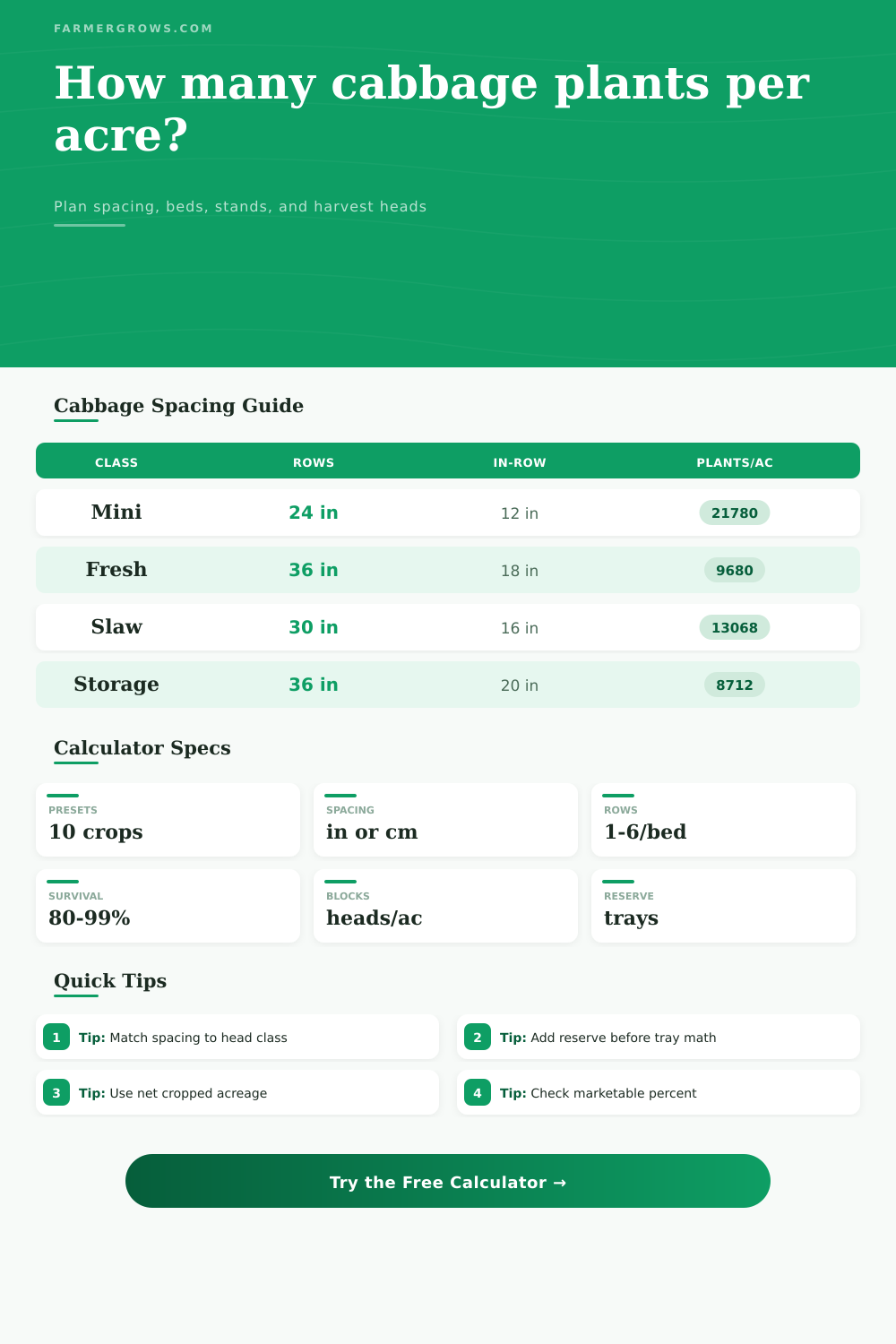
36 in rows with 20 to 24 in in-row spacing often land near 7,260 to 8,712 plants per acre before field losses.
36 in by 18 in spacing gives about 9,680 planting spaces per acre and fits many medium green cabbage crops.
30 in rows with 16 in spacing calculate to about 13,068 spaces per acre, useful for uniform slaw or kraut blocks.
24 in by 12 in spacing reaches about 21,780 spaces per acre where smaller heads and fast turns are wanted.
| Row x in-row spacing | Rows per bed | Planting spaces per acre | Typical cabbage use |
|---|---|---|---|
| 24 in x 12 in | 1 | 21,780 | Mini cabbage, tight fresh-market heads |
| 30 in x 14 in | 1 | 14,930 | Napa cabbage, compact fresh heads |
| 30 in x 16 in | 1 | 13,068 | Processing cabbage and slaw blocks |
| 36 in x 18 in | 1 | 9,680 | Standard green or red market cabbage |
| 36 in x 20 in | 1 | 8,712 | Storage cabbage or larger head sizes |
| 60 in beds x 18 in | 2 | 11,616 | Double-row bed system with wheel tracks |
| Head class | Common in-row spacing | Likely marketable range | Population caution |
|---|---|---|---|
| Mini or baby cabbage | 10 to 14 in | 80% to 92% | Needs fertility and steady water to avoid loose heads |
| Fresh market medium | 16 to 20 in | 82% to 94% | Most forgiving range for carton and direct-market crops |
| Red cabbage carton pack | 16 to 20 in | 78% to 90% | Size uniformity drops when stands are uneven |
| Processing cabbage | 14 to 18 in | 85% to 95% | Contract specs may set the final target population |
| Storage cabbage | 20 to 24 in | 80% to 92% | Too much density can reduce head size and airflow |
| Field efficiency setting | Net cropped area from 1 acre | When to use it | What it removes |
|---|---|---|---|
| 95% to 100% | 41,382 to 43,560 sq ft | Square block, minimal lanes | Only tiny edges and turning losses |
| 88% to 94% | 38,333 to 40,946 sq ft | Typical vegetable field | Headlands, irrigation edges, wheel tracks |
| 78% to 87% | 33,977 to 37,897 sq ft | Small farm with lanes | Access roads, odd corners, wash station paths |
| 65% to 77% | 28,314 to 33,541 sq ft | Patchwork blocks | Wide buffers, terraces, wet spots, tree shade |
| Tray size | Usable plants at 92% | Trays for 10,000 plants | Best fit |
|---|---|---|---|
| 72-cell tray | 66 plants | 152 trays | Larger plugs for tough transplant windows |
| 98-cell tray | 90 plants | 112 trays | Balanced brassica transplant size |
| 128-cell tray | 118 plants | 85 trays | Common cabbage and broccoli plug tray |
| 162-cell tray | 149 plants | 68 trays | Space-saving nursery production |
| 200-cell tray | 184 plants | 55 trays | High-count paperpot or plug systems |
| 288-cell tray | 265 plants | 38 trays | Short nursery turns and careful handling |
Calculate from net cropped area. A full acre has 43,560 square feet, but cabbage rows rarely occupy every foot. Use field efficiency to remove headlands, irrigation lanes, harvest access, and irregular edges before ordering plants.
Separate nursery reserve from field survival. Reserve seedlings cover weak trays and replanting needs before the crop is set. Transplant survival estimates the living stand after weather, handling, pests, and establishment stress.
If planning to grow cabbage, it all sounds so easy: till up a piece of ground, buy a thousand plants, and then what? How many should you sow per each square foot?
You can buy a thousand plant and still walk away with a hundred heads if the field isn’t planted right. If you get the planting wrong, that’s forty-three thousand square feet of possible disaster in an acre. Getting the population-to-headsize ratio right matter a lot because it is the difference between success and disaster. Buying the correct seed isn’t as much the issue as buying the right amount of space.
How to Plan Your Cabbage Spacing
Most growers begin their space guesses by starting with a baseline, say eighteen inches between plants within each row, and thirty-six inches between those rows. That results in roughly nine thousand six hundred spaces across an acre, which seem like a respectable amount of space for medium green cabbage headed for fresh market. But it’s all based off a perfect acre. That is to say, an acre shaped like a perfect square. It has no odd corners where the tractor won’t fit, no irrigation ditches, and no headlands (the places where you turn around in the middle of a field).
In real life, there are imperfection. These cut down on what part of the field is actualy usable. Field efficiency is the percentage of land that is covered in crop, after accounting for access paths and lanes. For example, if your field has wide wheel tracks or is otherwise patchy, lowering this figure to eighty-eight percent mean you are working on far fewer acres than the map shows. Plugging in your in-row and row spacing into the calculator takes care of these numbers for you; so you don’t have to try to guess at how many feet you’re losing to infrastructure.
And what about the rest of the story? What happens when those plants arrive in the ground? Will all of them survive? No. Shock, early weather stress, pests, and even the most careful handling will thin the ranks. You must consider the number of plants that fail to reach maturity.
For example: if you expect a 96% survival rate, what percentage of the survivors will be good enough to sell to your buyers? The marketable percentage removes the blemished plant, the split heads, and the ones that just aren’t big enough. Sometimes having a higher density population looks great on paper, yet if the resulting crop has tiny, crowded heads, they may not be of top tier quality. Quantity and quality do not always mix well.
And this depends hugely than who you sell to. When making slaw or cabbage, for example, you want everything to be cut to match; evenness is key. To that end, you may increase your plant counts to nearly thirteen thousand spaces per acre. You can do this with closer spacing within the row, such as sixteen inches apart within the row and thirty inches between rows. That’s tight, but it works because you want a lot of even heads in a block rather than giant ones. For big storage cabbages, where good air flow and root room matters most, too-tight quarters will yield smaller heads with a greater chance of disease. Again, the table on the page makes it clear: there’s variation depending on desired final use, so spacing changes accordingly.
Most beginners spend their dollars in nursery planning. Plan to get more plants than you anticipate needing. Account for extra seedlings to cover gaps in the field. These include the holes that open up once you begin planting, the empty cells in the tray, and the weak plant that won’t make it. The reserve can be eight-ten percent of what you’ll plant, which is the norm. It can be more or less depending on how well your seeds sprout, or how much experience you have growing seedlings in a greenhouse. Also take into account the size of the tray: Bigger trays = fewer trays overall, which is nice, but also potentially greater exposure if one entire tray goes bad.
We don’t want to fill the field; we want to fill the field with healthy, marketable heads that won’t compete for resources. A realistic view of what you can expect in your harvest comes from adjusting your inputs for expected losses and net acreage. It moves it from a hopeful guess to a workable plan.
You should of planned better.