
There are those of us who start out well intentioned and wind up with a wreck of a head of cabbage. It’s not typically because something’s wrong with the soil or the sun. It’s more often due to a white butterfly (or a tiny green caterpillar) seeing your brassica patch as a kind of all-you-can-eat buffet.
In such cases, companion planting is a matter of survival, a defense strategy: you are creating an ecosystem, yes, but one that gives your cabbage the best shot at making it through the season relatively unscathed. Which plants get along with cabbage, and which do not? Here is the breakdown:
How to Keep Cabbage Healthy
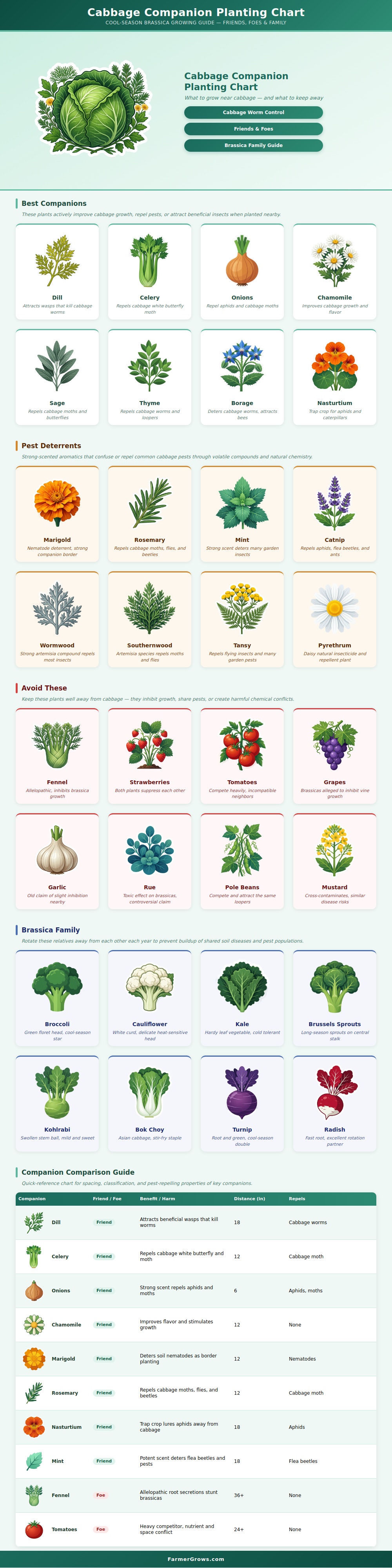
Your first line of defense is friends. For that, you can’t beat dill and celery. Dill will attract wasps who then seek out their prey: cabbage worms, keeping them in check. Celery will repel moth (the cabbage white butterfly), whose larvae you’re hoping to prevent. It forms a biological shield. Thyme, sage or onion with their strong scent masks the odor of the cabbage itself making it more difficult for pests to locate what they want.
Similarly, you may want to keep some plants well separated from one another, like fennel. Fennel is a bad garden neighbor because it releases chemicals that stunt growth of surrounding plants; yes, even cabbage! Or tomatoes: These heavy feeders will compete with your cool-season brassicas for food. Again, just think competition for resources. Plant ’em too closely together and the tomato will be happy, the cabbage a sad case.
And remember: You don’t have to learn this by making mistakes for years! The visual guide really helps you see how things relate to each other at a glance, and know what not to try. No more wasted season-long experiments.
There is one more: rotation. Though often ignored, rotating is yet one more form of insurance. All brassicas, cabbage, kale, cauliflower, Brussels sprouts, broccoli, are in the brassica family, which means they shares common foes. Laying down a red carpet by planting your cabbages in the same place year after year is just asking for trouble; you’re providing certain pests and soil-borne diseases with an invitation. Breaking this cycle of pests’ lives by not growing such related crops in the same place year to year confuses them and keeps the soil healthy. Fast-growing radishes, which help break up the soil and prepare it for the next crop, make great rotation partners, since they don’t carry over any of the same diseases as brassicas do.
It’s not just about who grows together. About companions… But also where they grow. Growing plants too close together leads to stagnant air and humid conditions inviting fungal problems. Keep those plant breathing room; when the leaves of cabbages stay relatively dry, the whole plant stays strong and is less likely to give in to any kind of pest pressure. A stressed plant cannot fight off pests better than a healthy one.
The graphic above is a handy reminder about spacing, so you know just how wide apart certain companions should go to prevent competition while still being beneficial. If you’re planting a marigold row as a boundary against nematode-infested ground, remember: Leave enough space to give them a chance to expand their root system and do there job.
It’s all about balance, not perfection. There will be some damage; a chewed-up leaf isn’t the end of the world. In fact, it means the ecosystem is in action. Knowing how one plant relates to another helps you not just react but prevent. You’ll have a self-sufficient garden, one where the right neighbors help keep the soil alive and pests at bay.
Begin with the fundamentals. Avoid the fennel. Tuck the dill nearby. Don’t let the brassicas repeat on the same spot. It is a small thing, but it makes a difference. The cabbage will get to form a tight, green head, ready for eating.