🌾 Bushel to KG Converter
Convert bushels to kilograms (and kg to bushels) for wheat, corn, soybeans & more — with accurate commodity weights
Wheat
Corn / Maize
Soybeans
Barley
Oats
Canola
Grain Sorghum
Sunflower
| Commodity | lbs / bushel | kg / bushel | bu / metric tonne | Moisture % |
|---|---|---|---|---|
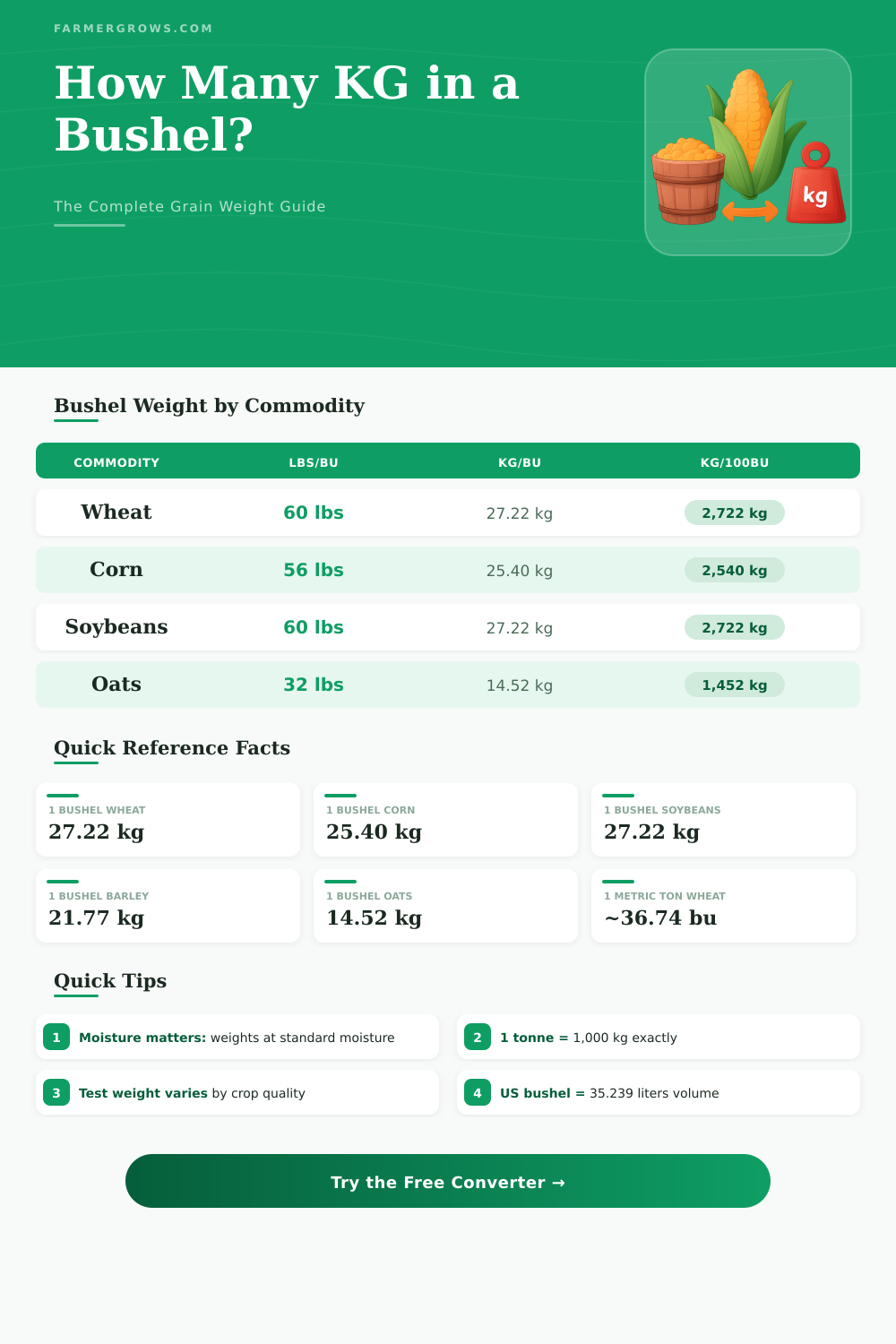
| Wheat (Hard Red) | 60 | 27.216 | 36.74 | 13.5% |
| Corn / Maize | 56 | 25.401 | 39.37 | 15.5% |
| Soybeans | 60 | 27.216 | 36.74 | 13.0% |
| Barley | 48 | 21.772 | 45.93 | 14.5% |
| Oats | 32 | 14.515 | 68.89 | 14.0% |
| Canola / Rapeseed | 50 | 22.680 | 44.09 | 8.5% |
| Grain Sorghum | 56 | 25.401 | 39.37 | 14.0% |
| Rye | 56 | 25.401 | 39.37 | 13.0% |
| Flaxseed | 56 | 25.401 | 39.37 | 10.0% |
| Sunflower (oilseed) | 24 | 10.886 | 91.86 | 10.0% |
| Bushels | Wheat (kg) | Corn (kg) | Metric Tonnes (Wheat) |
|---|---|---|---|
| 1 bu | 27.22 kg | 25.40 kg | 0.027 t |
| 10 bu | 272.2 kg | 254.0 kg | 0.272 t |
| 50 bu | 1,360.8 kg | 1,270.1 kg | 1.361 t |
| 100 bu | 2,721.6 kg | 2,540.1 kg | 2.722 t |
| 500 bu | 13,607.8 kg | 12,700.6 kg | 13.608 t |
| 1,000 bu | 27,215.5 kg | 25,401.2 kg | 27.216 t |
| 5,000 bu | 136,077.7 kg | 127,005.9 kg | 136.078 t |
| 10,000 bu | 272,155.4 kg | 254,011.7 kg | 272.155 t |
| Unit | Kilograms | Pounds | Metric Tonnes |
|---|---|---|---|
| 1 kg | 1.000 kg | 2.2046 lbs | 0.001 t |
| 1 lb | 0.4536 kg | 1.000 lb | 0.000454 t |
| 1 metric tonne | 1,000 kg | 2,204.62 lbs | 1.000 t |
| 1 short ton (US) | 907.185 kg | 2,000 lbs | 0.9072 t |
A bushel measure the volume of a grain, and an kilogram measures the mass of that grain. Since these two units measures different characteristics, it is impossible to direct convert one unit to the other. However, if a person know the density of the grain that is being measured, then it would be possible to derive the number of kilogram of that grain from the number of bushels of that same grain.
The density of a grain are related to the weight of that grain. Grains has different weights within the same volume of bushels. For example, wheat weigh 60 pounds per bushel, corn weigh 56 pounds per bushel, soybeans weighs 60 pounds per bushel, and oats weighs 32 pounds per bushel.
How to Convert Bushels to Kilograms
Because each grain have a different weight, it is essential to know the type of grain prior to perform the conversion of bushels to kilograms. Using the wrong weight per bushel for the type of grain will result in an incorrect calculation of the number of kilogram of that grain. The weight of the grain also may be affect by the moisture content of that grain.
The official weights of grains is calculated based off a specific percentage of moisture content within the grain. For example, the official weight of wheat is calculate at 13.5% moisture content, while corn is calculate at 15.5% moisture content. The more higher the moisture content of the grain, the more the grain will weigh.
Water will evaporate from the grain over time, which will reduce the weight of that grain over time. In order to accurately convert the bushels of grain to kilograms, it is essential to sample the moisture content of the grain prior to performing the conversion. Due to global trade activity, there exist two different measurement systems for the same unit of measurement.
While the United States utilize the unit of bushel to measure the weight of its grains, countries such as Asia and Europe uses the unit of weight of kilogram and metric tonnes for the same units of volume of grain. In order to fulfill international contracts, the person must calculate the weight in kilograms or metric tonnes of the grain that is grown in the United States. If the person who grows the grain calculate the number of kilogram incorrectly, there grain may be rejected or they will recieve less payment for their harvest.
In order to make this calculation easy and accurate, there exist online tools that can assist these farmers with the calculation of the weight of their grain in different unit of measurement. These online tools requires the person to first select the type of grain that is being measured. The person must then enter the number of bushels of that grain into the tool.
Finally, the person using the tool can select the unit of weight that they would like to convert the bushels of grain to (whether it is to kilograms), pounds, or metric tonnes. When contracting with another business for the sale of grain, the decimal value should be use. For other estimations of the weight of grain, the whole number can be use.
Beyond selling the grain to other businesses, the weight of the grain in kilograms is also use to determine the number of transport vehicle that will be needed to transport the grain from farm to farm. Based on the number of kilogram of the grain, the company can calculate the number of semi-trucks or rail car that will be needed for the transportation of that product. The weight of the grain is use to calculate the cost of the transport vehicles, the import and export tariffs, and the number of storage facility that will be required to store the grain.
Any error in the calculation of the number of kilogram of the grain will have a similar error in the total weight of the grain and impact the total profit from that agricultural harvest of the farm.