
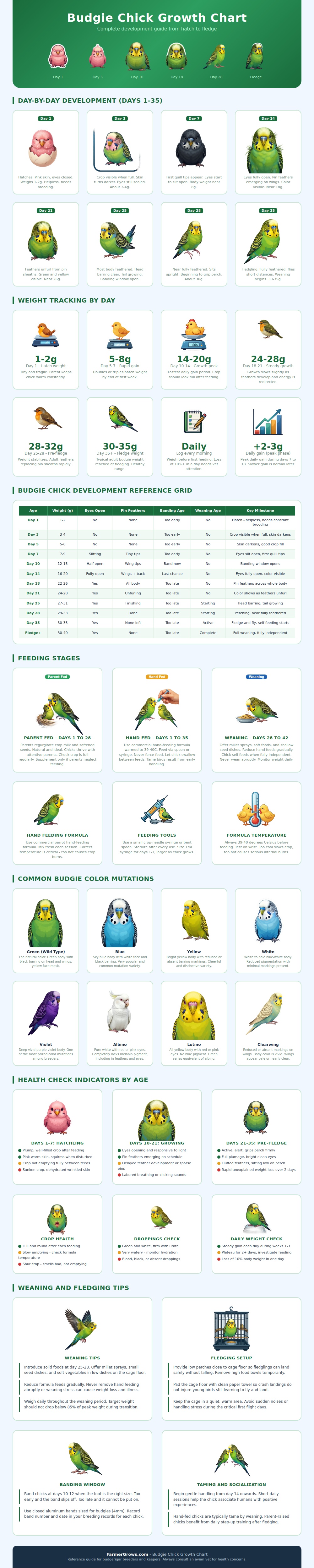
One of the joys of keeping budgies is watching their chicks develop from little pink bundles to a full fledged adult bird. They matures quickly in those first few weeks so knowing what normal development looks like allows you to detect any issues early on. That’s where a good growth chart comes into play, it doesn’t have to be guesswork but something tangible you can watch unfold.
For hatchlings, the first few days are a time of getting fed and staying warm, that’s it. They’re totally helpless, blind, and just eat and get big. Any good chart will show a sharp rise in weight after regular feeding start. The chick begins to look stronger. The skin darkens. You can even see the crop when they’re full. Most parents does fine with this one on their own, but for those who are being hand-fed the timings and temperatures is important, and require attentive care.
How Budgie Chicks Grow
The first week: Eyes begin to open by the end of the first week, with the first pin feathers showing soon after. Daily weighings starts now. You’ll have a benchmark (a chart of what the bird should weigh) against which to compare your chick’s progress. From day seven to 18 is prime time for most of its development as the body lays down the framework for future muscle mass (for flight and feathers). Stalled weight here typicaly indicates some type of temperature or feeding problem different than something more serious.
Day fourteen is when the picture changes again with feathering. The chick is more alert and begins to exhibit color on the back and wings. Charts often mention this: this is the brief moment when banding occurs. You have just a few days where the foot is of proper size for pinning on the band, otherwise it won’t go on at all or will slide off. Now that the pins are embedded through the body, it’s time for the rest of its feathers to fill out without adding much more weight.
At twenty-eight days they begin weaning which lasts through six weeks. That is also when most keepers makes mistakes. By pulling formula off too fast (or offering solids too soon) a chick will lose weight and struggle to regain it. Better to go slow and offer soft dishes and millet sprays at lower levels of cage where baby birds can reach it but not fall in. Use a growth chart that provides an idea of when weight ought to level off instead of continuing upward.
At each life phase there are health checks to make, but what to look for changes with age of the chick. In early days, it’s the skin and crop. After that, it’s a solid perch, good eyes, and consistent droppings. These indicators turn fuzzy concern into concrete things you can do about it, and any good chart lists them.
The whole process from hatching through fledging is about five weeks, but it’s not so much the length of time as the particulars. If you know how to watch for feeding patterns, feather growth, and weight changes you’ll have a good idea if any or all of your chicks is right on target. And that’s where they want you to be; close by, paying attention, rather than just playing a stressful guessing game with them. You should of checked the weights regularily.