Brome Seed per Acre Calculator
Estimate smooth or meadow brome seed by acre from target PLS rate, seed tag quality, germination, drilling or broadcast method, seedbed firmness, legume share, and erosion risk.
Pick a common bromegrass situation, then fine tune acres, seed tag numbers, brome type, companion legume share, and field conditions for your planting plan.
Brome Seed Plan
Your adjusted bulk seed order will appear here after calculation.
Spreads by rhizomes, fits hay fields and erosion cover, and often establishes more slowly than many short-lived grasses.
Often used where regrowth, palatability, and pasture persistence matter. It can be seeded at a slightly lower PLS target.
Use the full brome PLS target when bromegrass is the main stand and companion species are not carrying the stand.
Reduce the brome share when alfalfa, red clover, white clover, or trefoil should keep meaningful room in the canopy.
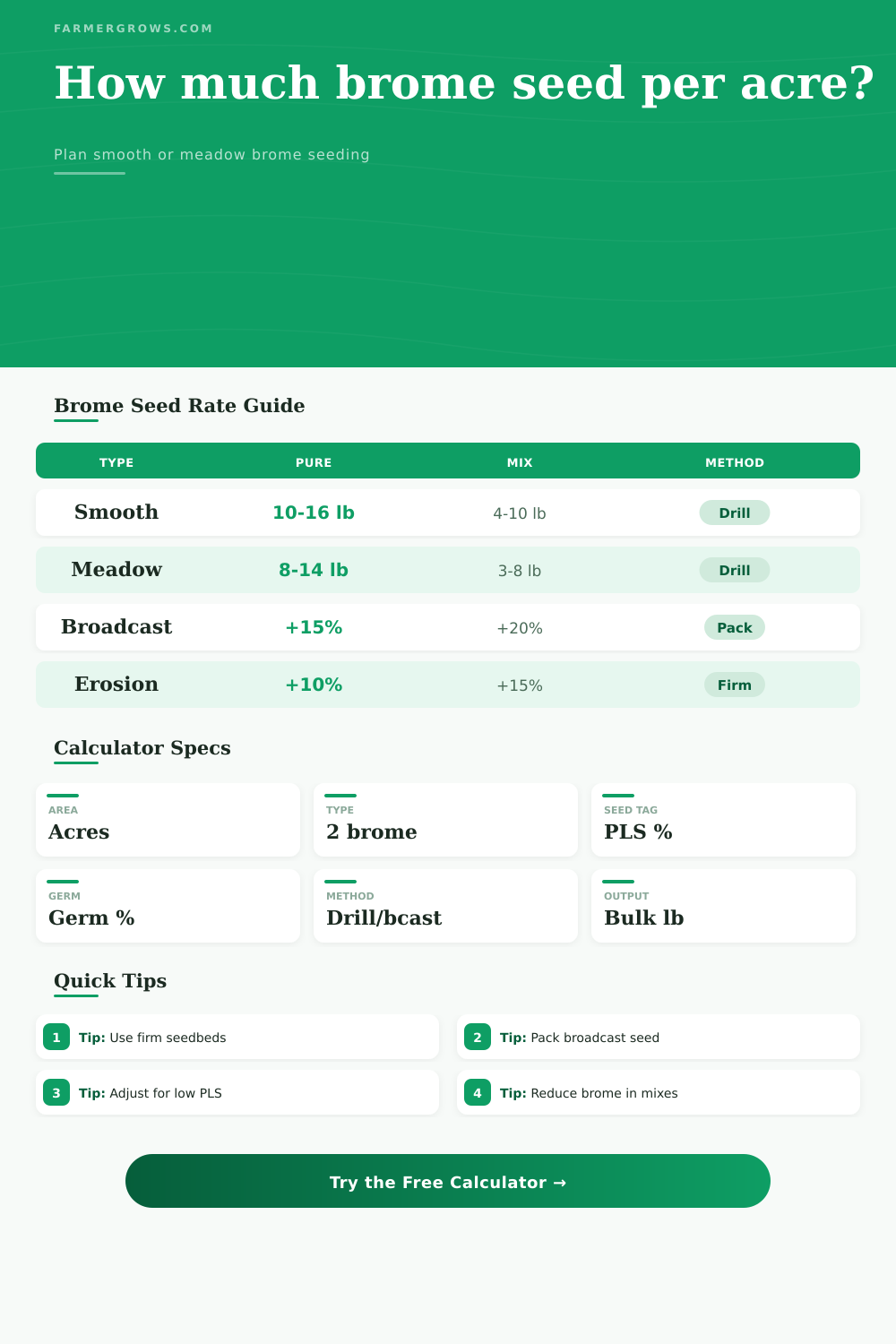
| Use case | Smooth brome PLS/ac | Meadow brome PLS/ac | Planning note |
|---|---|---|---|
| New drilled pure stand | 10 to 16 lb | 8 to 14 lb | Start with local guidance, then adjust for seedbed quality and expected pressure. |
| Hay field with legume | 4 to 10 lb | 3 to 8 lb | Use a lighter brome share when alfalfa or clover must remain productive. |
| Permanent pasture blend | 6 to 12 lb | 5 to 10 lb | Meadow brome is a common choice where grazing regrowth is a key goal. |
| Waterway or erosion cover | 12 to 18 lb | 10 to 16 lb | Higher-risk areas often need firm packing, mulch cover, and a reserve seed allowance. |
| Thin stand overseeding | 4 to 8 lb | 3 to 7 lb | Existing sod competition may limit success unless seed reaches soil and moisture. |
| Field setting | Calculator factor | When it applies | Practical check |
|---|---|---|---|
| Drilled shallow | 1.00 | Seed placed evenly with press wheels or good closing action. | Brome seed should not be buried deeply. |
| Broadcast and packed | 1.12 | Seed is spread on the surface then pressed firmly into contact. | Cultipack before and after if the surface is fluffy. |
| Broadcast light incorporation | 1.22 | Seed is broadcast and lightly harrowed or dragged. | Avoid pulling too much soil over small grass seed. |
| Loose or residue-heavy | 1.18 to 1.25 | Seed may hang in trash, clods, or air pockets. | Improve contact before raising the rate too far. |
| Excellent firm seedbed | 0.96 | Firm, moist, weed-free soil with accurate depth control. | Footprint is shallow, not deeply sunk. |
| Erosion risk | Rate effect | Best matched method | Management note |
|---|---|---|---|
| Low protected field | No extra factor | Drill or packed broadcast | Use normal calibration and a small cleanout buffer. |
| Moderate slope or runoff | About 6% extra | Drill across slope when possible | Firm the seedbed and avoid leaving seed exposed. |
| High wash or wind risk | About 12% extra | Drill plus residue or cover | Consider mulch, nurse cover, or a second pass on vulnerable edges. |
| Critical cover area | About 18% extra | Precision placement preferred | Seed rate cannot replace slope stabilization or moisture control. |
| Mix plan | Legume share | Brome share used | How to use it |
|---|---|---|---|
| Mostly brome hay | 0 to 15% | 85 to 100% | Keep the target near a pure stand when brome is the main yield species. |
| Balanced grass-legume | 20 to 35% | 65 to 80% | Useful for hay where legumes should contribute protein and nitrogen fixation. |
| Legume-forward hay | 40 to 55% | 45 to 60% | Use a lighter brome rate so alfalfa or clover is not crowded early. |
| Pasture diversity mix | 25 to 45% | 55 to 75% | Adjust alongside orchardgrass, timothy, fescue, or other grasses in the blend. |
Seed tag math: If your tag already lists PLS percent, enter that value in the PLS field and set germination to 100%. If the tag lists purity and germination separately, enter purity in the PLS field and germination in the germination field.
Field contact: Raising seed rate helps only a little when seed-to-soil contact is poor. Firm the seedbed, calibrate for fluffy brome seed, and pack broadcast seed before relying on extra pounds.
How much seed is needed? You have a seed drill and a bag of smooth bromegrass in your hand. It is good seed, but it also has some dirt, broken kernels, and weed seeds. Don’t go by weight; don’t expect to plant it that way. Chances are you’ll end up with a patchy stand.
Seeding rates is about math, the math of probability. You buy potential, but there is no guarantee. Aim to get enough live seeds on the ground to make it happen: create a dense canopy.
How to Calculate Your Seed Rate
The concept depends on PLS: Pure live seed. The primary measure everyone concentrates on is germination percentage. But with PLS, we account for purity as well. So if the seed tag reads ninety percent germination and also ninety percent purity, what does that mean? Your potential to have live seed are actualy only eighty-one percent.
The loss in purity is every bit as important than the loss in germination. You’re paying for fill weight. And you must figure out your bulk requirement based off PLS targets. The tool on this page will do that conversion for you. It translates your wanted rate of PLS into the real-world pounds of bulk seed that’s needed. Otherwise, you’ll likely under-seed if you assume entire bag is good seed.
Meadow and smooth brome are different animals, so choosing between them change your approach. Meadow brome tends to bunch up. It is good for grazing persistence. It doesn’t compete as strongly with companion legume.
Smooth brome is a spreading plant that grows from underground stems. It is good for erosion control and hay fields. Over time, the grass knits together. On the calculator you can choose one or the other. Based off that choice, the baseline recommendations changes.
For instance, if you’re planting a pure stand of something, you want to go for a strong rate. You’ve got to get quick cover. If you’re mixing brome with another crop like clover or alfalfa, you want to dial back grass rate. Too much brome in a mix will choke the legumes. They won’t fix nitrogen while they’re being choked out by the grass. A balancing act: when do you want cooperation vs. Dominance?
Then there’s the planting method. Drilling ensures seeds are placed accurately and make good contact with the soil. Drilling is ideal for small, lightweight seeds like brome. Broadcast planting isn’t so hot, though it’s quicker: Seed will be up high instead of in contact with soil. That means it’s vulnerable to drying out, to birds, to blowing away. To make up for that loss, adjust your seed rate upward.
The calculator does that; it adds a percentage buffer for broadcast operations. And if your broadcast surface is a loose, cloddy seedbed, the penalty become even larger. Seeds may not actualy touch moist soil, falling instead into air pockets. It is usually best not to throw more seed at the problem. Instead, firm the seedbed. But if the ground’s already prepped, you can only adjust the rate.
The condition of the field matter, too. Soil type and slope. If there are steep spots, areas that tend to erode/run off, you want more seeds per square foot. Get something up fast to stabilize it.
Overlap the headlands by a little bit, calibrate a bit on both ends; it’s just smart practice. Even if you do all the math correctly, your drill will have some variation from one end of field to the other. A few extra percent in the order totals adds a reasonable margin for error. You won’t have to worry about running out mid-acre on the final pass. It is a bit of an insurance policy against frustration.
The trick is how you plant brome. Providing the ideal conditions for those live seeds. Follow the numbers… But follow through. How you do it matters.
Bulk weight isn’t the same as live potential. This determines if you will get a stand of grass or if you would of been disappointed. The calculator gets the math correct for you. Then it’s time to focus on putting the seed where it needs to go: in the ground.