Broiler Feed Calculator
Estimate feed pounds, bag counts, phase intake, protein and energy targets, FCR, mortality buffer, and expected live weight for broiler chicken flocks.
Use the calculator for farm planning, feed ordering, and phase checks. Local genetics, heat, disease pressure, feeder adjustment, litter condition, and feed form can shift real intake, so compare results with actual flock weights.
Broiler Feed Estimate
Results combine live-weight FCR, age-based intake, phase share, mortality buffer, and feed form adjustment.
| Age week | Typical phase | Daily feed per bird | Weekly feed per bird | Planning note |
|---|---|---|---|---|
| 0 to 1 | Starter | 0.03 to 0.06 lb | 0.25 to 0.40 lb | Use crumble or fine pellet and keep feeders easy to reach. |
| 1 to 2 | Starter | 0.07 to 0.10 lb | 0.50 to 0.75 lb | Watch early uniformity and remove damp or stale feed. |
| 2 to 3 | Starter or grower | 0.11 to 0.16 lb | 0.80 to 1.10 lb | Many flocks transition from starter to grower in this window. |
| 3 to 4 | Grower | 0.17 to 0.23 lb | 1.20 to 1.60 lb | Feeder space starts to affect intake and bird uniformity. |
| 4 to 5 | Grower | 0.24 to 0.30 lb | 1.70 to 2.10 lb | Use body weight checks before moving into finisher feed. |
| 5 to 6 | Finisher | 0.31 to 0.36 lb | 2.20 to 2.50 lb | Fast broilers may reach processing size during this period. |
| 6 to 8 | Finisher | 0.36 to 0.44 lb | 2.50 to 3.10 lb | Heavy birds need dry litter and good air exchange. |
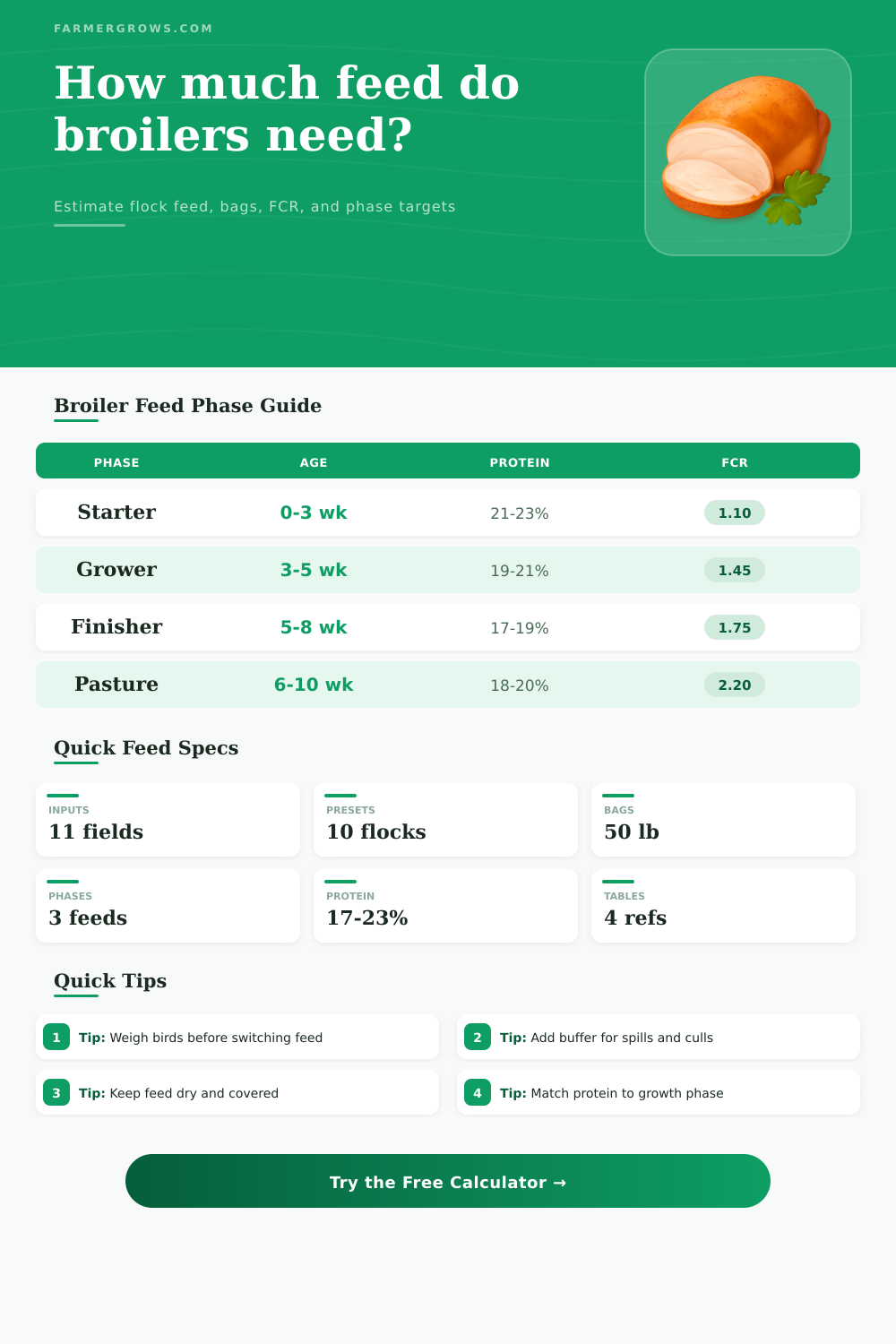
| Feed phase | Typical crude protein | Energy target | Age range | Use when |
|---|---|---|---|---|
| Starter crumble | 21% to 23% | 1,380 to 1,500 kcal ME/lb | 0 to 21 days | Chicks are building frame, organs, and early muscle. |
| Grower ration | 19% to 21% | 1,430 to 1,550 kcal ME/lb | 18 to 35 days | Birds are eating more and converting feed rapidly. |
| Finisher ration | 17% to 19% | 1,450 to 1,600 kcal ME/lb | 35 days to processing | Use for final weight gain after frame is established. |
| Pasture finish | 18% to 20% | 1,380 to 1,520 kcal ME/lb | 35 days onward | Outdoor birds often need a little more feed allowance. |
| Breed or system | Planning FCR | Feed for 5 lb bird | Feed for 7 lb bird | Management note |
|---|---|---|---|---|
| Cornish Cross fast broiler | 1.55 to 1.85 | 7.8 to 9.3 lb | 10.9 to 13.0 lb | Excellent FCR when temperature and feeder space are right. |
| Standard white broiler | 1.75 to 2.05 | 8.8 to 10.3 lb | 12.3 to 14.4 lb | Useful middle range for small farm planning. |
| Pasture mixed broiler | 1.90 to 2.30 | 9.5 to 11.5 lb | 13.3 to 16.1 lb | Movement, weather, and feeder loss raise feed need. |
| Slower red broiler | 2.10 to 2.60 | 10.5 to 13.0 lb | 14.7 to 18.2 lb | Plan more days on feed and a higher feed reserve. |
| Heavy roaster target | 1.90 to 2.35 | 9.5 to 11.8 lb | 13.3 to 16.5 lb | Late feed intake is high; check heat and litter closely. |
| Age week | Fast broiler live weight | Standard broiler live weight | Slow-growth live weight | Feed phase cue |
|---|---|---|---|---|
| 2 weeks | 0.8 to 1.2 lb | 0.7 to 1.0 lb | 0.5 to 0.8 lb | Still on starter for most flocks. |
| 3 weeks | 1.7 to 2.3 lb | 1.4 to 2.0 lb | 1.0 to 1.5 lb | Transition into grower when birds are even. |
| 4 weeks | 3.0 to 4.0 lb | 2.4 to 3.3 lb | 1.7 to 2.4 lb | Grower intake climbs quickly. |
| 5 weeks | 4.4 to 5.7 lb | 3.6 to 4.8 lb | 2.5 to 3.4 lb | Start finisher for many market plans. |
| 6 weeks | 5.8 to 7.2 lb | 4.8 to 6.1 lb | 3.4 to 4.5 lb | Fast birds may be ready for processing. |
| 8 weeks | 7.5 to 9.5 lb | 6.2 to 8.0 lb | 4.8 to 6.3 lb | Heavy birds need careful heat and litter checks. |
Phase change check: Move from starter to grower and grower to finisher by age and body weight, not by the calendar alone. Uneven flocks often benefit from a slower transition.
Ordering check: Round bags up and keep a small reserve. Heat stress, feeder spills, damp feed, wild birds, and late processing dates can all raise the final feed need.
Broilers will eat a certain amount of feed before they reaches the market weight that you want for your flock of broiler chickens. This amount of feed that will be eaten is important to determine because the amount of feed will determine the number of bag of feed that will be needed to feed the broiler chickens and it will also determine whether or not the batch of broiler chickens will be finished in the time that you would like for them to be finished. Making an educated guess as to the amount of feed that is necesary can lead to loss of both money and time if not accurately made.
The amount of feed that is needed will change with the age of the broiler chickens, the breed of broiler chickens, and the housing system in which the broiler chickens are raised. For instance, a breed of broiler chicken like Cornish Cross may eat feed differently in a controlled house as compared to a red breed of broiler chicken who is keep on pasture. The controlled house may require feed management to be more precise and controlled, but the pasturing system may require feed to be provided in excess of the amount that is required to meet the need of the broiler chickens due to the effect of weather and movement on the feed consumption of the broiler chickens.
How Much Feed Do Broiler Chickens Need
These different factor can be accounted for in the calculator to make sure that each flock of broiler chickens isnt treated as the same as every other flock. Each of the factors that are requested of the broiler chicken farmer in the calculator can be determined as important for the specific situation in which the broiler chickens are raised. The target live weight of the broiler chickens will determine how much feed is consume by the broiler chickens.
The feed conversion ratio will determine how much feed will be consumed for the amount of pound of broiler chickens that is gained. The mortality and spill buffers will account for the number of broiler chickens that die and the amount of feed that is wasted in the housing area of the broiler chickens. These three factor will result in the estimation of the amount of feed that will be needed for the broiler chickens during the phase in which they are raised.
Changing any of these three factor will impact the amount of feed that is calculated for the broiler chickens. The protein and energy target for the broiler chickens will have effects upon the amount of feed that is calculated for that flock of broiler chickens. For instance, starter feed will contain more protein than finisher feed because broiler chickens of a young age requires more protein to build their frame and organs.
Broiler chickens of a more mature age will have their frames set, so the finisher feed will contain less protein to encourage the finisher feed to contribute to the final weight of the broiler chickens. The percentage of protein in the feed can be checked against a normal range for that type of feed, and if the percentage of protein is outside of that normal range, a warning will be presented to the broiler farmer. A mismatched amount of protein in the feed will result in the wasting of feed purchases or the slow growth of the broiler chickens.
Energy follows the same logic as protein. If the amount of energy in the feed is too low for the broiler chickens of that age, the broiler chickens will eat more feed to meet their needs for energy. If the amount is too high, then the farmer will be paying for energy that the broiler chickens will not be able to use.
The housing style in which the broiler chickens are raised can impact the amount of feed that is required for each broiler chicken. For instance, conventional houses tend to have more consistent temperatures and more space for the broiler chickens to eat. Pasture systems will require the broiler chickens to travel further to reach their feed, and they are exposed to the effects of the weather which can impact their feed consumption.
Broiler chickens that are free range will have access to forage for their feeding area, but the forage will not replace the feed that is required of the broiler chickens. Broiler chickens that gain their slow growth will require more feed over time to reach their target live weight. These factor can also be accounted for in the feed calculator prior to determining the amount of feed that is required for the flock of broiler chickens.
The reference tables provided on the calculator will allow the broiler farmer to have a better understanding of the numbers that is presented in the calculator. These reference tables will explain how feed consumption increases over time as the broiler chickens age, how the protein percentage increases during different phases of the broiler chickens lives, and how their live weights compare to the target live weights of the broiler chickens. These tables can be used to compare the amount of feed that is calculated by the calculator to the actual amount of feed that is used in the rearing of the broiler chickens.
For instance, if calculations show that 18 bags of feed are required for the broiler chickens, but in actuality 22 bag of feed are consumed, there may be issues with the adjustment of the feeders, the moisture content of the litter in which the broiler chickens’ droppings live, or the target live weight of the broiler chickens. It is recommended that the feed calculator is performed both upon the receiving of the flock of broiler chickens, as well as each time as the broiler chickens are fed in relation to the different phase of their lives. Each time that the calculator is performed, the amount of bags of feed that will be needed can be compared with the amount of bag of feed that were actualy consumed by the broiler chickens.
Performing this calculation for several flocks will reveal a pattern in relation to the amount of feed required. This pattern will allow the broiler chicken farmer to recognize which factor in the raising of the broiler chickens is most often underestimated, as well as recognize in what ways the lives of the broiler chickens may differ from the average. These records will be more useful for the broiler farmer than the feed calculator.
The purpose of the feed calculator is not to provide the most accurate calculation of the amount of feed that will be consumed by the broiler chickens, but to provide a calculation that ensure that the farmer will not have to make emergency purchases for feed. Providing for the broiler chickens with enough feed ensures that there is no wasted feed that can sit in the storage areas for the broiler chickens’ coop for too long of a period of time. When the farmer provides the calculator with the factor related to the broiler chickens’ lives, the calculator will complete the calculations required to determine the amount of feed that will be consumed.
From that point forward, it is up to the broiler farmer to continue to care for the broiler chickens and to adjust the calculator for the next flock of broiler chickens.