Broiler Chickens Per Acre Calculator
Estimate pasture broiler density from batch size, move interval, bird age, outdoor space, field condition, rest days, tractor capacity, and total growout timing.
Pick a real broiler production pattern, then adjust flock size, field size, space per bird, move interval, mortality allowance, rest target, shelter footprint, and pasture pressure.
Broiler Acreage Results
Results update when you change batch, land, movement, and shelter values.
Best when pens move every day and feed, water, and shade move with the birds.
Allows practical hand moves while keeping density high enough for clean rotations.
Birds leave a shelter during the day, so traffic around water and shade matters more.
Useful for slow-growth broilers, hot weather, orchards, or fields that mark easily.
| Broiler setup | Outdoor target | Birds per acre | Field note |
|---|---|---|---|
| Daily-move floorless tractor | 8 to 10 sq ft per bird | 4356 to 5445 birds/ac | Only works when the shelter moves before manure mats or bare strips form. |
| Hand-moved pasture pen | 10 to 12 sq ft per bird | 3630 to 4356 birds/ac | Good for 75 to 100 birds per pen when weather is moderate. |
| Mobile shelter with day range | 12 to 18 sq ft per bird | 2420 to 3630 birds/ac | Spread water, shade, and feeders so birds do not camp in one corner. |
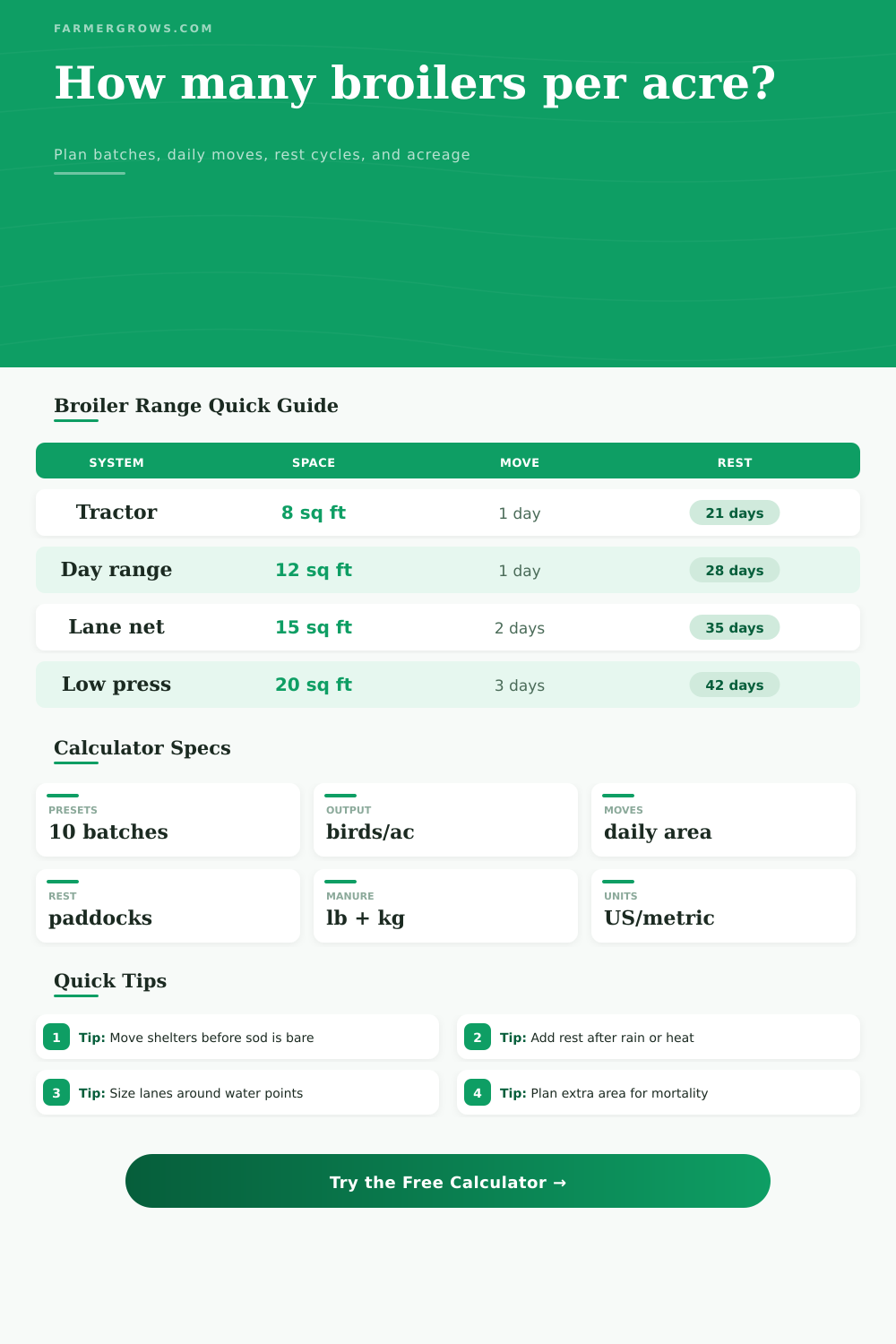
| Electric net lane rotation | 15 to 25 sq ft per bird | 1742 to 2904 birds/ac | Use more land when lanes are reused during the same growout season. |
| Slow-growth or fragile pasture | 20 to 30 sq ft per bird | 1452 to 2178 birds/ac | Lower density protects sod during longer growouts and wet conditions. |
| Move interval | Pasture days | Rest target | Planning meaning |
|---|---|---|---|
| 1 day | 28 to 42 days | 21 to 30 days | Most common for tractor broilers because manure and traffic stay even. |
| 2 days | 28 to 42 days | 28 to 35 days | Can fit small pens if cover stays green and the surface remains open. |
| 3 days | 35 to 49 days | 35 to 42 days | Better at lower density or with larger day-range areas. |
| 7 days | 42 to 56 days | 45 to 60 days | Use carefully because birds concentrate near shelter, feeders, and water. |
| Shelter pattern | Indoor floor target | Typical pen size | Capacity check |
|---|---|---|---|
| Compact pasture tractor | 1.0 to 1.3 sq ft per bird | 80 to 100 sq ft | Often 60 to 90 broilers depending on heat and final weight. |
| Large floorless pen | 1.2 to 1.6 sq ft per bird | 120 to 160 sq ft | Useful when moving by hand or with skids over uneven ground. |
| Mobile shade shelter | 1.5 to 2.0 sq ft per bird | 200 to 400 sq ft | Day-range birds need space at night and during bad weather. |
| Slow-growth broiler shelter | 1.8 to 2.5 sq ft per bird | varies | Extra space helps heavier, older birds stay dry and mobile. |
| Broiler age on pasture | Feed planning rate | Water planning rate | Use note |
|---|---|---|---|
| 3 to 4 weeks | 0.12 to 0.18 lb per bird | 0.12 to 0.20 qt per bird | Early pasture days need frequent checks while birds learn the setup. |
| 5 to 6 weeks | 0.20 to 0.28 lb per bird | 0.20 to 0.35 qt per bird | Demand rises quickly, especially when weather is hot. |
| 7 to 8 weeks | 0.28 to 0.38 lb per bird | 0.30 to 0.50 qt per bird | Large birds stress wet ground and crowded shade first. |
| Slow-growth finish | 0.22 to 0.34 lb per bird | 0.25 to 0.45 qt per bird | Longer time on pasture means the rest-cycle acreage matters more. |
| Batch example | Dry manure estimate | N estimate | Management check |
|---|---|---|---|
| 100 broilers | 12 to 18 lb/day | 0.5 to 0.8 lb/day | Move pens before bedding, spilled feed, or manure cakes the surface. |
| 250 broilers | 30 to 45 lb/day | 1.2 to 1.8 lb/day | Place waterers to avoid one wet patch inside the tractor. |
| 500 broilers | 60 to 90 lb/day | 2.4 to 3.6 lb/day | Daily moves are usually needed for clean sod and even fertility. |
| 1000 broilers | 120 to 180 lb/day | 4.8 to 7.2 lb/day | Divide across pens or lanes so traffic does not exceed recovery. |
Use usable pasture only. Subtract lanes, buildings, shade dead zones, standing water, steep slopes, and any area the broiler tractors cannot physically cover.
Watch the last two weeks. Heavy broilers consume more, drink more, and press the sod harder, so the calculator uses finish count and move area as the main pressure check.
Maybe you’ve felt that specific kind of panic when you realize your broiler chickens has stripped a patch of grass down to bare dirt as market day approaches. Or maybe you’ve done the math on paper. You might find that it doesn’t take into account how much heavy birds tramples the ground in the rain and eat more then you expected.
The solution is a tool for proper sizing of pastures, a batch at a time. It is a plan instead of a guess so that you can be sure your birds has plenty of room to grow while not trashing land for next flock.
How to Size Your Pasture for Broiler Chickens
It’s a time versus space equation: Are you stuffing an acre with birds or are you figuring out how many acres it take for each bird to have the time he wants? Every day you move his shelter, you’re putting less wear on ground; but building more infrastructure. Moving him every week save you work, but it requires more land so you can reach everyone quickly enough.
Enter your number of birds and your move interval into the calculator, and let it do the math for you: no more splitting up acres by days of rest in your head. It link your biological timeline to your physical assets.
People tend to underestimate how weather impact stocking density. In a dry spring you can have more birds due to fast grass drying and rapid manure breakdown. But July heat cause grass to go dormant, so that same density suffocates the soil. See it in your pasture scores. Ideal conditions allow high-density set-ups to work, but when ground goes soft, then they’ll collapse.
Notice how much space you need changes from eight square feet when using a tractor to twenty square feet for slow-growth birds on fragile ground (see the reference table). The other variable is shelter space. Yes, maybe you’ve got acres and acres of pasture. But when it rain, those birds will cram in a small coop. You suddenly are creating a high-density situation, regardless of how many acre they have outside.
With the tool, you see area covered by a shelter. This forces you to admit that birds spends a lot of their day under cover. And if there isn’t much room inside, you better have more out there to make up for the time they spend clustered together.
The way you lay things out depend on feed and water logistics. For instance, with a big long lane there’s no point putting your waterer in the middle. Birds won’t spread out along the length; instead, they’ll move toward those resources. Those hot spots will get worn out quicker then the rest. If you plan to move feeders regularly, or even have more than one water point, that impact how many birds you can sustain.
It isn’t as much total acreage as usable acreage. Subtract the areas that are too steep, too wet, or where your tractors can’t go. That’s what you’ve got of to work with.
Manure loads can damage pasture systems. There is an amazing amount of broiler manure. If they hangs out in one spot too long, it will burn the grass (nitrogen build up). Knowing what’s going on help you know if you want to rotate your fields more aggressively or maybe you need more rest days between batches. Long term health of your soil matters. You’re not only farming the chickens but also the ground.
“The idea is to strike that balance between land health, bird welfare, and labor efficiency. So maybe you begin at very high density, but you discover that it’s just too tiring for them to move every day, and you increase your acreage size. Maybe you begin at very low density and discover that you want more birds to have a viable farm. Knowing this about pros and cons allow you to be flexible. Get that density correct, and the birds will remain happy and healthy while the grass remains green. No panic: no bare dirt on market day. Year after year, the system support itself.”