☀️ Boxwood Sun Requirement Calculator
Find out if your garden spot has the right light for healthy boxwoods
Please fill in all fields before calculating.
✅ Your Boxwood Sun Assessment
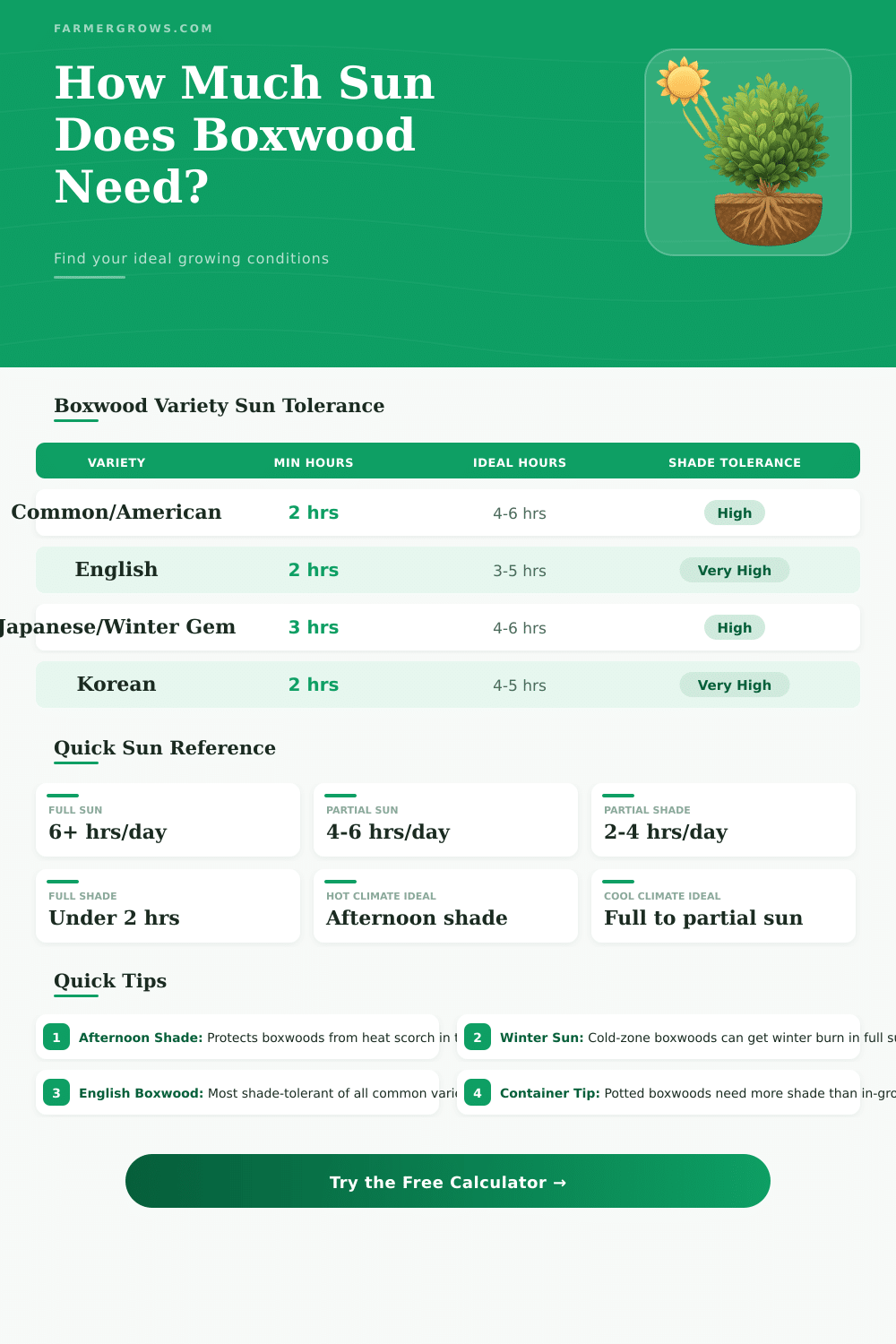
| Variety | Min Sun (hrs) | Ideal Sun (hrs) | Shade Tolerance | Full Sun Notes |
|---|---|---|---|---|
| Common / American | 2 | 4-6 | High | Tolerates well in cool zones |
| English | 2 | 3-5 | Very High | Prefers partial shade in South |
| Japanese / Winter Gem | 3 | 4-6 | High | Good adaptability |
| Korean | 2 | 4-5 | Very High | Best for cold climates |
| Dwarf / Green Velvet | 3 | 4-6 | Moderate | Compact; needs consistent light |
| Variegated | 3 | 4-6 | Moderate | May scorch in intense full sun |
| Climate Zone | Afternoon Shade Needed | Risk Without Shade | Recommendation |
|---|---|---|---|
| Cool Northern | No | Winter sun scorch | Full to partial sun OK |
| Temperate | Optional | Low | 4-6 hrs ideal |
| Hot Southern | Yes (strongly) | Leaf scorch, stress | Morning sun only preferred |
| Purpose | Min Sun (hrs) | Preferred Exposure | Notes |
|---|---|---|---|
| Formal Hedge | 4 | Full / Partial Sun | Dense growth needs good light |
| Topiary | 4 | Full / Partial Sun | Shape detail needs strong light |
| Foundation Planting | 3 | Partial Sun / Shade | Often shaded by building eaves |
| Container | 3 | Partial Sun | Roots heat faster; more shade needed |
| Border | 2 | Partial Shade | Most flexible placement |
Boxwood trees show big flexibility with light. They grow well in half-shade or filtered sunshine, although they also last well in full Sun. According to my experience most Boxwood trees benefit from around four to six hours of direct Sun daily.
Especially morning light seems to suit them best.
How Much Sun and Shade Do Boxwood Trees Need
The situation changes when temperature levels climb. In warm regions, Boxwood trees benefit from shade in the afternoon, because strong midday rays can burn the sheets brown (something to notice), especially during long and strong summers.
American and Korean types of Boxwood commonly hardly last too much Sun, so half-shade works more for them. When summers are warm and winters gentle, shady cover truly helps (it stops drying and injury). On the other hand, some types of Boxwood like fully sunny place all day.
For instance, the Green Velvet Boxwood is ideal: it grwos under permanent light, well absorbing Sun.
The Heritage Boxwood sits somewhere interesting, benefiting whether in full Sun or in half-shade. Interesting fact is, that full Sun commonly gives denser increase and sometimes more vivid foliage. The sheets seem too win more colour and general health from those extra rays.
Wintergreen Boxwood raises flexibility to new height… It grows anywhere from full Sun to full shade. Truly, all Boxwood trees grow well in shady areas just as in sunny or half-sunny.
Sunny spots receive light from morning to afternoon. Even so, Boxwood trees in almost-full shade do not grow as strong as those with more light.
Planting Boxwood, choose a sheltered place, that will make a difference. Aim for area with at least four to six hours of direct Sun, but protected against warm afternoon rays. Here one sample.
Buxus microphylla ‘Bulthouse’, this type is especially flexible: it lasts more than six hours of Sun, or four to six hours of half-Sun, or even almost full shade with less than four hours. It grows well in USDA-zones 5 to 9.
Boxwood trees adapt to almost any type of soil, that you give to them, no matter, whether alkaline, whether clay, whether sandy. The most important thing is good drainage. Also they react well to regular, gentle watering.
While trimming Boxwood, make the top narrower than the bottom branches, so that light enters everywhere. Winter Sun can truly injure, so shade in cold months helps to protect them. New growth, covered by cloth after cold, saves from winter burn.
Later, in spring, green sheets return, and filtered light or a bit of morning Sun works well for regrowth.
Pot growing does not work for Boxwood. Roots in jars suffer from temperature changes, both heat and cold… That ground plants simply donot experience.
That matters even more in sunny places or during winter winds.