Bone Meal Per Plant Calculator
Estimate bone meal per plant from soil-test phosphorus, plant spacing, pH, product analysis, calcium content, spoon density, and label-style per-plant rates.
Load a common garden situation, then adjust the soil-test category, pH, plant spacing, product grade, and measuring density.
Bone meal is a phosphorus and calcium amendment. It is most useful when a soil test shows a real phosphorus need.
Phosphorus from bone meal is much more useful in mildly acidic soil than in alkaline soil.
Phosphate moves slowly, so this calculator assumes the product is mixed into the planting zone, not left on top.
If phosphorus is already high, the safest output is usually zero bone meal and a nitrogen-only plan if plants need feeding.
Your Bone Meal Per Plant Estimate
Enter a soil-test category and plant area to calculate bone meal.
| Reference situation | Bone meal rate | Per-plant conversion | Best use | Watch point |
|---|---|---|---|---|
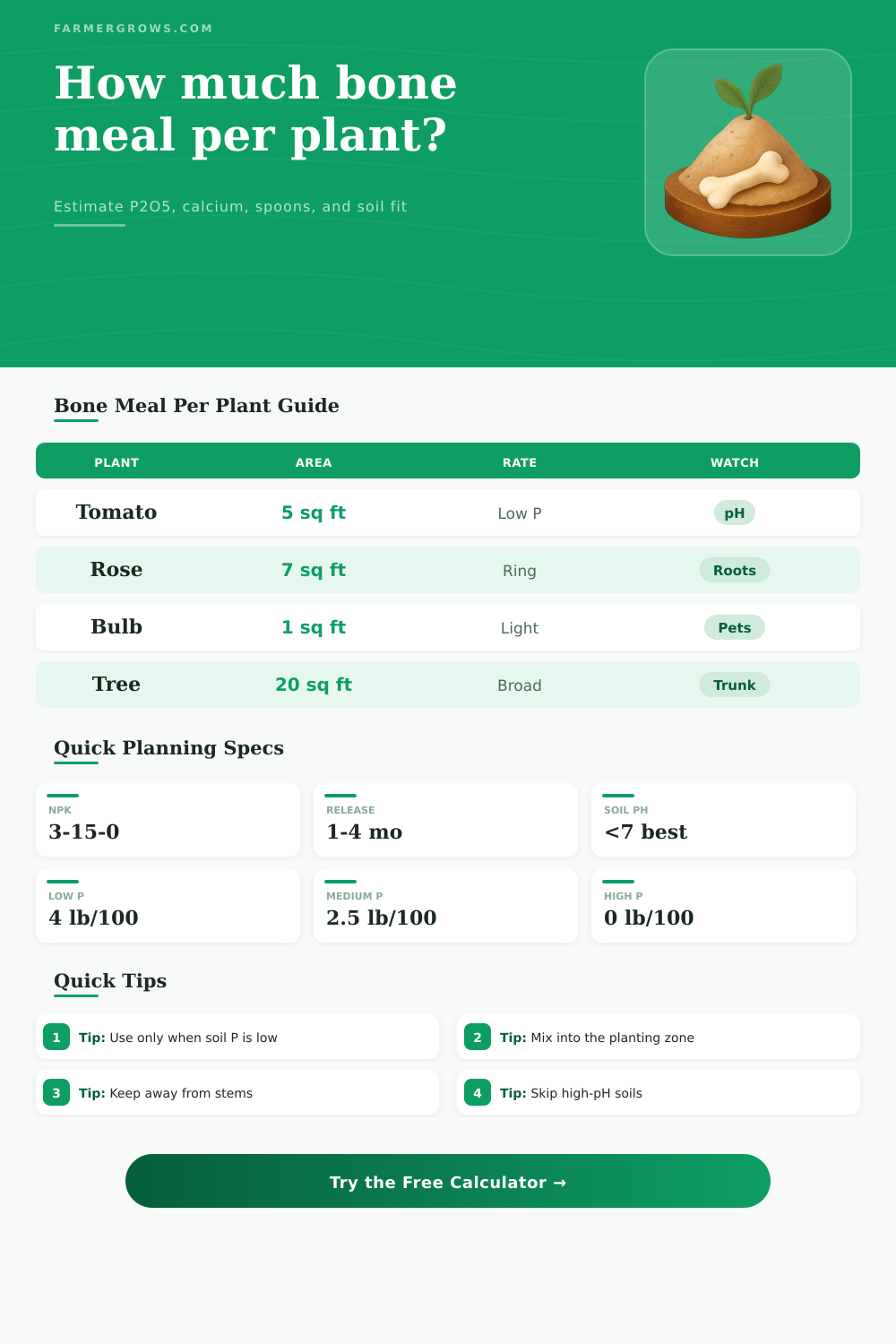
| Very low soil-test P | 4 lb per 100 sq ft | 0.2 lb for 5 sq ft | Pre-plant root zone | Mix into soil before planting. |
| Low to medium soil-test P | 2.5 lb per 100 sq ft | 0.125 lb for 5 sq ft | Moderate correction | Use lighter rates near tender roots. |
| Adequate or high P | 0 lb per 100 sq ft | 0 per plant | Skip phosphorus | Extra P can accumulate in soil. |
| Broad organic amendment | 10 lb per 100 sq ft | 0.5 lb for 5 sq ft | Only when justified | Too strong for many planting holes. |
| Bone meal analysis | In 100 g product | In 1 lb product | Calculator default | Practical note |
|---|---|---|---|---|
| Nitrogen | 3 g N | 13.6 g N | 3% | Small contribution, not a main N source. |
| Phosphate P2O5 | 15 g P2O5 | 68 g P2O5 | 15% | Main reason gardeners use bone meal. |
| Elemental phosphorus | 6.5 g P | 29.7 g P | P2O5 x 0.436 | Useful when comparing soil-test units. |
| Calcium | 20 g Ca | 90.7 g Ca | 20% | Varies by product and processing. |
| Soil pH | Calculator pH factor | Bone meal fit | What to do | Reason |
|---|---|---|---|---|
| 5.8 to 6.8 | 100% | Strong fit | Use soil-test rate | Phosphorus availability is favorable. |
| 6.9 to 7.2 | 65% | Caution | Confirm need first | Availability begins to drop. |
| 7.3 to 7.8 | 35% | Weak fit | Consider other guidance | Alkaline soils tie up phosphorus. |
| Above 7.8 | 15% | Poor fit | Do not rely on bone meal | Much of the product may remain unavailable. |
| Planting style | Area assumption | Placement | Keep-away zone | Use case |
|---|---|---|---|---|
| Large vegetable | About 5 sq ft | Mix through planting area | 4 to 6 inches | Tomato, melon, squash starts. |
| Small vegetable | About 2.5 sq ft | Band beside row | 2 to 4 inches | Broccoli, pepper, leafy starts. |
| Bulb or clove | 0.25 to 1 sq ft | Blend below root plate | Do not pile in hole | Bulbs, garlic, tubers. |
| Shrub or young tree | Canopy or ring area | Broad ring, not trunk | 8 to 18 inches | Roses, shrubs, young fruit trees. |
Soil test first: Bone meal is mainly phosphorus. If a soil report already shows adequate or high P, the calculator intentionally recommends little or none.
Mix, do not pile: Phosphate moves slowly. Blend bone meal into the planting area and keep concentrated powder away from stems, crowns, and tender roots.
Check pH: In alkaline soil, bone meal may not release useful phosphorus. The pH factor shows why a high-pH site can need a different plan.
Measure carefully: Tablespoon weight varies by grind and moisture. For repeatable rates, weigh a level tablespoon and enter that density.
Your tomato plant arrives with bushy foliage promising fruit yet to come. It is proud as punch in its container. The garden books said to add some bone meal (because phosphorus promotes root development). That’s great: feeding the soil is always instinctive and good, but nobody realy knows or thinks about how much to use. Not enough won’t do anything; too much can burns tender young roots, or otherwise lock up other available nutrients.
Enter the calculator, which does the arithmetic after you enter number of plants and the spacing between them. Now you will know whether a handful will be enough, or if you are wasting an entire package on a small area that does not need it.
How to Use Bone Meal Correctly
Dusty Powder is ground animal bone (bone meal). It also contains slow-release fertilizer, serves as a source of calcium, and helps with phosphorus for strong root growth before fruiting. Phosphorus travels slowly in the soil, which explains why the when matters. Apply it now, before the fruiting stage hits.
Spread it on top as if it were mulch? It’s just sitting there doing nothing but collecting dust. Mix it in with the root-zone soil, where the roots comes in direct contact with it. That’s what the calculator takes into account. For example, it calculates exactly how much to use per plant based off the large amount you would apply over an entire garden bed area.
Know what you’re measuring with your soil test. I’m not suggesting you do one (most gardeners avoid them; they feel like homework). But to guess is dangerous. Adding more bone meal does nothing if your soil phosphorus level is sufficient; all you will do is increase the potential for longterm accumulation problems. That’s why there is a “soil-test” category selector on the tool: It controls the result. Say you check “high phosphorus”? It tells you to add none. Why? This prevents over-fertilizing out of habit instead of need.
Soil pH is another variable that makes all the difference. Phosphorus is most effective in slightly acidic conditions, around pH 5.8 to 6.8. Under these conditions, microbes breaks up the bone particles and release phosphorus that the plant’s roots can take up. If your soil is more alkaline, then the phosphorus will bind to iron and calcium and become unavailable as an insoluble compound; again, inaccessible to the plant. The pH factor is adjusted on the calculator accordingly to reflect that chemistry. It factors in how much limestone there may be in your soil or how hard the water is where you live. That’s what helps explain why one garden might react more different than the next side-by-side, even though they’re treated similarly.
It’s about where things go physically. Bone meal on or too close to the crown, or even the stems, of your transplants is what you don’t want. Amounts that get too high next to living tissues can burn them, just like salt does. With the tool, you mark off an area to stay away from; creating a keep-away zone. That reduces the workable space, so you know the fertilizer goes in the soil mass and not right against the base of the plant. It makes a general instruction (fertilize) into a concrete one: how to apply it safely.
Spoon measurement is convenient, but not precise. Different brands of bone meal has different densities when ground up. One tablespoon could be 8 grams in one brand and 12 in another. The calculator asks you to define your spoon density, bridging the gap between kitchen convenience and agricultural precision. The calculator provides this bridge from convenient kitchen scale to precise farm scale. If you’re in a hurry just use default estimate, or better yet take out a sample and weigh it yourself.
What you get back is your measurement of how much to give each plant, whether by weight or volume. That said: Root zones vary in volume. Two-inch-deep garlic cloves take up less space underground than a big tomato will. To account for that, enter either your distance apart (spacing) or your total area per plant into the calculator. It’ll scale the typical rate, often expressed as pounds per hundred square feet, to your own plant’s specific needs. That avoids the mistake of assuming that a little pepper transplant is equivalent to a full-grown rose bush.
And it analyzes products as well. Not all bone meal is created equal. Some are processed in ways that result in lower phosphorus and higher calcium percentages. Some are finer and release faster than others. You can input the NPK ratio on your particular bag along with its calcium content and recieve a detailed breakdown right down to the exact contents of whatever you’re adding to the mix. That kind of transparency will help you balance the equation if you happen to be using other amendments such as compost tea or lime.
The main weakness and planning difficulty with bone meal is that this stuff lasts, feeding gradually for months instead of days. Can’t feed instant gratification; can’t address urgent hunger. It is an investment in the early part of a plant’s life cycle; it is not a rescue mission for when leaves start to wilt in high summer.
Makes sense? This timing allows you to put it in the right place ahead of time, before the shock of transplanting sets in. The point of gardening is not ritual, but resourcefulness by matching real need with available resources. A little bone meal applied where needed goes a long way. Strong roots; use it carefully so you don’t mess up the soil or cause burn stress to your plants. Trust your instinct to amend, but let the data guide your hand. Begin with the soil test; heed the pH limits; incorporate well throughout the root zone. Look for steady growth, not a flashy spike of instant gratification doomed to fade fast. Restraint combined with know-how transforms a patch of dirt into a garden in bloom.