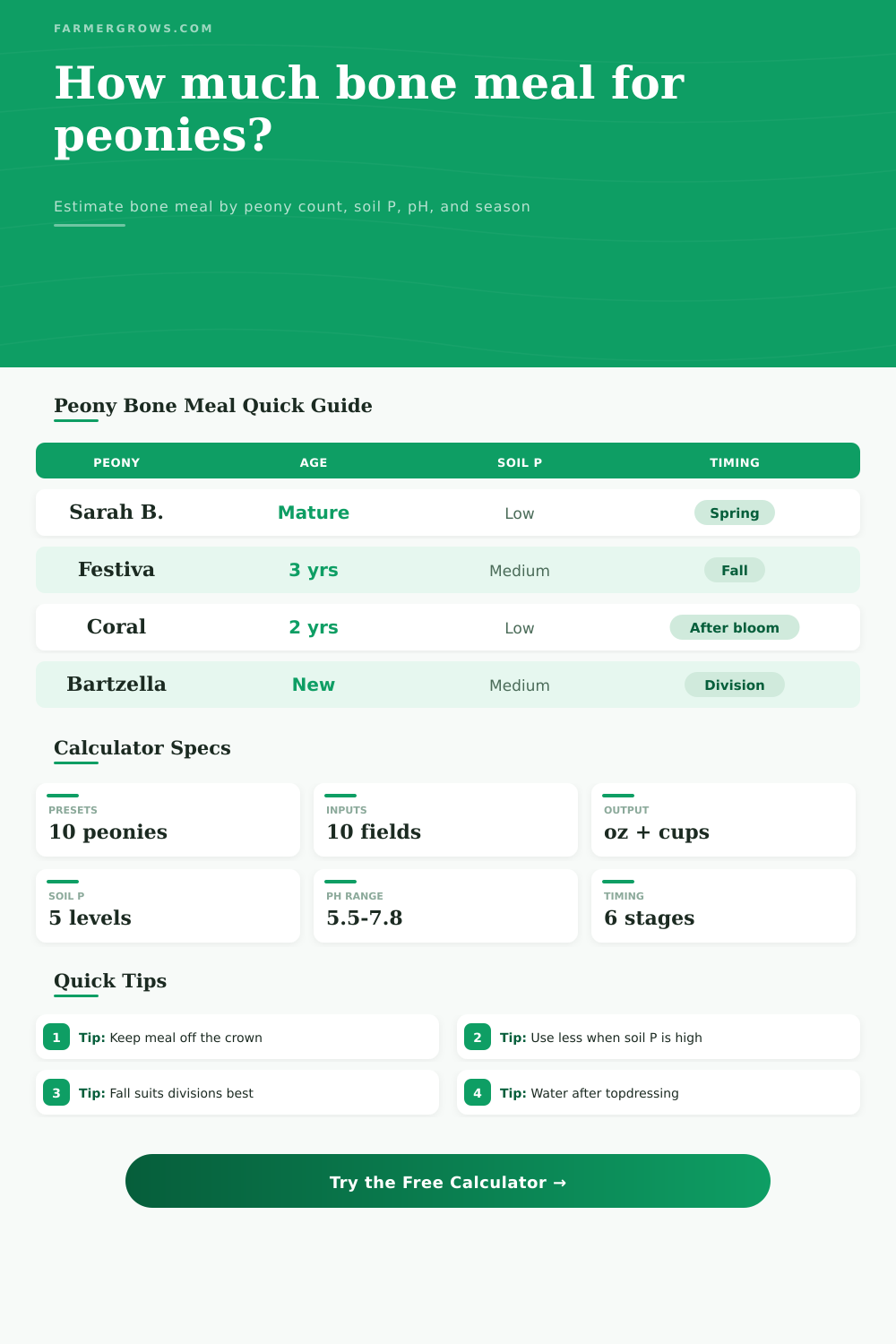
Bone Meal for Peonies Calculator
Estimate a peony-safe bone meal amount from plant count, crown age, root-zone width, bud stage or season, soil phosphorus, pH, compost use, and division status.
Choose a real peony cultivar scenario, then adjust soil test values and product analysis. Presets are examples for planning, not a replacement for a soil test.
Bone Meal Estimate
Adjust inputs to calculate a peony-specific bone meal plan.
| Peony age | Base P2O5 target | Root-zone cue | Bone meal note |
|---|---|---|---|
| New bare-root | 0.055 lb P2O5 per plant | 12 to 18 in circle | Mix below and around roots, not against eyes |
| Young, 2 to 3 years | 0.080 lb P2O5 per plant | 18 to 24 in circle | Light ring feeding supports root expansion |
| Mature, 4 to 10 years | 0.115 lb P2O5 per plant | 24 to 36 in circle | Topdress at drip edge or just outside shoots |
| Old clump, 10+ years | 0.100 lb P2O5 per plant | 30 to 42 in circle | Use soil test before adding more phosphorus |
| Soil phosphorus status | Calculator factor | Peony response | Practical action |
|---|---|---|---|
| Very low | 1.40x | Root and bud reserves may be limited | Apply full calculated amount and retest |
| Low | 1.15x | Good case for modest bone meal | Use ring placement and water in |
| Medium | 0.72x | Maintenance only | Keep dose conservative |
| High | 0.22x | Little bloom gain likely | Skip or use a token transplant dose |
| Very high | 0.00x | Added P can be wasteful | Do not add bone meal unless advised |
| Soil pH | Calculator effect | Why it matters | Peony note |
|---|---|---|---|
| Below 6.0 | 0.90x with caution | Acidity can reduce vigor and nutrient balance | Correct pH separately before chasing blooms |
| 6.0 to 6.4 | 1.00x | Slightly acidic and workable | Good for many herbaceous peonies |
| 6.5 to 7.2 | 1.00x | Preferred garden range | Best overall range for steady uptake |
| 7.3 to 7.8 | 0.85x with caution | Phosphorus can become less available | Avoid heavy repeated bone meal use |
| Above 7.8 | 0.65x with caution | High pH can tie up several nutrients | Use soil test and local amendment advice |
| Timing or bud stage | Factor | Best use | Placement reminder |
|---|---|---|---|
| Early spring shoots | 1.00x | Normal annual maintenance | Ring outside shoots and scratch shallowly |
| Visible bud stage | 0.60x | Only if soil P is low | Avoid pushing tender stems or buds |
| After bloom | 0.86x | Rebuild crown reserves | Keep foliage healthy through summer |
| Early fall | 1.05x | Root growth and next-year buds | Water in before soil gets cold |
| Fall division day | 1.18x | New divisions and planting holes | Blend into soil below roots |
| Frozen dormant soil | 0.25x | Delay if possible | Wait until soil can be worked |
Dies back each year. Feed in a wide ring around shoots and keep material off the crown eyes.
Often forms a broad clump with strong stems. Use a slightly wider feeding zone as plants mature.
Woody framework stays above ground. Feed farther from the stem base and avoid deep cultivation.
Usually needs a restrained dose, especially in woodland-style beds with leaf mold or compost.
Place it where feeder roots work. Scratch bone meal into the outer root-zone ring, then water it in. Avoid piling powder directly on crown eyes, woody stems, or fresh cut division surfaces.
Let the soil test set the ceiling. Bone meal is mostly phosphorus and calcium; when soil phosphorus is already high, compost, mulch, and pH correction usually matter more than extra bone meal.
Bone meal: Peonies and bigger blooms? Sounds good to me. So you go sprinkling this stuff all over top of the bloom, as if it were some kind of miracle. Here’s what seldom happens: It’s not that bone meal doesn’t work. It’s just you haven’t timed its application correctly, used too much or applied it in the wrong way (like direct contact with plant tissue, which can lead to burn). Respect the soil chemistry. And respect what stage your peony clump is in.
Don’t expect generic bag directions to offer such a detailed approach. That requires a calculator… A dedicated one. It transform guessing into planning with precision.
The Right Way to Feed Peonies
Why? Because peonies are hungry plants. They need phosphorus. To make new buds, and then to grow strong roots. But they don’t like it on their eyeballs. Fertilizer must be kept away from the eyes of peony. To avoid damaging emerging buds by piling up granules against the crown, keep this in mind: Peonies is heavy feeders. They are finicky about how they eat.
You can use the calculator tool (at top) to do the math for you. Enter size of each crown and number of plants, and you’ll have the proper dose. It calculates based off the area covered by their actual feeding grounds, which includes more than just the part of the plant seen above ground. That’s why peony roots spreads so far… And why those feeder roots stretch beyond the stem.
Another variable where people go wrong: When to apply. Bone meal can be applied in early spring for maintenance. Apply when shoots has emerged and reach heights from two to six inches. Even better, fall is often best. In early fall, roots are actively growing. Before they go dormant, the plants take up the food.
For a plant that’s being divided out of a crowded clump, then the timing changes. New divisions require an extra boost to help them get established. Fertilizer can be worked into the soil beneath their root; don’t sprinkle it on top. The calculator takes this scenario into account. Depending on whether the plant is newly divided or not, it will adjust to match, and thus prevent us from overdoing it on stressed roots.
Phosphorus in the soil is less discussed but very important. Slow-release bone meal are available. But it stays put in the soil for years. And you don’t need more phosphorus if your soil test indicates high levels of it. In fact, extra phosphorus can tie up other needed elements such as zinc or iron. The calculator asks about your phosphorus status in the soil, and if it’s high, will slash its recommendations accordingly. Or even suggest none at all (bone meal).
As a gardener whose mind conjures flowers when I think bone meal, that seems counterintuitive. But it’s science. Get the other nutrient balance wrong, and no matter what you do, you won’t get a plant to bloom. Sometimes the best fertilizer is no fertilizer at all.
All this happens under the control of pH. And peonies like things slightly acid to neutral, about 6.5-7.0. Outside that range, phosphorus availability decreases rapidly. Outside that range, phosphorus availability decreases rapidly. On the one hand, if you’re pretty alkaline, phosphate combines with calcium, and then nothing gets absorbed. That’s because it’s bound up. On the other hand, if you’re really acidic, it combines with aluminum or iron. Again, that won’t work. Your tool considers your ph, and will decrease its recommendations for bone meal if your soil is too far along on either end.
If the chemistry shuts down absorption, you can’t add more fertilizer. First fix the ph.
Don’t overlook the compost factor: Adding a generous mulch of compost will add phosphorus at no extra charge. So will well-rotted animal manures. Enter that as an input in the calculator, too. The machine knocks down the dose of bone meal accordingly.
Do not amend redundantly. Don’t burn up all available nutrients. A hole filled with too much goodness leaves nothing else able to live. You’re aiming to grow a balanced, healthy root system. From that come big flowers and strong stems. It is not a scorching-hot, nutrient-saturated hole where nothing else can survive.
Think about your peony bed as a living thing, treat it like one, not just a bucket you fill. Give your plants only what they need, and then do so when they need it. And have a garden that rewards that kind of precision, rather than one that feeds its hungry appetite for excess.