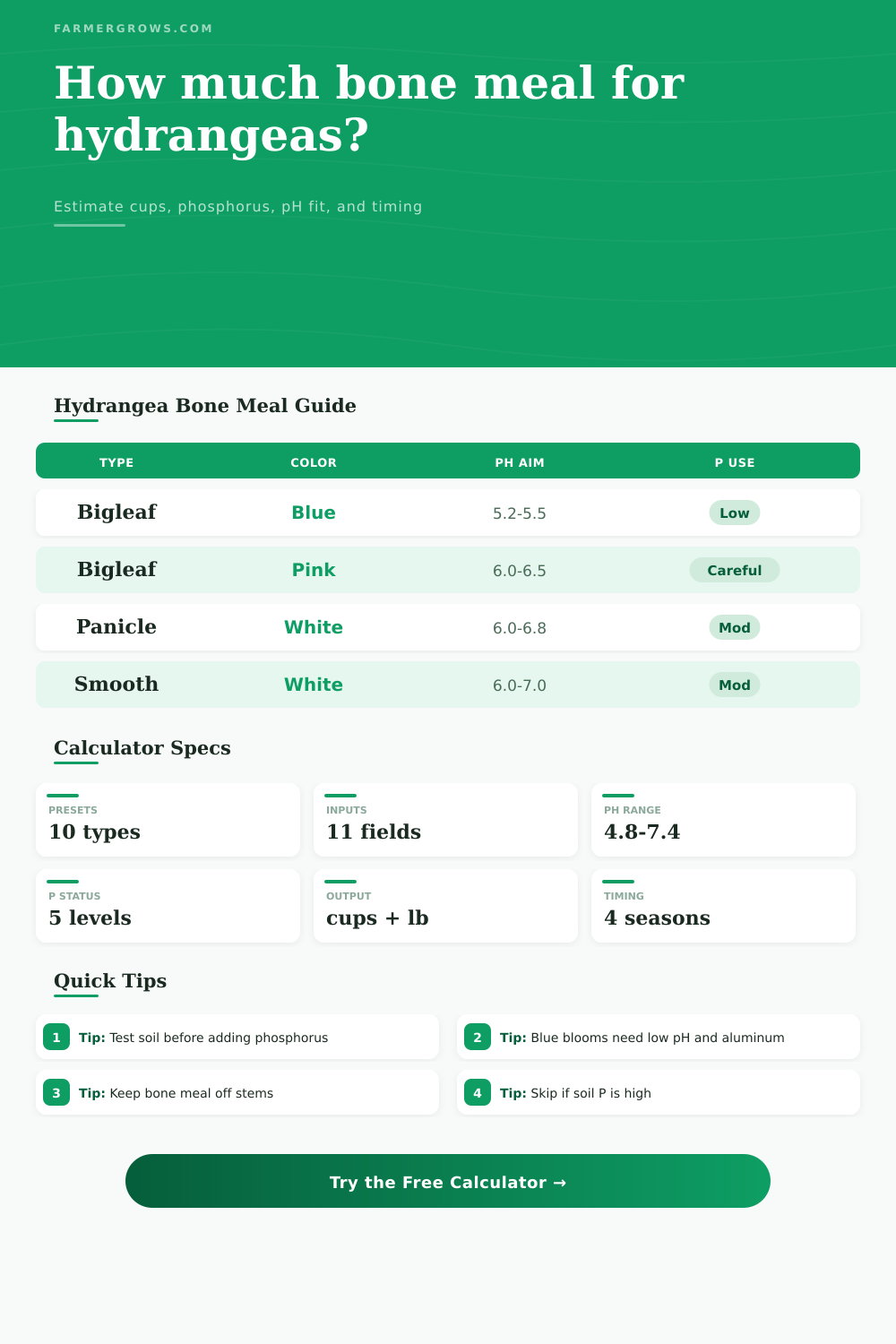
Bone Meal for Hydrangeas Calculator
Estimate a conservative bone meal amount for hydrangeas from shrub type, root-zone area, soil phosphorus, pH, bloom-color goal, product analysis, season, and lime or aluminum sulfate plans.
Choose a named hydrangea scenario, then adjust your soil test, canopy size, product analysis, and bloom-color goal.
Hydrangea Bone Meal Estimate
The estimate will appear here after calculation.
Color can shift blue, purple, or pink with pH and available aluminum. Bone meal should be cautious for blue goals.
Same color chemistry as mopheads, often with a lighter feeding rhythm in mixed shade borders.
Color-responsive like bigleaf types, but usually smaller and best with moderate fertility.
White-to-pink aging is genetic and seasonal. Bone meal will not turn these blooms blue.
Usually white, green, or blush by cultivar. Use bone meal only when phosphorus is actually low.
Prefers woodland-style soil. Flower color is not managed with pH the way bigleaf blooms are.
Large mature root systems need restraint; prioritize soil tests before adding phosphorus.
Containers accumulate salts and nutrients quickly. Use a reduced bone meal rate and fresh potting mix cues.
| Soil phosphorus result | Suggested P2O5 target | Bone meal stance | Hydrangea note |
|---|---|---|---|
| Very low or deficient | 3.2 oz P2O5 per 100 sq ft | Useful, apply gently | Most relevant at planting or when soil test flags low P |
| Low | 2.0 oz P2O5 per 100 sq ft | Moderate application | Good place for a conservative spring feeding |
| Medium | 0.9 oz P2O5 per 100 sq ft | Light application | Often enough for maintenance in mixed beds |
| Adequate | 0.35 oz P2O5 per 100 sq ft | Very light or skip | Use only when growth is weak and soil pH fits the goal |
| High or excessive | 0 oz P2O5 per 100 sq ft | Skip bone meal | Extra phosphorus can interfere with blue color management |
| Bloom color goal | Best pH zone | Bone meal caution | Aluminum or lime interaction |
|---|---|---|---|
| Blue bigleaf or mountain | About pH 5.2 to 5.5 | Use only with low P; excess P ties up aluminum | Do not expect aluminum sulfate to work well in high-P soil |
| Purple or mixed | About pH 5.6 to 6.0 | Small amounts are usually safer than heavy feeding | Avoid changing pH in both directions at once |
| Pink bigleaf or mountain | About pH 6.0 to 6.5 | Bone meal can fit if P is low and pH is not too high | Lime and bone meal both push away from blue conditions |
| White panicle, smooth, oakleaf | Often pH 6.0 to 7.0 | Color will not turn blue from pH amendments | Feed for root support, not color change |
| Application season | Calculator factor | Best use | Practical timing note |
|---|---|---|---|
| Early spring | 100% of calculated rate | Normal maintenance | Scratch into the outer root zone before mulch refresh |
| Right after bloom | 85% of calculated rate | Rebloomers and light correction | Keep rates modest so late soft growth is not pushed |
| Fall after leaf drop | 60% of calculated rate | Soil-test correction only | Avoid forcing growth; phosphorus moves slowly |
| Winter or frozen soil | 0% of calculated rate | Wait | Do not spread on frozen, saturated, or runoff-prone soil |
| Hot summer | 50% of calculated rate | Emergency low-P correction | Water well and avoid feeding drought-stressed shrubs |
| Cultivar or type | Common flower behavior | Bone meal fit | Color management note |
|---|---|---|---|
| Endless Summer Original | Blue, purple, or pink by soil chemistry | Only low to medium P soil | Blue needs acidic soil and available aluminum |
| Nikko Blue | Classic color-shifting mophead | Use cautiously for blue | High phosphorus can dull blue attempts |
| Cityline Paris | Usually saturated pink to red | Light maintenance if P is low | Pink goals tolerate a higher pH than blue goals |
| Merritt's Supreme | Pink, purple, or blue in suitable soils | Moderate only when test supports it | Split pH changes from fertilizer decisions |
| Limelight | Lime-white aging to rose | Based on soil P, not bloom color | pH amendments do not create blue flowers |
| Annabelle | White to greenish white | Usually light if any | Use balanced fertility for stems and leaf health |
Keep color chemistry separate from feeding. Bone meal adds phosphorus and calcium. For blue bigleaf or mountain hydrangeas, soil pH and available aluminum matter more than adding extra phosphorus.
Apply in the active root zone. Spread the calculated amount around the drip line, keep it off stems and crowns, scratch it shallowly into moist soil, then water before replacing mulch.
Most gardeners think bone meal will help things bloom. You buy it; you sprinkle it; you hope. And then nothing much happens. The flowers don’t change color and the plants still look exhausted, despite all the fertilizer. What happened? Nothing was wrong with the product. We were simply assuming more is always better, especially when it comes to phosphorus helping make plants bloom better. Turns out that hydrangeas don’t like having phosphorus added when they aren’t ready for it, and that those extra-fancy nutrients can actualy shut down the ones you do want. Get a read on what’s happening in your bed first (above) to avoid wasting money, and messing up things you might not know you’re trying to thwart.
First of all: Not all hydrangeas is created equal when it comes to amending their soils to change colors. Bigleaf and mountain varieties change shades (pink to blue) depending on the pH and availability of aluminum in the soil. Oakleaf, smooth, and panicle hydrangeas don’t. It’s in their DNA. You’re not only battling chemistry but also biology if your goal is to make a Limelight blue, for instance. The calculator take this into consideration and adjusts its recommendation accordingly (depending upon which kind of hydrangea you say you have). So there will be no more waste and no more product wasted on a shrub that is naturaly built to resist any effort to trick it into changing color. Just think how much money you’ll save; how many roots you’ll spare from being burned.
Why Too Much Bone Meal Hurts Hydrangeas
Phosphorus is a difficult one in this area. On the plus side, it promotes root growth and flowers; on the minus side, it’s slow to release from soil particles once bound. While nitrogen leaches out or gets depleted within a few years, phosphorus just hangs around, so whatever you apply today may remain active in decades. Adding more bone meal won’t help if the soil test shows that P is already plenty or high. It doesn’t do the plant any good, though it can lock out other nutrients such as zinc and iron. That’s why the calculator wants to know about your soil phosphorus status. If you enter “rich” as your answer, chances are good the recommendation will be no or very light applications. Follow that advice; better to amend down the road than try to undo too much phosphorus.
But there’s one other wrinkle: color targets. To achieve blue, the soil must be acidic enough for the hydrangea to absorb aluminum; this means a soil pH somewhere between 5.2 and 5.5. Slightly alkaline bone meal won’t shift that quickly (no change in an instant). However, repeated doses applied heavily enough can move the soil toward neutral. This is good news if you want pink blooms, but bad news if you’re after blue. A little bit would be OK if you know your soil is already low on phosphorus but you’re pursuing blue. If your pH is already too high for blue (you’re going for pink instead) then you have more room. Assuming the soil isn’t already off-the-chart high or low, the tool takes into account where you start and what you hope to achieve, giving you a safe place to meet in the middle. This also applies to whether you’re adding lime or aluminum sulfate, which affects bone meal directly.
Of course there’s a caveat to that timing advice: The soil isn’t a fast-moving conveyor belt for phosphorus. If applied too late. Say, right after bloom has started… The roots don’t have enough opportunity to tap into it prior to the intense burst of flower production. Too early? If you apply it in the winter when the ground is frozen, it is a waste, since no absorption will occur in the lifeless soil, and it is likely also wasteful due to possible run-off. The calculator takes all this into account by adjusting its recommended dosage depending on which month you select. In summer and fall, plants are often stressed by heat or are beginning to wind down. During these times, you should restrain yourself. Apply fertilizer only where it is needed most to prevent shock to the shrub.
Finally, there is the root zone itself. Remember that hydrangeas are fibrous rooted; they extend from the base outward to the tree’s canopy drip line. So applying food to the area under the center of the plant isn’t nearly as good as making sure it gets worked in at the edges where the feeder roots live. The calculator bases its estimate on canopy diameter (or you can enter it directly) to prevent overdosing a small spot or underfeeding a large one. And no more wondering how much it’s going to weigh when it’s time to measure out your meal. No, it figures it for you in pounds and cups.
Sometimes gardening’s all about restraint. We often want to do something visible, but the best care is often invisible. Bone meal applied in just the right amount at just the right time beats a heavy hand every time. Let the plant be your final judge. It is not just about bigger blooms. It is a shrub that thrives.