Bone Meal For Roses Calculator
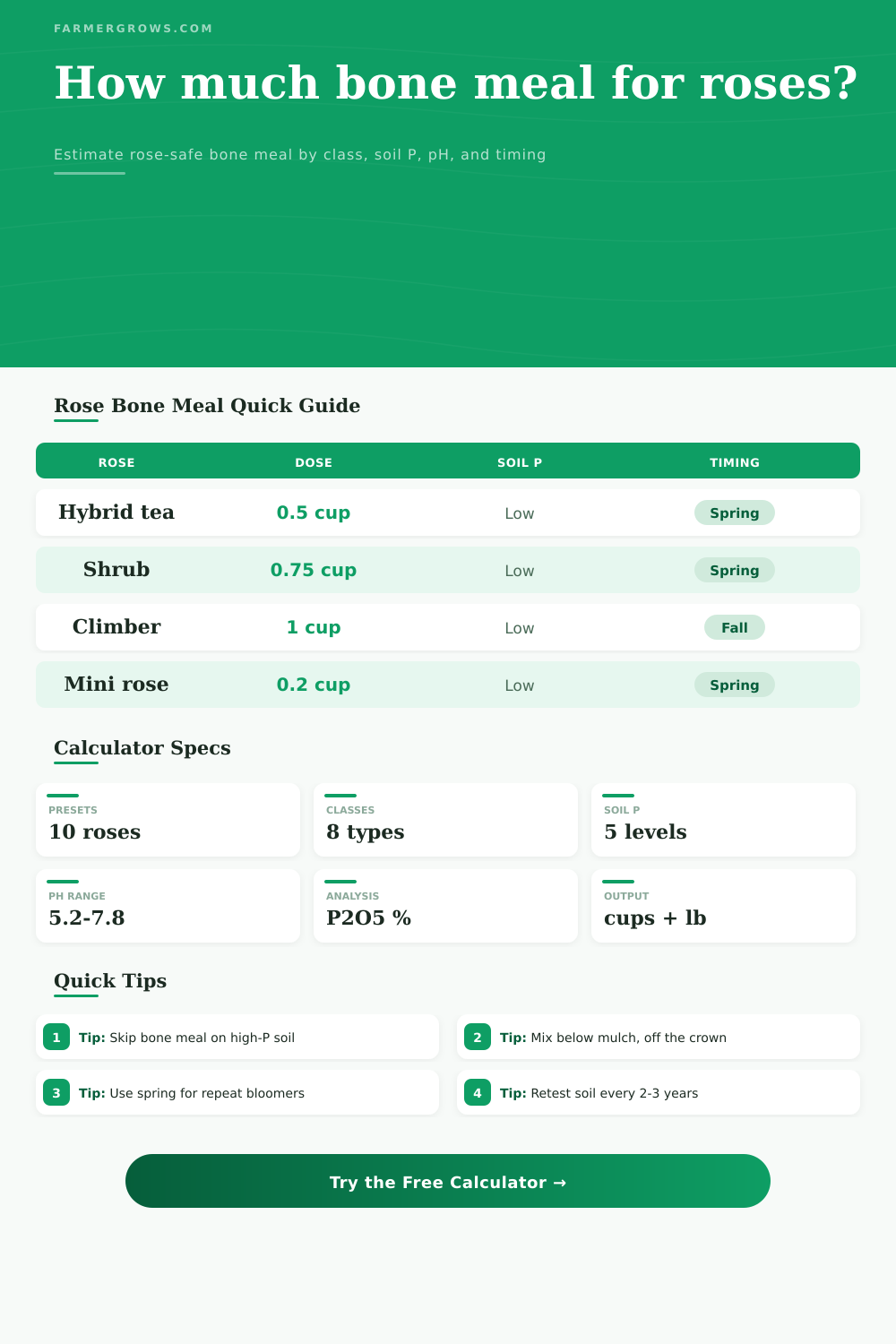
Estimate a rose-safe bone meal amount from rose count, class, planting hole or bed area, bloom cycle, soil phosphorus status, product analysis, pH, compost, mulch, and spring or fall timing.
Choose a real rose variety preset, then edit the count, soil test status, product label, and timing to match your bed.
Bone Meal Estimate
Adjust the inputs to estimate a rose-safe phosphorus application.
Moderate feeder with large blooms; use a measured planting-hole dose only when soil P is low.
Vigorous repeat bloomer; compost-rich beds often need less bone meal than new bare soil.
Large root zone and long canes make placement and wide feeder-ring coverage more important.
Repeat blooming clusters respond better to steady nutrition than heavy phosphorus spikes.
Tall growth and repeat bloom place it between hybrid tea and shrub dose ranges.
Broad shrub habit favors a wider ring, kept away from the crown and mulch surface.
Small clustered growth means lighter per-plant rates, especially in established beds.
Use the climber class for planting holes, but reduce if soil P is already adequate.
| Rose class | Typical low-P dose | Best placement | Watch point |
|---|---|---|---|
| Miniature or patio | 1/8 to 1/4 cup per rose | Lightly mixed into container edge or small ring | Containers build salts and phosphorus faster |
| Floribunda or polyantha | 1/3 to 1/2 cup per rose | Feeder ring outside the crown | Repeat bloom needs balanced feeding too |
| Hybrid tea | 1/2 cup per rose | Mixed through backfill below root zone | Do not place concentrated meal on roots |
| Grandiflora | 1/2 to 2/3 cup per rose | Wide ring or blended planting hole | Tall growth still needs nitrogen and potassium |
| Shrub or English rose | 2/3 to 3/4 cup per rose | 12 to 18 inches from crown | Reduce in compost-rich landscape beds |
| Climber or rambler | 3/4 to 1 cup per rose | Broad ring at feeder-root zone | Keep away from graft union and cane base |
| Soil phosphorus status | Calculator factor | How to use bone meal | Rose note |
|---|---|---|---|
| Deficient soil test | 1.25x | Use full calculated dose and retest later | Best case for bone meal at planting |
| Low soil test | 1.00x | Use normal rose-class dose | Good match for new beds and transplanting |
| Unknown, no recent test | 0.75x | Use a conservative dose | Avoid repeating annually without testing |
| Adequate or medium | 0.45x | Use little or none unless planting bare-root roses | Focus on balanced rose fertilizer instead |
| High or very high | 0.00x | Skip bone meal | Extra phosphorus can interfere with balance |
| Soil pH near roots | P availability effect | Calculator factor | Rose action |
|---|---|---|---|
| Below 5.8 | Phosphorus can be tied up in very acid soil | 0.85x | Correct pH gradually before chasing phosphorus |
| 5.8 to 6.1 | Usable but slightly acid for many roses | 0.95x | Good for many garden soils with organic matter |
| 6.2 to 6.8 | Strong rose root and nutrient range | 1.00x | Best target range for most rose beds |
| 6.9 to 7.2 | Still workable, but micronutrients tighten | 0.90x | Use compost and monitor leaf color |
| Above 7.2 | Phosphorus and iron can be less available | 0.65x | Do not solve alkaline soil with extra bone meal |
| Timing | Calculator factor | Best fit | Practical rose note |
|---|---|---|---|
| Early spring, buds swelling | 1.00x | New season root and shoot growth | Water in after mixing beneath mulch |
| After first bloom flush | 0.70x | Repeat bloomers needing a light refresh | Keep the dose modest and balanced |
| Fall planting or transplanting | 0.80x | Bare-root or moved roses before dormancy | Avoid pushing tender late growth |
| Late fall, near dormancy | 0.55x | Only where soil is low and beds are prepared | Skip on frozen, saturated, or high-P soil |
Let soil tests lead. Bone meal is mainly a slow phosphorus source, not a complete rose fertilizer. If phosphorus is adequate or high, roses usually benefit more from balanced nutrition, organic matter, water management, and pH correction.
Place it where roots will grow. Mix bone meal into backfill or the feeder-root ring and cover it with soil. Keep concentrated product away from bare roots, the crown, graft union, stems, and mulch surface.
A bone meal isn’t a complete fertilizer. It’s mainly phosphorus, and applying too much (more than your soil requires) doesn’t produce larger flowers. Applying too much instead cause a chemical imbalance that locks up other nutrients your roses need. There’s no sense guessing what the dose should be, guesswork will result in a chemical imbalance.
This page has a calculator to do the math for you. Simply input where the plant was planted, what type of rose variety it is, and your soil test results. The calculator takes care of the rest, saving you from overfeeding your bed.
How to Use the Bone Meal Calculator
Soil pH also affects how phosphorus works its magic: Phosphorus can be “tied up” in acid soils, making it unavailable to the roots (too much acidity) and in alkaline soils as well (too little). By using your own pH reading, the tool takes this into account, adjusting the dosage recommendation to match. For instance, it assumes you have an optimal reading of six point four. So that’s the standard factor applied. But if you’re growing in really alkaline clay or acidic-sandy soil, the factor is drastically lowered, protecting you from wasting your money on phosphorus that’s inaccessible to the roots. Another small detail. But one that makes all the difference when you consider the biggest error in organic rose care: Blind application.
The right time is also important (as is the amount of what). Late-spring applications of bone meal don’t help this bloom cycle. The bush is already going all out, seeking potassium and nitrogen more than phosphorus. Phosphorus take weeks to leach into an available form. The calculator has different recommendations depending on whether you’re applying in fall or early spring. Fall is for getting the soil ready for winter dormancy; early spring is timed more toward root development.
For a newly planted bare-root rose, the tool recommends that you add a full dose when backfilling the hole. When topdressing an existing plant after its initial flush, use a smaller dose to avoid shocking the system. That way, your feeding schedule matches the plant’s natural cycle.
Not all roses are the same; their design also means they don’t feed themselves in the same way. A pot-grown miniature rose develops phosphorus and salt buildup fast because its rootzone is tiny, and it’s simple to overfeed such a little thing. But a large shrub or climbing rose spreads its feeder roots across a larger area. It needs a wider ring for fertilizer, rather than having it concentrated near the crown of the plant, but not too wide. That’s where the reference part of the page comes in, explaining how each class feeds differently. See? One miniature rose only gets a quarter cup, one big hybrid tea a half. You could burn your roots off if you didn’t take into account structure like that. It would also waste effort. This tool accounts for that. It asks for the type of rose (class) to know how far the root system will likely go. This tells the tool what volume is appropriate.
However, you don’t really need to use bone meal unless your soil test shows that you do. Many gardeners simply add it each year as a matter of course…again. But over-fertilizing with phosphorus (as bone meal contains) will prevent the uptake of other nutrients, such as zinc and iron, resulting in weak plants and a condition called chlorosis. The soil phosphorus status can be entered into the calculator. Choose high or very high for this entry, and the recommendation becomes a dose of zero. Counter-intuitive though it may seem, it’s botanically sound: The idea is balance, not abundance.
So now that you know how many you need, what do you do next? To apply it, again, don’t heap the bone meal around the graft union (the place where the rootstock meets the grafted plant) or right at its stem. Work it into the area the roots are growing into. Water it well, and cover it with soil so it can begin breaking down with moisture. If you’re applying to a big bed, use the buffer function on the tool to allow for uneven mixing or spillage.
There’s science to gardening, and there’s hunches. Using the calculator removes the guesswork of when to apply phosphorus from the equation, because the science gives you a starting point: a baseline. Based off your particular conditions, it calculates exactly how much phosphorus to apply. Then it’s up to your eyes to observe the results. This brings us to the hunch side, the part where your roses tell you whether or not you’re on the right track. Do they appear vibrant? Are the blooms holding their shape?
Get the numbers correct using the tool; let your eyes take it from there. Begin by applying a measured dose, resist the urge to overfeed, and let the soil biology go to work. Let nature do her thing, and expect that your roses will respond accordingly. With steady, healthy growth instead of the stress-induced, short-burst bloom. That’s the true secret to a thriving garden.