Blueberry Plants Per Acre Calculator
Estimate blueberry bush population, row footage, nursery order size, replacement plants, and mature crop range from field area, row spacing, in-row spacing, survival, and harvest system.
Use the net planted area for the most accurate blueberry plant count. Row spacing is measured center to center, so it should include the alley, mower lane, sprayer lane, or harvest equipment clearance that belongs to each row.
Blueberry Planting Population Results
Calculated from spacing, planted area, row count, and nursery order assumptions.
| Blueberry type or system | In-row spacing | Row spacing | Plants per acre | Planning note |
|---|---|---|---|---|
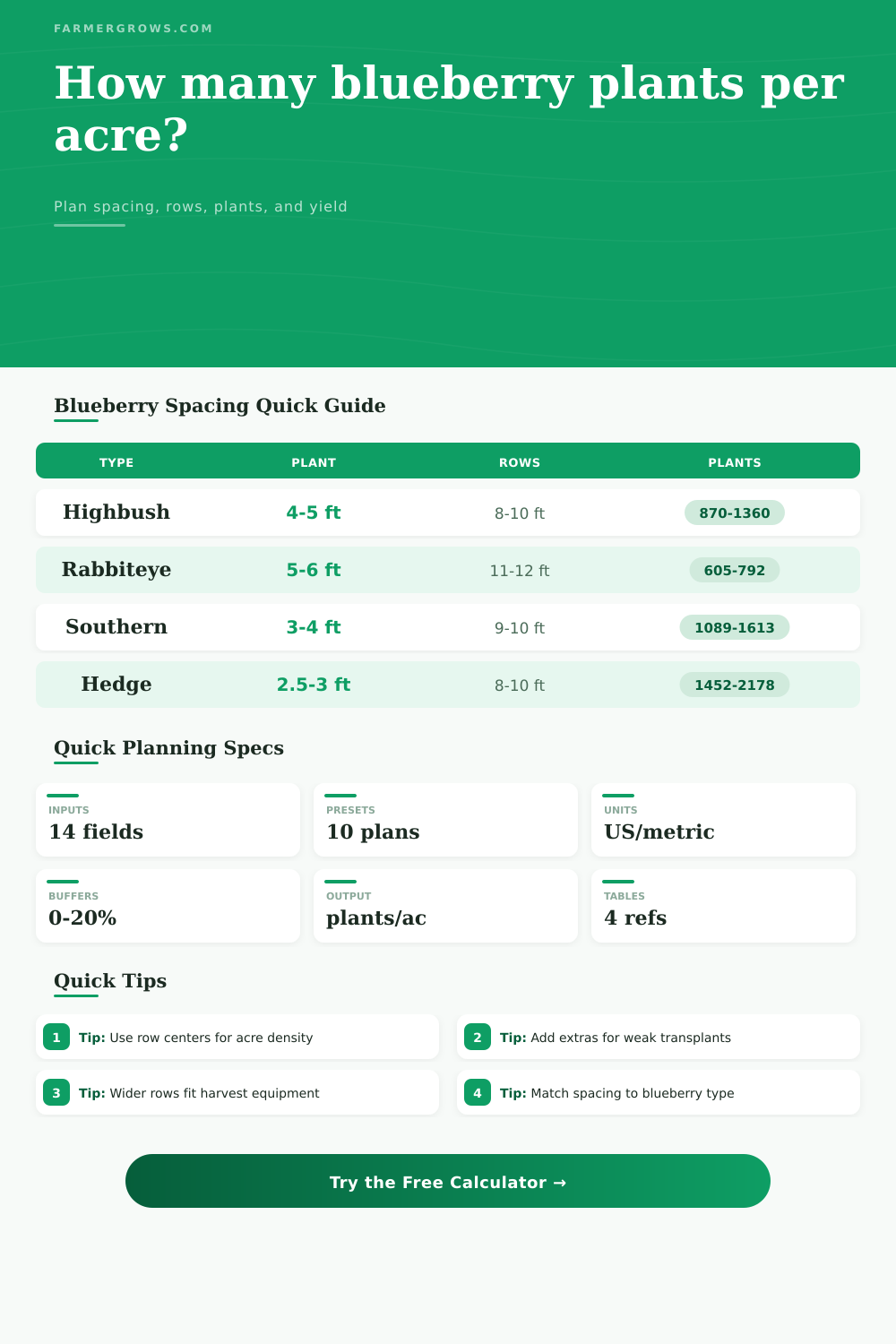
| Northern highbush fresh market | 4 to 5 ft | 8 to 10 ft | 871 to 1,361 | Balances hand harvest access, pruning, and mature canopy size |
| Southern highbush hedge | 3 to 4 ft | 9 to 10 ft | 1,089 to 1,613 | Tighter density fits smaller plants and fast hedgerow formation |
| Rabbiteye planting | 5 to 6 ft | 11 to 12 ft | 605 to 792 | Wider spacing suits vigorous plants and U-pick movement |
| Machine harvest highbush | 4 to 5 ft | 10 to 12 ft | 726 to 1,089 | Keep row centers compatible with harvester and sprayer width |
| Dense hedgerow trial | 2.5 to 3 ft | 8 to 10 ft | 1,452 to 2,178 | High density requires careful pruning, airflow, and fertility control |
| Spacing layout | Footprint per bush | Bushes per acre | Net acres for 1,000 plants | Typical fit |
|---|---|---|---|---|
| 4 ft x 8 ft | 32 sq ft | 1,361 | 0.73 acre | High-density hand harvest or compact cultivars |
| 4 ft x 10 ft | 40 sq ft | 1,089 | 0.92 acre | Southern highbush commercial hedgerow |
| 5 ft x 10 ft | 50 sq ft | 871 | 1.15 acres | Common highbush planning shortcut |
| 5 ft x 12 ft | 60 sq ft | 726 | 1.38 acres | Rabbiteye or machine-friendly row centers |
| 6 ft x 12 ft | 72 sq ft | 605 | 1.65 acres | Wide U-pick or vigorous rabbiteye bushes |
| Gross field scale | Square feet | Hectares | At 871/ac | At 1,361/ac |
|---|---|---|---|---|
| 0.10 acre | 4,356 | 0.040 ha | 87 plants | 136 plants |
| 0.25 acre | 10,890 | 0.101 ha | 218 plants | 340 plants |
| 0.50 acre | 21,780 | 0.202 ha | 436 plants | 681 plants |
| 1.00 acre | 43,560 | 0.405 ha | 871 plants | 1,361 plants |
| 2.00 acres | 87,120 | 0.809 ha | 1,742 plants | 2,722 plants |
| Planning factor | Conservative | Typical | High | How to use it |
|---|---|---|---|---|
| Usable planted area | 70% | 85% | 95% | Lower it for wide headlands, service roads, and irrigation headers |
| Establishment survival | 85% | 92% | 98% | Lower it for weak liners, drought stress, or difficult first-year care |
| Order buffer | 5% | 10% | 20% | Use extras for culls, misses, and early replacement plants |
| Row end loss | 3% | 5% | 12% | Accounts for turning gaps, odd edges, valves, and row breaks |
| Mature yield factor | 50% | 100% | 115% | Use lower values for young fields and higher values for strong sites |
For plant orders: Order quantity should cover the planned stations, expected survival, and a modest buffer. Replacement reserve is counted separately so it does not inflate plants per acre.
For row spacing: Do not copy a tight garden spacing into a commercial block unless pruning, sprayer access, harvest lanes, mulch rows, and mature canopy width still work.
Creating a plan for a blueberry field requires turning concepts into details. Sure, there’s taste and cost to consider; but there are also numbers: How many will grow in that area? How many will survive? Growers too frequently guess wrong, which is why plans goes wrong. The calculator does the survival and spacing math so you can concentrate on choosing varieties and growing soil. A fuzzy idea becomes a set list of markers and orders.
You have to know your net planted area. Netting a gross acre doesn’t help when half that acre is a service road or no good ground on the headland. 80-90% of most fields is actualy bush. The other 10-20% are left open for odd shaped ends, turn circles and irrigation. Because farming logistics often change, you can account for those shifts by adjusting the percentage of usable area. This way you don’t end up with extra plants and no place to put them.
Planning Your Blueberry Field
The question is always how to balance airflow with canopy size. The wider a row, it will be easier for sprayers to get around in there, and the greater the chances of letting some light down into lower branches (which helps prevent fungal diseases, a particular problem in damp weather). Tighter spacing puts more plants into ground (increasing yields), but means you have to prune harder. Tables of reference shows that going from 5 feet to 4 feet of spacing will give almost a half again as many plant per acre. More berries, yes, but also more daily work.
You must plan for the ones that don’t make it. Even with all this good prep work, no transplant is guaranteed to establish. Winter wreaks havoc on tips; birds dig them up. They dies. To plan for these losses, enter a survival percentage into the calculator, along with a buffer factor when ordering (to make up for those losses). Assuming you anticipate a 92 percent success rate, you’ll need to order a few more plants, ten to fifteen percent above what your final population will be. To provide a buffer to protect against holes in the hedgerow. Nothing is worse then a broken line, not aesthetically and not from a crop-management standpoint.
The field geometry shifts with machine harvesting. Alleys may be narrower in hand-picked fields than those destined for machines; people can be more flexible. Machines requires space for their wheels and heads. For machine-harvested fields, expect to expand the center-to-center distance between rows so that the machinery (plus a safety margin) fits through. Reducing plant density by increasing this distance is reflected in total number of row feet. At harvest time, fewer plants will get harvested on each acre; but it’s worth the sacrifice if your largest bottleneck is labor.
Calculate what it will yield. How much do you get back over time? Depending on your site quality and variety, a mature highbush may yield six to ten pounds of fruit from each plant. The calculator estimates this number per acre and shows you the cumulative effect in your whole field. This is useful for determining whether there’s enough demand at market to justify the investment. It also illustrates how a mature field differ from a young one. The early years are nothing like what the moddern model predicts. You would of had to plan for that ramp-up period in your cash flow.
Precision and patience are required to plant blueberries. This is just one moment, a snapshot of what your plan looks like on the screen. And then you go out into the field and walk it, and say does this feel right? The calculator provides the framework. You provide the judgment. If you get the spacing right in the beginning, life in the orchard becomes a series of manageable tasks, not fighting against poor geometry.