Beet Seed Viability Calculator
Estimate usable beet seed clusters from a germination test, seed age, storage, soil temperature, row length, target stand, and thinning buffer before you sow.
📋Beet sowing presets
Choose a real starting point for table beets, baby greens, storage roots, monogerm seed, pelleted seed, old packets, and tricky seedbeds.
🌿Seed lot and germination test
Beet seed is usually a dried multigerm fruit. Count seed balls or pellets in the test, then estimate viable planting stations and extra thinning work.
🌱Rows, stand, and seedbed conditions
Enter your row length, number of rows, final thinning target, and seedbed conditions. Soil temperature and crusting adjust lab viability into a field stand estimate.
Beet seed viability results
Calculated beet seed cluster plan appears here.
Calculation breakdown
📊Stand and thinning summary
⚖Comparison grid
Compare the current plan against common beet seed choices. Multigerm seed can need fewer viable clusters but more thinning; monogerm and pellets place more evenly.
📗Beet seed reference tables
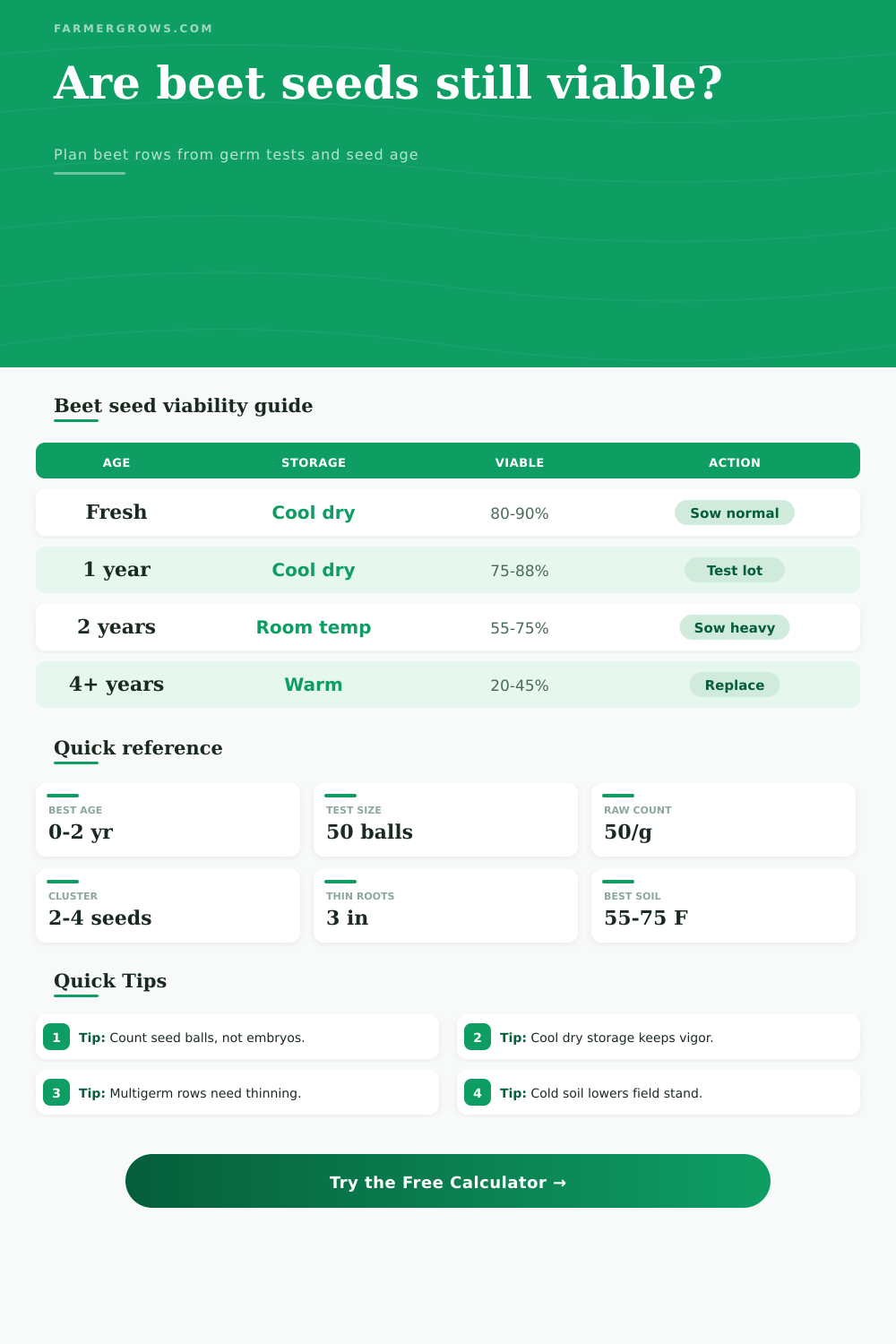
| Seed age | Cool dry | Room temp | Warm or humid |
|---|---|---|---|
| Fresh | 80-92% | 76-88% | 65-80% |
| 1 year | 75-90% | 68-84% | 55-72% |
| 2 years | 65-82% | 55-75% | 38-60% |
| 3 years | 48-70% | 35-58% | 20-42% |
| 4+ years | 25-55% | 15-42% | 5-28% |
| Seed type | Cluster count | Seedlings | Planning note |
|---|---|---|---|
| Multigerm raw | 40-70/g | 2-4 each | Thin every station |
| Monogerm raw | 45-75/g | 1 each | More precise spacing |
| Pelleted seed | 25-45/g | 1-2 each | Needs steady moisture |
| Baby greens | 45-80/g | 2-4 each | Sown much denser |
| Old mixed lot | Varies | Uneven | Test before sowing |
| Crop style | Thin to | Rows | Best use |
|---|---|---|---|
| Baby leaf greens | 0.5-1 in | 4-8 in | Cut young leaves |
| Baby beet roots | 1.5-2 in | 8-10 in | Small bunching roots |
| Round table beets | 3 in | 12-15 in | Main garden crop |
| Cylindra beets | 3-4 in | 12-18 in | Long uniform roots |
| Storage beets | 4-5 in | 15-18 in | Larger fall roots |
| Soil temp | Field factor | Risk | Action |
|---|---|---|---|
| 40-45°F | 0.55-0.70 | Cold delay | Use cover or wait |
| 50-55°F | 0.70-0.84 | Moderate | Keep evenly moist |
| 60-75°F | 0.86-0.95 | Low | Sow normal |
| 80-85°F | 0.70-0.84 | Drying | Water more often |
| Crusted clay | 0.45-0.65 | High | Soften top layer |
A beet seed ball can produce several seedlings. Good viability does not remove thinning; it often means you thin sooner and more carefully.
Cold soil, dry crust, or heavy rain after sowing can make a good germination test look worse in the field. Adjust the buffer before blaming the packet.
Calculator results are planning estimates for garden beet seed. Actual emergence changes with cultivar, seed lot, planting depth, irrigation, crusting, pests, and local soil temperature.
Plan according to the biology of beet seeds, lest you end up with bare spots in your vegetable-garden beds because the seeds won’t germinate. Because each one is actualy a cluster of embryos in a dried-out fruit, it has more complexity than most seeds (lettuce, say; even carrot seeds are simpler). And so you can’t simply toss them around and hope something comes up.
The online calculator at top will help you translate that strange thing into an actual garden-plot plan. It takes into account soil temperature, the strength of the germinating power, and certain amount of labor you’ll have to put in to thin things out later. Seed packets aren’t infinite supplies, but most of us act like they are until we finally exhaust them. The second they leave regulated storage, however, their viability diminishes. Humidity especially harms beet seeds’ vigor.
Plan Your Beet Planting
How many of those leftover cluster will yield a typical seedling? The device includes both average seed-decay rates (based off the storage conditions and age) and your personal germination-test findings. You might have used 50 clusters last weekend, and had 42 sprout; that’s your starting point for lab viability, but the field is hardly ever the same than the petri dish.
The hidden ingredient here is soil temperature. Though beets will grow happily in cool conditions, they does require steady warming to come up evenly. Metabolism slows too much in cold soil for them to push through the surface without rotting first. If you’re planting in soil still barely above freezing (or perhaps warmed a bit by spring sunshine), the calculator factors this into how many of your seeds it thinks will come up. It does so according to whether your soil might crust or not and how consistently moist it’s been. Moisture is another factor; clay soils can create a hard shell when wet, which traps tender little beet seedlings underneath, even if their roots are perfect down below. Fine mulching or row covers help prevent this, but the calculations must account for your soil type to accurately predict real-world results.
Most beet seeds are multigerm clusters that’ll throw two or three stems from each unit that lands on the ground, so plan for thinning from day one. Planting them too close in hopes that something might survive and produce seeds is useless: What emerges will all fight over the same limited nutrients, yielding stunted roots. The calculator considers your desired final spacing between plants and how much weight you should sow to reach your target number of plants per square foot. It leaves room for losses, since nature doesn’t always cooperate exactly as planned. It also adds a buffer for less-than-perfect soil contact, birds, and slugs. You don’t want to create a jungle; aim for just enough extra to cover holes, but not too many.
The math shifts dramatically depending upon whether you use pelleted seed or something called “multigerm” raw seed. Pellets has just one embryo per pellet. Multigerm has multiple embryos that must be thinned. They are easy to work with, so they requires less time-thinning effort but cost more money. If your objective is good spacing (and you should of had an idea what that means!), then raw seed is economical but demands accuracy at planting time. A few charts on the page show those contrasts well. How much raw seed would you need to get the same number of mature roots as pellets planted with such-and-such spacing? this-and-that? Are you willing to spend time with a pair of scissors later, or will you pay now?
Don’t assume all old seed is no good, but treat it with respect. A few-year-old packet stashed in a hot shed may have little chance of growing. You cannot bring dead tissue back to life with a calculator. But one that’s been kept cool and dry may yet go for you, if you do more sowing, perhaps, or sow thicker. Input the storage quality and age into tool. Will it tell you that you’re on a ghost hunt, or just that you need to sow more heavily? Don’t think your seed is bad and waste it. It may have just been planted too early or too late because of a missed germination window. This can happen due to late frosts or because you planted in wet ground.
Anxiety becomes action when you plan ahead. You’ll actualy be able to weigh your seed out instead of guessing, knowing confidently how heavy to make each drop. You’ll know exactly how many rows each packet covers and roughly how thick or thin they should be at thinning time. Knowing that makes all the difference in shifting your growing experience from reacting (scrambling!) to having intention: intentional gardening.
Knowing that those little hard balls you’re holding aren’t just single seeds but clusters, waiting to unfurl given the right conditions…that’s the difference between a bump crop and a patchy one.