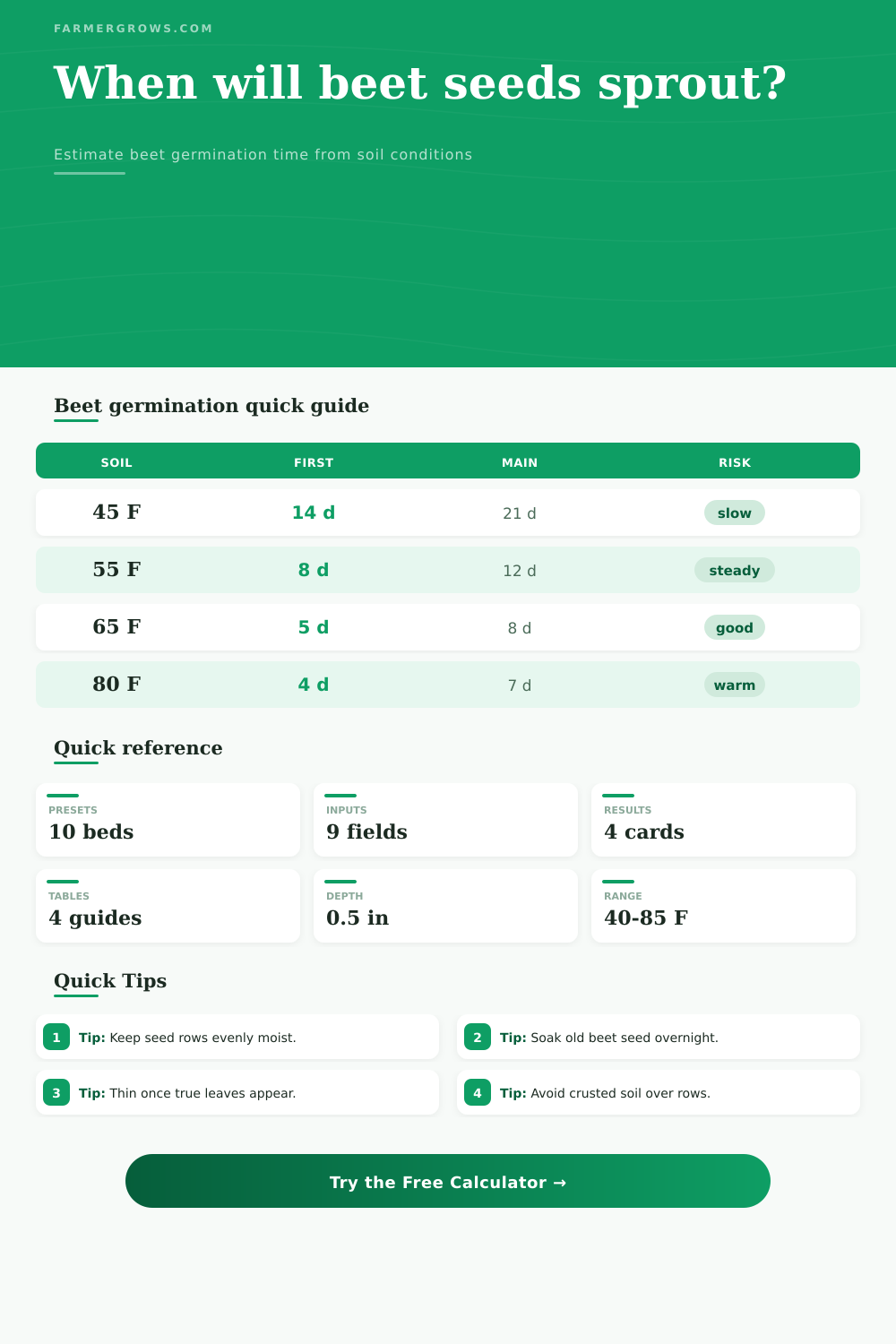
Beet Seed Germination Time Calculator
Estimate first sprouts, main emergence, thinning timing, and likely stand percentage from beet variety, soil temperature, moisture, planting depth, seed age, and row protection.
📋Beet sowing presets
Start with a common beet planting situation, then adjust the seed lot, soil temperature, depth, and seedbed conditions to match your bed.
🌱Germination inputs
Use soil temperature at beet seed depth, not afternoon air temperature. Beet seed clusters can sprout unevenly, so the main emergence window matters more than a single day.
Estimated beet emergence window
Calculated from the current seed row conditions.
Full beet germination breakdown
📊Scenario comparison grid
Compare the current seedbed with a cooler row, warmer row, and protected row. Use this to decide whether to wait, cover, or resow.
🧮Beet germination reference cards
📗Beet seed reference tables
| Soil temp | First sprouts | Main flush | Field note |
|---|---|---|---|
| 40°F / 4°C | 18-28 days | 25-35 days | Very slow; rot risk rises |
| 50°F / 10°C | 10-14 days | 14-21 days | Acceptable for early spring |
| 60°F / 16°C | 5-8 days | 8-12 days | Reliable garden sowing |
| 70°F / 21°C | 4-6 days | 6-9 days | Fast and even if moist |
| 85°F / 29°C | 5-8 days | 8-13 days | Watch drying and heat stress |
| Depth | Best use | Moisture need | Risk |
|---|---|---|---|
| 0.25 in | Trays, fine mix | Very steady | Surface drying |
| 0.5 in | Most garden beds | Evenly moist | Low |
| 0.75 in | Warm raised beds | Moist below surface | Slight delay |
| 1.0 in | Dry sandy rows | Deep watering | Weak emergence |
| Crusted | After heavy rain | Re-soften row | Trapped sprouts |
| Seed age | Typical stand | Delay | Action |
|---|---|---|---|
| Fresh | 80-90% | None | Thin clusters normally |
| 1 year | 75-88% | 0-1 day | Normal spacing |
| 2 years | 65-80% | 1-2 days | Sow slightly thicker |
| 3 years | 50-70% | 2-4 days | Run a germination test |
| 4+ years | 25-55% | 3-6 days | Use fresh backup seed |
| Situation | Check day | What to look for | Next step |
|---|---|---|---|
| Cold spring bed | 14-21 | Patchy rows | Wait if soil is cool |
| Ideal moist row | 7-10 | Even red stems | Thin at true leaves |
| Dry surface | 8-14 | Gaps in sunny spots | Water and shade lightly |
| Old seed | 14-18 | Thin stand | Overseed gaps |
| Tray start | 5-9 | Clustered seedlings | Keep lights close |
Beet seed clusters have a corky coat, so one watering at sowing is not enough. Keep the top half inch damp until most red stems are visible.
Most beet seed balls contain more than one embryo. A good stand can still need thinning once seedlings have their first true leaves.
Reference values are planning estimates for garden beets, chard-like beet greens, and common table beet seed lots. Local seed quality and soil crusting can shift emergence.
Sowing beets: Put those corky-seeded thing in the ground, then wait. Wait some more. Wait longer. And yet there’s no change. What? Why can’t I just make something grow alredy?
That’s why you’re anxious: Because the seed is underground where you can’t see what’s going on, when it’s most vulnerable. Is it drowning (mud)? Is a crust trapping them inside? Will anything ever happen, or is that a dead row? Input your own soil moisture and temperature, and let the calculator do math.
How to Grow Beets Successfully
It’s all about heat in the soil (not what’s happening up top). Cool-weather beets can takes a bit of cold weather (they even like it), but they still need a minimum amount of warmth to kickstart things. But they have a thermal floor, they won’t begin to do metabolic work if the soil an inch or two below them are still at around forty-five degrees F. There, the enzymes needed to break down their stored fuel does not realizes it is time to start working. They wait; the seed waits (though I suppose it could of survived the cold).
Most gardeners look out window at a sunny day with a high of sixty and sow confidently. However, the soil is still cold underneath. This is because the stubborn stuff we call clay holds on to winter chill. This disconnection kills us come early spring sowing time. Following the daily highs are pointless. Instead, the tool predicts your emergence date based off average conditions at ground level.
This gives you a range that tells you when to expect those first signs of red to poke through surface. When does a beet sprout? It all depends on how you manage water around this time frame. Their seed coat is thick and resists taking up moisture, but that’s not enough; sprouting won’t happen until the seed ball inside are fully soaked.
Once the outside has softened, though, you have only the next quarter-inch or so to go; if the top part dries off while the rest remains hard, the whole thing stops dead in its tracks. To keep things going, water gently and often instead of watering heavily and rarely to keep seed bed steadily moist. Letting it dry out will form a physical barrier that even a weakling shoot won’t be able to break through, resulting in odd bare spots along what was once a row of good, livig seed.
Before you sow to ensure a good crop, ask yourself: how old is that seed? Especially beet seeds (but also others) will lose strength gradualy. They may still work for a couple of seasons, or up to four years, through a slow but noticeable decline. Don’t assume an older seed won’t germinate at all. It’ll eventually, and then there’s no telling when, or which one.
What happens is that you get vigorous shoots here, nothing but bare ground a few inches away, or patches where some of every seed seems to have failed. That’s what makes thinning increasingly difficult with older seed, the odd-looking sections you’re trying to get along without, instead of evenly spaced, evenly vigorous rows. See the chart below for the stand percent by storage time.
The trick is to thin at the right time, in sync with how the seedling develops. This means you should thin them after the baby beets produces their first true leaves, the ones that are different than the original starting leaves. Do this before they grow so big and sturdy that the other plants around them begins to stop the roots from growing well.
Too-early thinning can damages tender young stems that haven’t yet taken hold. If you thin too late, competition causes the seedlings to struggle. This leads to less desirable results later on. The calendar gives you an idea of when to check if you need to thin, but only if the plants are ready.
The key to success with beets is to observe carefully without digging, wait patiently, and trust that the conditions below is right until they show signs otherwise. The secret’s to think moist but not sloppy, warm but not scalding, and resist temptation to turn over every empty-looking area to find a clue. Keep things going at the same pace, steady moisture and heat, and those stubborn seeds will work their way upward when the time is right. And reward your self-control with robust roots ready for the growing season.