Beeswax Conversion Calculator
Convert raw cappings, comb, clean blocks, pellets, and recipe blends into practical batch yield.
Beeswax Batch Results
Formula Breakdown
This comparison applies the same starting amount, loss, buffer, wax share, blend density, and unit size to several source types.
| Source Type | Clean Wax | Finished Blend | Units Filled |
|---|---|---|---|
| Fresh cappings | Calculate | Calculate | Calculate |
| Clean Wax Weight | Solid Volume | Hot Melted Volume | Kitchen Measure |
|---|---|---|---|
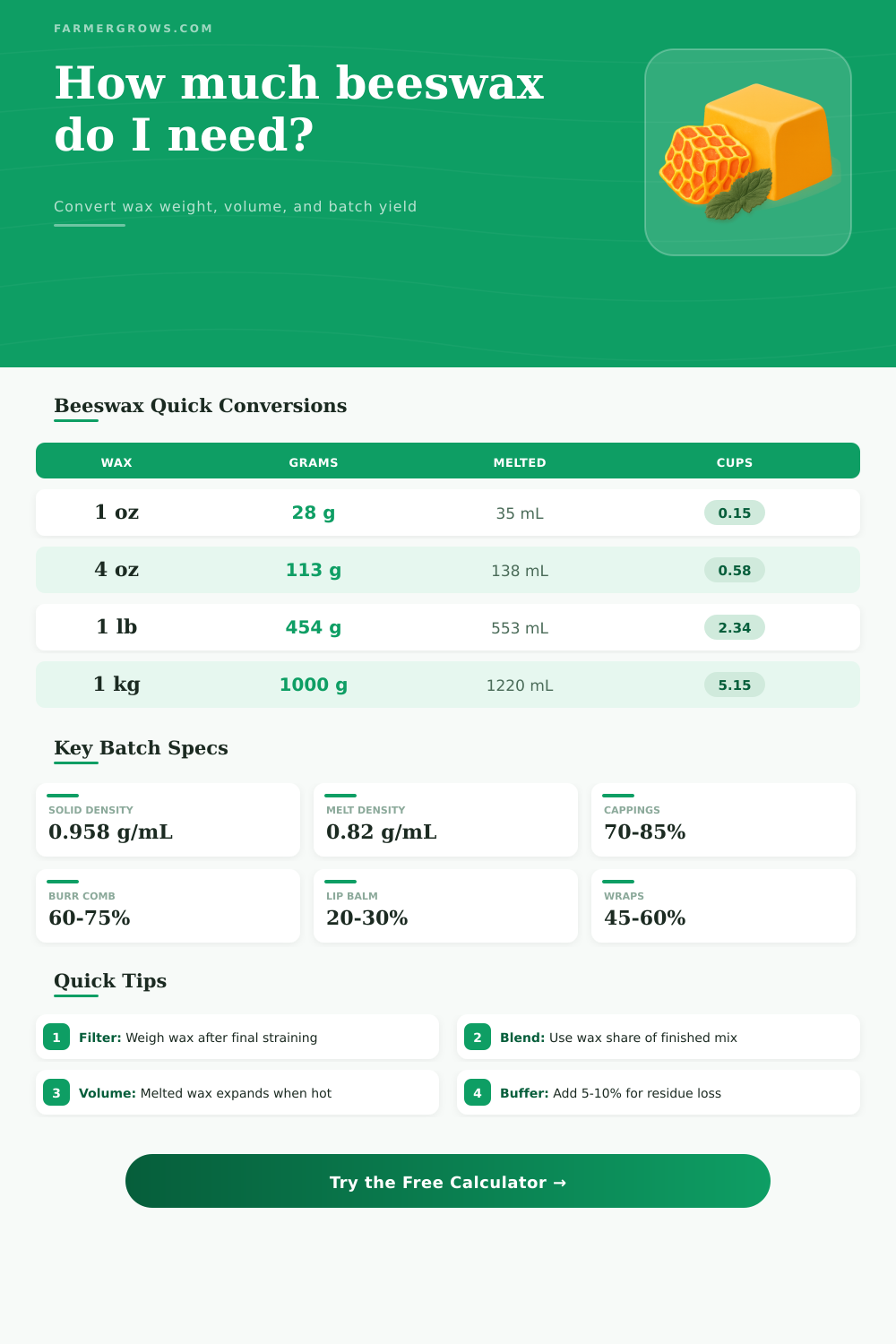
| 1 oz / 28.35 g | 29.6 mL | 34.6 mL | 0.15 cup / 1.17 fl oz |
| 4 oz / 113.4 g | 118.4 mL | 138.3 mL | 0.58 cup / 4.68 fl oz |
| 1 lb / 453.6 g | 473.5 mL | 553.2 mL | 2.34 cups / 18.7 fl oz |
| 1 kg / 1000 g | 1043.8 mL | 1219.5 mL | 5.15 cups / 41.2 fl oz |
| Wax Source | Typical Clean Wax Yield | Best Use | Calculation Note |
|---|---|---|---|
| Clean block or pellets | 100% | Direct recipes | Only account for melting residue. |
| Fresh cappings | 70% to 85% | Light wax, balm, wraps | Drain honey well before weighing. |
| Burr or bridge comb | 60% to 75% | Candles, polish, blocks | Expect propolis and debris loss. |
| Crush-and-strain comb | 45% to 60% | Rendered utility wax | Honey and pollen lower wax share. |
| Old dark comb | 20% to 35% | Outdoor candles, polish | Cocoons and slumgum raise waste. |
| Brood comb salvage | 12% to 25% | Non-cosmetic wax only | Use extra filtering and discard residue. |
| Finished Product | Beeswax Share | Typical Density | Blend Planning Note |
|---|---|---|---|
| Pure candles, blocks, pellets | 100% | 0.958 g/mL cooled wax | No oils are added to the finished mass. |
| Lip balm tubes | 20% to 30% | 0.90 to 0.94 g/mL | More wax gives a firmer pocket balm. |
| Herbal salve tins | 12% to 20% | 0.90 to 0.94 g/mL | Lower wax share keeps salve scoopable. |
| Food wrap coating | 45% to 60% | 0.92 to 0.97 g/mL | Resin and oil change tack and stiffness. |
| Board butter or polish | 25% to 35% | 0.88 to 0.93 g/mL | Commonly blended with mineral or plant oil. |
| Soap additive portion | 1% to 3% of oil weight | Use recipe total | This calculator sizes the wax portion only. |
| Container or Unit | Capacity | Pure Wax Equivalent | Useful For |
|---|---|---|---|
| Lip balm tube | 4.5 mL | 4.3 g | Use with 20% to 30% wax blends. |
| Small salve tin | 30 mL | 28.7 g | One ounce tins and pocket tins. |
| Medium tin or jar | 60 mL | 57.5 g | Two ounce salves, polish, and balms. |
| Four ounce candle tin | 118 mL | 113.0 g | Small container candles or polish jars. |
| Tea light cup | 15 mL | 14.4 g | Small pour tests and color trials. |
| Foundation sheet estimate | 73 mL | 70 g | Approximate medium brood sheet weight. |
Beeswax require careful measurement in part because the usable beeswax that comes from the source of the beeswax may not be the same amount as the raw beeswax. The raw beeswax often contain impurities that reduce the amount of usable beeswax that can come from those raw beeswax inputs. Additionally, the density of the beeswax change both when the beeswax is heated and when the beeswax cools.
Consequently, each individual that prepare beeswax must understand the relationship between raw beeswax, clean beeswax, and the final product that are to be made from the beeswax. The type of beeswax that is use can reduce the yield of the beeswax that can be prepared. For instance, fresh cappings contains honey and water, while old brood comb contains cocoon silk and slumgum.
How to Measure Beeswax for Products
Because old brood comb contain more impurities than fresh cappings, more clean beeswax will come from fresh cappings than from old brood comb. Consequently, you must select the type of beeswax source in the calculator to prepare the beeswax to receive the percentage of yield from that type of beeswax. If the user selects the incorrect type of beeswax, the yield percentage will be inaccuracy.
In addition to the type of beeswax that is rendered, there will also be loss in the filtering of the beeswax. Some beeswax may remain in the kettle after filtering the hot melted beeswax. Additionally, some beeswax may remain within the filter after the hot melted beeswax has been poured into the filter.
Both of these losses should of been accounted for in the calculator. A high percentage for filtering loss may be entered if messy comb is to be used, while a low percentage may be entered if clean beeswax pellets is to be used. Additionally, a percentage can be added to the filtering loss to account for the fact that the beeswax may be filter more than once.
The amount of clean beeswax that is available will impact the amount of product that can be made from that beeswax. For instance, if the beeswax that will be made is pure candles, the beeswax share will be 100% for each finished candle product. However, if the beeswax that will be made is lip balm products, the lip balm will contain both beeswax and oil.
The wax share of the product will need to be enter into the calculator. For instance, if the wax share for lip balm is changed from 25% to 30%, a different number of lip balm products can be made from the amount of beeswax that is available. Beeswax will also need to be consider in regard to the difference between the weight of the beeswax vs. The volume of the beeswax.
While beeswax is measured in weight in most instance, the volume of the beeswax is often poured into the products in which the beeswax will be utilized. When hot melted beeswax is poured into an container, hot melted beeswax have less density than cooled beeswax. Both hot melt volume and cooled solid volume will be provided by the calculator to account for these difference.
Furthermore, if a person pours hot melted beeswax into a container to the top of the container, the beeswax will sink to the bottom of the container after it is cooled. Another factor to consider in the preparation of beeswax is the composition of the beeswax. For instance, darker beeswax often contain more nonwax materials than lighter beeswax.
These non-wax materials can lead to the formation of cloudiness or grit in the beeswax that is prepared. If the beeswax is to be utilized in products that are applied to the skin, the beeswax should be cleanly to avoid the grit in the beeswax. Additionally, the addition of oil to the beeswax can alter the density and the firmness of the beeswax blend.
More wax will result in a firmer beeswax blend than a blend that contains less wax. The wax share can be adjusted to account for the actual beeswax that will be prepared. Factor in that a pound of fresh cappings will contain more beeswax than a pound of old brood comb.
However, the calculator will automate these type of calculations so that beekeepers dont ever again find themselves out of beeswax during their project. The calculator will account for all variable regarding beeswax yields, filtering losses, wax shares, and density, allowing the individual to focus upon rendering and blending the beeswax.