Beekeeping Sugar Syrup Calculator
Mix bee syrup by weight-based 1:1, 2:1, or custom concentration, then size the batch by gallons or liters, colony count, season, sugar type, and waste buffer.
Bee syrup ratios are normally mixed by weight. This calculator converts the final syrup volume into sugar weight, water weight, water volume, and practical cup estimates using sucrose solution density near room temperature.
Light syrup supports brood rearing and comb work when nectar is thin or weather blocks flight.
Small, frequent feeds help bridge dry spells while limiting the chance of excess storage.
Heavy syrup carries more sugar per gallon and takes less hive work to cure before cold nights.
Multi-colony batches benefit from a measured spill and transfer buffer so each hive gets its share.
Syrup Batch Results
Your sugar syrup mix will appear here.
Fresh water weight at common room-temperature calculator precision.
US liquid gallon conversion used for all volume switching.
Ingredient weights are calculated in metric first, then converted.
Typical white granulated sugar cup estimate for field measuring.
| Mix target | Sugar by weight | Water by weight | Approx density | Common beekeeping use |
|---|---|---|---|---|
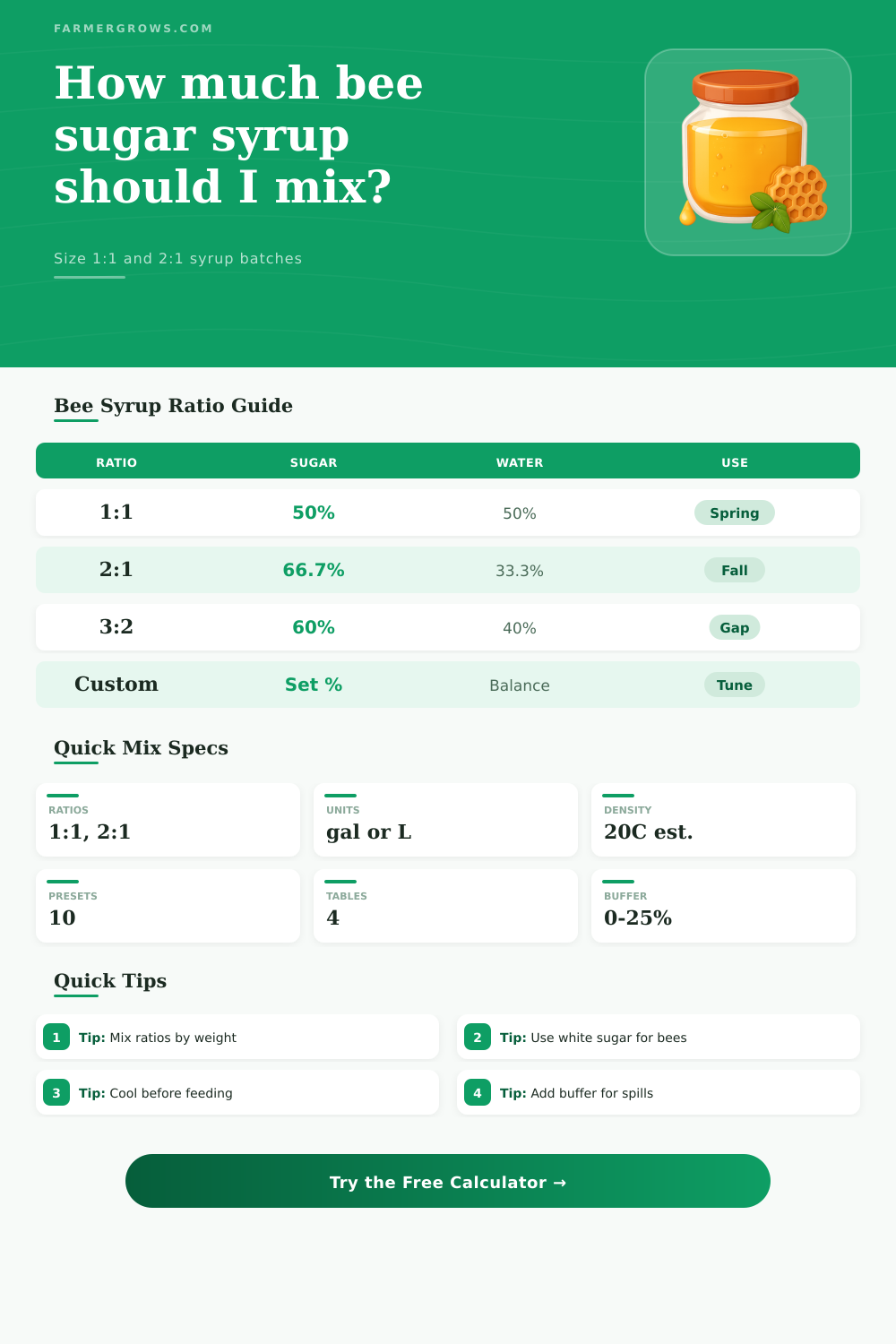
| 1:1 light syrup | 50.0% | 50.0% | 1.230 kg/L | Spring stimulation, packages, splits, and comb drawing. |
| 3:2 medium syrup | 60.0% | 40.0% | 1.286 kg/L | Short nectar gaps when a little heavier feed is useful. |
| 2:1 heavy syrup | 66.7% | 33.3% | 1.329 kg/L | Fall stores because each feeder volume carries more sugar. |
| Custom concentration | 35% to 72% | Balance | Interpolated | Used when matching a specific feeder plan or local practice. |
| Sugar type | Approx grams per cup | Best measuring method | Bee-feeding note |
|---|---|---|---|
| White granulated cane | 200 g | Scale preferred, cup estimate acceptable | Standard choice for most syrup feeding. |
| White beet sugar | 200 g | Scale preferred, cup estimate acceptable | Works like white cane sugar in syrup math. |
| Organic white cane | 190 g | Weigh for best accuracy | Use only refined white sugar for routine feeding. |
| Fine caster sugar | 225 g | Weigh or level cups carefully | Dissolves quickly but packs more per cup. |
| Raw turbinado | 180 g | Weigh only | Short-term emergency use only; not a winter default. |
| Season or goal | Common ratio | Typical per-colony feed | Batch rhythm | Main calculator check |
|---|---|---|---|---|
| Spring buildup | 1:1 | 0.5 to 1 gal | Small repeat feeds | Avoid making more than colonies can take promptly. |
| Package or split install | 1:1 | 1 to 2 gal | Refill as accepted | Check colony coverage before mixing large batches. |
| Comb drawing | 1:1 | 1 to 3 gal | Steady access | Match feed to equipment and drawn comb target. |
| Nectar dearth gap | 1:1 or 3:2 | 0.5 to 1 gal | Short controlled feed | Keep buffer modest to limit leftover syrup. |
| Fall winter stores | 2:1 | 2 to 5 gal | Heavier batches | Use concentration and colony count to size sugar weight. |
| Colony group | Spring 1:1 at 1 gal each | Comb draw 1:1 at 2 gal each | Fall 2:1 at 3 gal each | Suggested buffer |
|---|---|---|---|---|
| 1 colony | 1 gal syrup | 2 gal syrup | 3 gal syrup | 5% |
| 2 colonies | 2 gal syrup | 4 gal syrup | 6 gal syrup | 5% to 10% |
| 5 colonies | 5 gal syrup | 10 gal syrup | 15 gal syrup | 10% |
| 10 colonies | 10 gal syrup | 20 gal syrup | 30 gal syrup | 10% to 15% |
| 25 colonies | 25 gal syrup | 50 gal syrup | 75 gal syrup | 15% to 20% |
| Feeder or container | Usable syrup volume | 1:1 sugar estimate | 2:1 sugar estimate | Best use |
|---|---|---|---|---|
| Quart jar | 0.25 gal / 0.95 L | 2.3 lb sugar | 3.0 lb sugar | Nucs, queen work, short checks. |
| Half-gallon jar | 0.5 gal / 1.89 L | 5.1 lb sugar | 6.7 lb sugar | Small spring refills. |
| One-gallon feeder | 1 gal / 3.79 L | 10.3 lb sugar | 13.4 lb sugar | Single hive feeding rounds. |
| Five-gallon pail | 5 gal / 18.93 L | 51.3 lb sugar | 67.1 lb sugar | Outyard mixing or fall feeding. |
Measure by weight when you can. A 1:1 syrup is equal sugar and water by weight, not equal dry cups and liquid cups. Cup estimates are included for convenience, but a scale keeps concentration steady.
Use the buffer as a field allowance. A small buffer covers drips, pail residue, and feeder transfer loss. For late feeding, keep records so every colony receives the intended finished syrup volume.
Beekeepers must provide sugar water to the bee colony if there is no available natural nectar in the environment. Bee colonies need sugar water as it provide the energy required for the survival of the bee colony. The ratio of sugar to water in the sugar water is another important factor to consider as different ratio of sugar water can affect the ability of the bees to process the sugar water.
If beekeepers use the wrong ratio of sugar to water in the sugar water that they provide to the bee colonies, the bee colonies may not have enough food to sustain them, or their bodies may work more hard to process the sugar water from the sugar water feed that is provided to them. Light syrup is an type of sugar water that contains equal parts of sugar and water by weight. This type of sugar water is mostly used in the spring to aid in the build-up of the bee colony.
How to Mix and Measure Sugar Water for Bees
Heavy syrup is a type of sugar water that contains two parts of sugar to one part of water. Beekeepers use this type of sugar water in the fall to aid in the preparation of the bee colonies for the winter months. The heavy syrup contains more energy per gallon of liquid than light syrup, and it requires less curing of the sugar water by the bee colonies before the winter months.
If a beekeeper decides to feed many bee colonies with sugar water at once, the beekeeper must calculate the amount of sugar and water that will be required to feed all of the bee colonies at once. Calculating the amount of sugar and water is difficult because if a beekeeper makes a small error when measuring the amount of sugar or the amount of water, that small error will significantly impact the total amount of sugar water that will be available to the bee colonies. A calculator will assist the beekeeper in determining the weights of both the sugar and water that will be required to feed the bee colonies.
The calculator will require the beekeeper to enter information regarding the target volume of the sugar water, the ratio of sugar to water in the sugar water, the number of bee colonies that will be fed with the sugar water, and the percentage of sugar water that will be lost to waste in the feeding process. Based on this information, the beekeeper will weigh the sugar and water, the volume of the water will be measured, and the coverage check will be performed to ensure that the batch of sugar water that will be prepared is sufficient for the bee colonies that will be fed with the sugar water. Many people will begin the process of calculating the amount of sugar water that will be required by selecting a season for the sugar water in the calculator.
Spring months will have a lighter ratio of sugar water compared to the fall months when bees will be preparing for winter. The number of bee colonies and the rate at which each bee colony will be fed will help determine if the batch of sugar water that is prepared is sufficient for all of the bee colonies in the apiary. If the coverage check indicates that the batch of sugar water will be too low to effectively feed all of the bee colonies in the apiary, then the beekeeper can change the target volume of sugar water or the number of bee colonies to reflect the coverage check’s determination.
It is important to remember that the calculations are based off the weight of the sugar and water rather than the volume of the sugar and water. Because a cup of sugar will weigh differently from a cup of water, the density of the sugar water will change with the ratio of sugar to water. The calculator takes into account the difference in the density of sugar water by different ratios of sugar to water.
The calculator also allows the beekeeper to select whether the target volume of the sugar water is to be in gallons or in liters. The type of sugar that will be used in the sugar water is another input in the calculator. While the weights of the sugar can be used to measure the sugar, different types of sugar may contain different volumes in a cup of that type of sugar.
Therefore, it is better to weigh the sugar rather than measure the sugar by volume. In addition, it is important to include a buffer percentage for the amount of sugar water that might be lost in the feeding process to ensure that there is enough sugar water to feed all of the bee colonies. The reference tables within the calculator will include information regarding the ratio of sugar to water for the sugar water and the use of each ratio.
The tables will also indicate the size of the feeder to the weight of the sugar water. The colony batch grid can help the beekeeper to determine how much sugar water will be produced based on the number of bee colonies that will be fed. Based on this information, the beekeeper will be able to decide whether the sugar water batches will be prepared in large batch amounts or in smaller batch amounts.
In order to prepare the sugar water that will be used to feed the bee colonies with energy, the beekeeper should heat approximately half of the water that will be used for the sugar water. The sugar will then be added to the water while it is being stir. The remaining water will then be added to the mixture.
The sugar water will then be allowed to cool to the desired temperature before moving it to the bee colonies’ hives. Allowing the sugar water to cool before moving it to the hives ensures that the sugar water is not too hot for the bee colonies and will not warp the feeder that will be used to dispense the sugar water to the bee colonies. Some of the mistakes that may occur with preparing sugar water include treating the volume of the sugar water as if it is the same as the weight of the sugar water.
Using a measuring cup to measure the sugar is one mistake that can be made; the sugar should be weighed to ensure that the proper amount of sugar water is prepared. Not using the coverage check before dispensing the sugar water to the bee colonies is another mistake. If the coverage check is not used, the beekeeper may find themself without enough sugar water to feed all of the bee colonies in the apiary.
By using the sugar water calculator, beekeepers can ensure that the sugar water that is prepared for the bee colonies will remain consistent with the seasons in which it is prepared. Whether feeding the colonies for spring, summer, or fall, the beekeeper can use the same method to prepare the sugar water for the colonies. The calculator will perform the mathematics in the preparation of the sugar water, but the beekeeper will make the final decisions for the ratio of sugar water, the number of bee colonies that will be fed, and the waste buffer for the feeding process.
By using these steps in the preparation of the sugar water, the beekeeper can transform the process of feeding sugar water to the bee colonies into a process that can be performed consistent and effectively to manage the bee colonies.