Bedding Sand Calculator
Estimate bedding sand volume, loose allowance, bulk weight, and bag counts for livestock stalls, kennel runs, paver beds, pipe trenches, play areas, and yard leveling.
Sand weight changes with moisture, gradation, and compaction. This calculator uses common bulk density ranges and accurate volume conversions so you can size the order before checking site specifications.
Bedding Sand Estimate
Results include finished bed volume, loose ordering allowance, bulk weight range, and practical bag counts.
| Finished depth | 1 cubic yard covers | Metric coverage | Common use |
|---|---|---|---|
| 1 in | 324 sq ft | 30.1 m² | Screeded paver bedding over compacted base |
| 2 in | 162 sq ft | 15.1 m² | Livestock stall refresh, kennel touch-up |
| 3 in | 108 sq ft | 10.0 m² | General bedding layer or greenhouse floor |
| 4 in | 81 sq ft | 7.5 m² | Fresh animal bedding or pipe embedment base |
| 6 in | 54 sq ft | 5.0 m² | Play sand, pipe bedding, deeper soft footing |
| 8 in | 40.5 sq ft | 3.8 m² | Deep play fill or loose exercise area |
| Sand type | Bulk density used | Approx kg/m³ | Best-fit use |
|---|---|---|---|
| Washed bedding sand | 2,900 lb/yd³ | 1,721 kg/m³ | Horse stalls, freestalls, kennels, dairy lanes |
| Coarse damp bedding sand | 3,200 lb/yd³ | 1,899 kg/m³ | High-drainage beds where moisture is expected |
| Mason or play sand | 2,600 lb/yd³ | 1,543 kg/m³ | Play areas, fine leveling, softer surface work |
| Paver bedding sand | 3,000 lb/yd³ | 1,780 kg/m³ | One inch bedding layer under concrete pavers |
| Pipe bedding sand | 2,800 lb/yd³ | 1,662 kg/m³ | Utility trenches and pipe support zones |
| Compacted damp sand | 3,400 lb/yd³ | 2,018 kg/m³ | Compacted pads and dense backfill estimates |
| Project type | Typical finished depth | Compaction allowance | Waste or grading buffer | Field note |
|---|---|---|---|---|
| Horse stall or kennel refresh | 2 to 3 in | 0% to 5% | 5% to 10% | Leave loose unless you intentionally tamp the surface |
| New livestock bedding layer | 3 to 4 in | 5% to 10% | 8% to 12% | Allow for raking, edge loss, and low spots |
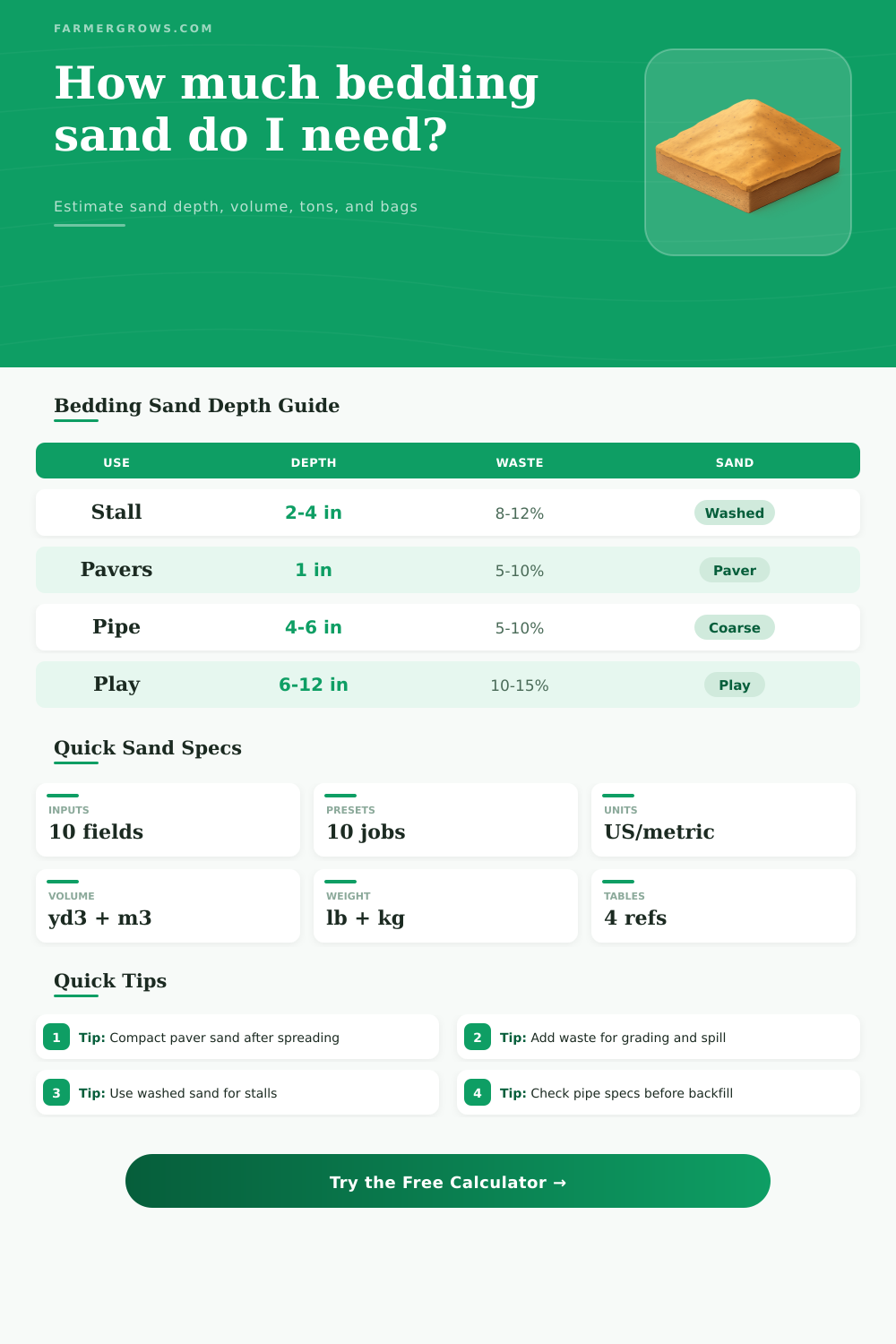
| Paver bedding course | 1 in after screed | 10% to 15% | 5% to 10% | Do not use bedding sand to fix an uneven base |
| Pipe bedding and surround | 4 to 6 in base | 5% to 10% | 5% to 10% | Follow pipe, soil, and local utility specifications |
| Play area or yard leveling | 2 to 8 in | 5% to 10% | 10% to 20% | Irregular edges usually need the largest buffer |
| Example project | Area | Depth | Loose volume with 10% | Approx 0.5 cu ft bags |
|---|---|---|---|---|
| 10 x 12 stall refresh | 120 sq ft | 2 in | 0.81 yd³ | 44 bags |
| 8 x 24 kennel run | 192 sq ft | 3 in | 1.96 yd³ | 106 bags |
| 12 x 16 paver patio | 192 sq ft | 1 in | 0.65 yd³ | 36 bags |
| 100 ft x 1.5 ft trench | 150 sq ft | 6 in | 3.06 yd³ | 165 bags |
| 15 x 15 play area | 225 sq ft | 6 in | 4.58 yd³ | 248 bags |
For animal bedding: Measure the actual low area after scraping manure or old bedding. A 2 inch refresh on a flat stall can become 3 inches quickly when corners and worn spots are included.
For pavers and pipe bedding: Treat the calculator as a volume takeoff, then follow the project specification for final sand gradation, compacted lift thickness, and inspection requirements.
Calculating an correct amount of bedding sand is a necessary step in any project that involve the use of this type of material. Calculating the correct amount of bedding sand will prevent either running out of the material that is necessary to complete the project, or ordering too much of that material. To calculate the amount of sand that is necessary for a project, it is first necessary to account for the area that will be covered in sand, the depth that the sand should be poured, and how the sand will compress over time.
Sand tend to compact when weight is applied to the sand, whether the weight of the use of the sand in some project, or the weight of the equipment that compacts the sand. Thus, the depth from which the sand is poured will be more deeper than the depth to which the sand will compact and settle. Factors that the calculator must consider to account for this potential compaction are the inclusion of a factor that ensures that the depth of the sand when it is compacted will still meet the depth requirement of the project.
How Much Bedding Sand Do I Need
If the calculator calculates the depth of the sand based on the finished depth of the sand only, the sand will be too thin after it is compacted. Thus, a percentage for compaction should be added to the calculation to ensure that the amount of sand ordered will result in the depth requirement for the project. Because different types of sand has different weights, the weight of the bedding sand that is ordered will also change.
For instance, people often use washed bedding sand in projects related to livestock. Paver sand is another type of sand that is denser than washed bedding sand. Pipe bedding sand has a different density than both washed bedding sand and paver sand.
Thus, a selection of the type of sand to be used within the calculator is necessary to provide an accurate calculation of the weight of the sand that should be ordered. In addition to the parameters related to compaction, it is also necessary to account for the waste that will occur when the sand is being installed into the project area. Waste of the sand occur both from the raking of sand that may fall off the edges of the area to be covered in sand, as well as from the use of some of the sand to fill low spot within the ground.
The amount of waste that will occur is often less for projects like horse stalls than for areas used for play by children or other individuals. Thus, the inclusion of a percentage within the calculation that allows for this waste is another necessary component of the calculator, as it ensures that there will be enough sand to complete the project. In addition to calculating the amount of bedding sand necessary for the project, the calculator also allow for the measurements of the sand to be converted from imperial units to metric units, or vice versa.
Furthermore, the calculator can help to determine whether the bedding sand should be ordered in bag or in bulk. Bags may be used for small projects, while bulk sand is often better for large projects due to the efficiency with which bulk sand can be delivered. The weight of the sand also change with the amount of moisture that is contained within the sand.
Damp sand weigh more than dry sand, and the sand is often delivered in this damp state from the sand suppliers that store the sand outside. Thus, the weight of the sand will range within the calculator to reflect these different weight. This weight can help to determine the weight of the sand that will be delivered to the project, and whether the vehicle can handle that weight or if multiple deliveries will be required.
By using the calculator, it is possible to determine the amount of bedding sand that should be ordered in loose cubic yard, in tonnage, and in bags. By measuring the length and the width of the area to be covered by the sand, by selecting the depth requirement for the sand, and by accounting for compaction and waste, an individual will know the correct amount of bedding sand to order for they project.