Basil Seed Germination Time Calculator
Estimate when basil seeds should sprout, when to thin cell trays, and when seedlings are ready to transplant based on warm soil, variety type, light cover, media, and humidity dome conditions.
🌱Basil tray presets
⚙Seed starting conditions
Basil germination estimate
Formula uses variety baseline days, measured soil temperature, cover depth, starter media, humidity, moisture, seed age, and tray format.
📊Basil variety, temperature, and media grid
🌡Soil temperature reference
| Seed mix temperature | Expected basil response | Typical sprout window | Tray action |
|---|---|---|---|
| Below 60°F / 16°C | Unreliable and slow | Often 14+ days or failure | Warm the tray before resowing. |
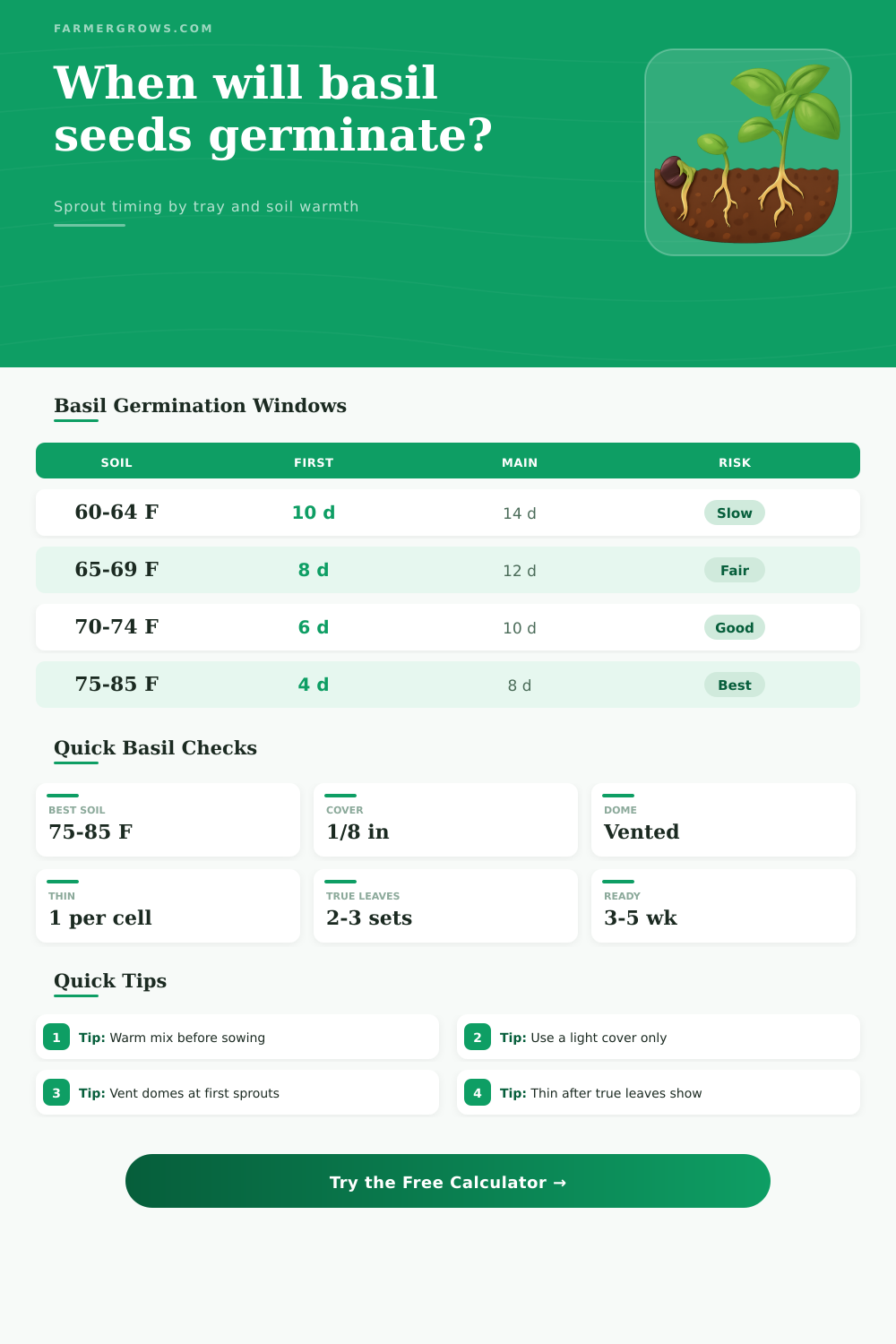
| 60-64°F / 16-18°C | Slow basil emergence | 10-14 days | Use bottom heat and keep mix even. |
| 65-69°F / 18-21°C | Fair germination | 8-12 days | Keep the dome vented and avoid chilling at night. |
| 70-74°F / 21-23°C | Good germination | 6-10 days | Check daily after day 5. |
| 75-85°F / 24-29°C | Best basil range | 4-8 days | Remove or vent dome as sprouts appear. |
| 86-90°F / 30-32°C | Fast but drier surface | 5-9 days | Watch moisture and vent excess heat. |
| Above 90°F / 32°C | Heat stress risk | Uneven, 8+ days | Move off hot mats or sunny covers. |
🌿Basil variety timing reference
| Basil variety type | Warm-tray baseline | Growth habit | Planning note |
|---|---|---|---|
| Genovese basil | 5-8 days | Classic large-leaf culinary type | Usually one of the most even tray performers. |
| Sweet basil | 6-9 days | Broad green leaves | Use as the standard timing comparison. |
| Thai basil | 6-10 days | Purple stems, firmer seedlings | Often benefits from very steady warmth. |
| Lemon or lime basil | 6-10 days | Fine leaves, citrus scent | Thin gently because seedlings can be delicate. |
| Purple Opal basil | 7-12 days | Purple foliage selection | Expect a slightly wider emergence window. |
| Holy basil / tulsi | 7-12 days | Branchy medicinal basil | Give extra warmth before judging old seed. |
| Cinnamon basil | 6-11 days | Tall, aromatic stems | Move to bright light quickly after germination. |
| Lettuce Leaf basil | 6-10 days | Large, puckered leaves | Use larger cells if holding seedlings longer. |
| Greek dwarf basil | 6-9 days | Compact small-leaf mounds | Works well in plug trays and small pots. |
🧪Media, cover, and humidity reference
| Starter condition | Good basil target | Timing effect | Risk to watch |
|---|---|---|---|
| Fine sterile seed mix | Small particle, pre-moistened | Baseline timing | Can crust if allowed to dry. |
| Coco coir and perlite | Even moisture with air space | Add about 0-1 day | Low nutrients after germination. |
| Compost-heavy mix | Screened, not clumpy | Add about 2 days | Fungus gnats and damping-off. |
| Light 1/8 inch cover | 3 mm of fine mix or vermiculite | Best balance | Too much cover slows emergence. |
| Vented humidity dome | Moist air until first sprouts | Baseline timing | Remove once seedlings stand up. |
| Sealed wet dome | Heavy condensation | May add 1-2 days | Damping-off and algae on the surface. |
📋Cell tray thinning and transplant reference
| Tray format | Thin to | Transplant readiness after emergence | Best use |
|---|---|---|---|
| 128-cell plug tray | 1 plant per cell | 14-21 days | Fast greenhouse turnover or potting on. |
| 72-cell seed tray | 1 plant per cell | 21-28 days | Standard home basil starts. |
| 50-cell deep tray | 1 strong plant per cell | 28-35 days | Holding basil longer before planting out. |
| 1.5 inch soil blocks | 1 plant per block | 21-30 days | Air-pruned starts with less root disturbance. |
| Open flat | Prick out at first true leaves | Pot on after 10-14 days | Dense sowing when final cell count is flexible. |
| 2.5 inch nursery pots | 1-2 plants per pot | 30-42 days | Retail starts or larger kitchen herb pots. |
💡Basil seed-starting tips
Warm soil: Basil reacts more to seed mix temperature than room temperature. A thermostat mat set near 78°F usually shortens the sprout window without cooking the tray.
Thin and vent: Keep a humidity dome only until the first hooks appear, then vent or remove it and thin crowded cells after the first true leaves open.
Germinating basil seed are an art form; it’s got a unique set of requirements that don’t apply to most garden varieties (tomatoes, for instance). It won’t germinate well if you throw it into the ground and hope for the best.
Most people fail because their soil isn’t warmed up sufficiently. Basil seeds wants heat down in the soil, not just out in the air around the soil. Measuring the actual soil temperature can make all the difference between success and failure. Don’t trust the living room thermometer; check the dirt.
How to Grow Basil Seeds Successfully
In other words: Most home gardeners base their estimate on ambient air temperature. A warm house doesn’t mean warm soil (particularly if the tray’s positioned beside a drafty window or on a cold floor). Raising the temperature of all that dirt take energy (and the seed mix itself is an insulator). This is precisely why bottom heat make such a big difference. With a heating mat set to a consistent range, there’s no guessing involved.
Your job is simply to measure soil temperature and enter that number in calculator up top. You’re giving the algorithm its single-most-important variable in predicting emergence. If your mix is sitting at eighty degrees, or at sixty, the baseline days gets adjusted accordingly. A mere temperature difference of that size changes the wait more then almost a week. When you’re staring at a potted-up mass of sodden soil, that feels like a long time.
Another frequent mistake is cover depth. Those basil seeds are fine as dust; tiny, basically, and if you bury them more than a quarter inch deep in compost, they may not emerge at all. A fraction of an inch of a very fine mix (or a light sprinkling of vermiculite) will anchor them while keeping them nice and moist. The tool takes that into account by penalizing heavier cover with a longer time to germinate. Makes sense physically, too, since the little seedling has to expend some energy pushing through extra soil before it can access light.
Variety also plays into timing. Medicinal Holy Basil (above) and ornamentals such as Purple Opal tend to be trickier than standard Genovese types which sprout reasonably consistently. Sometimes they have just a bit longer baseline time to emerge. When sowing multiple type in one tray, you may experience some uneven germination. Not a reflection of how you did it but simply genetics at work. Knowing that will keep you from giving up on good seeds too soon. You might also drench a tray thinking something went wrong when it is simply slow.
Remember: For best health, always thin your plants. If you sow multiple seeds in each cell (two or three are good), at least one will survive. If you let them all fight it out, they’ll be weak and struggle after. The calculator estimates your thinning time. It connects it not with an arbitrary calendar day, but with a visible sign: the appearance of true leaves instead of just counting days. When you see those, you know the plant has settled into its growing spot and can cope with a little transplant jostling.
And that’s where humidity comes into play. The sealed dome retains moisture, but it also traps heat which encourages fungal issues if left on to long. Venting your dome as soon as you see sprouts bridges this little gap from germination to growth, and sets the tone for the rest of the plant’s life.
Bottom line: Growing basil starts out as a game of expectation management… Of yourself (and your growing conditions). It’s about coaxing life out of nothing, which means being patient while really paying attention. When you get the variety, the seed depth and the soil temperature into sync, then you know what to expect. And then the seeds will crack once conditions are right. Just give them the invite, the consistent moistening of warm soil (and they’ll accept).