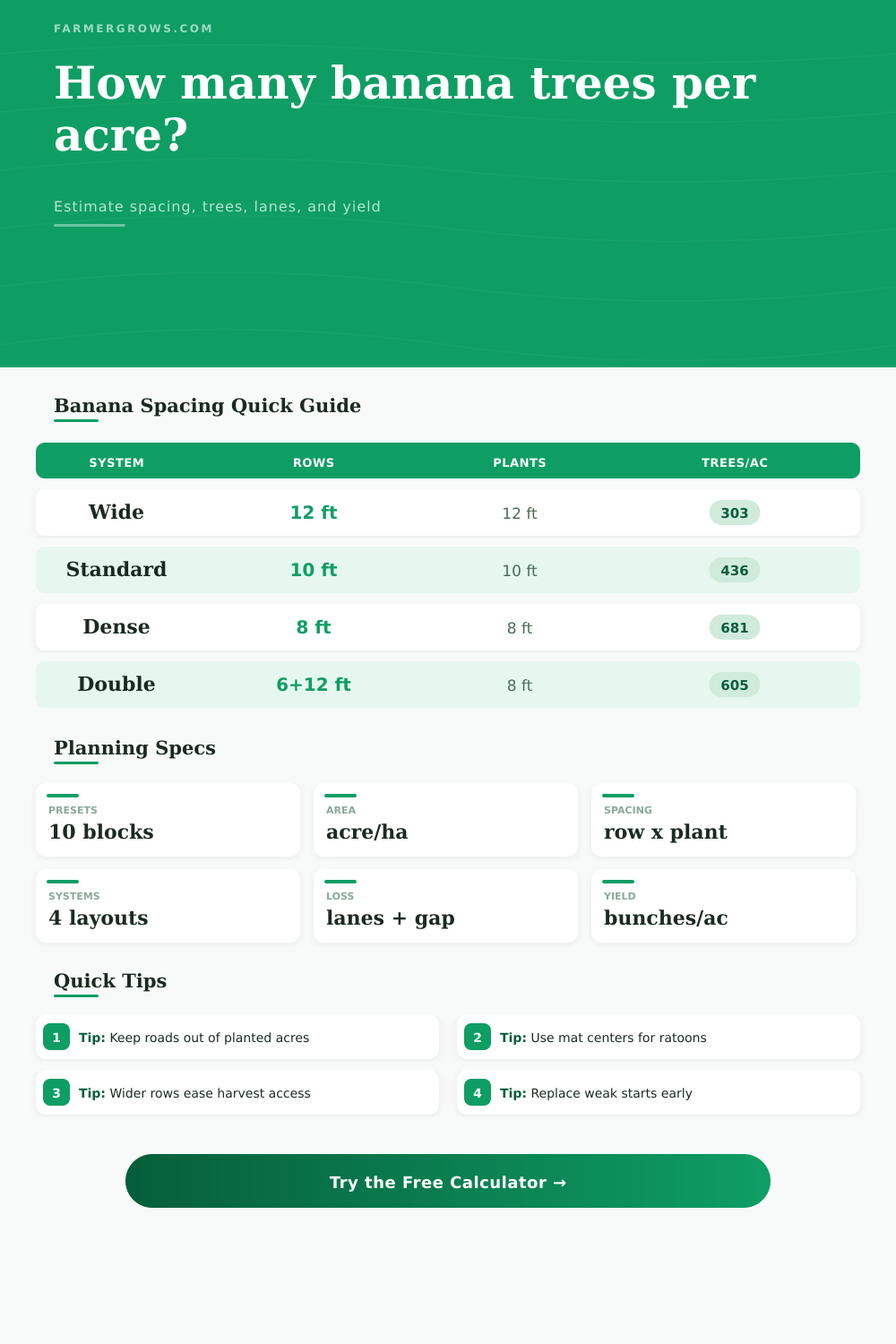
Banana Trees Per Acre Calculator
Estimate banana trees per acre from planted area, row pattern, in-row spacing, double-row alleys, headlands, access lanes, stand survival, replacements, and bunch yield.
Choose a starting layout, then adjust spacing, variety vigor, access space, survival, replacement allowance, and expected bunch weight for the block you are planning.
Banana Planting Results
Spacing and field layout results will appear here.
| Spacing pattern | Area per plant | Gross trees per acre | Best use |
|---|---|---|---|
| 12 ft x 12 ft square | 144 sq ft | 303 trees/ac | Tall cultivars, plantains, windy sites, and wider tractor access. |
| 10 ft x 10 ft square | 100 sq ft | 436 trees/ac | Balanced density for dessert bananas with moderate canopy vigor. |
| 9 ft x 9 ft rectangle | 81 sq ft | 538 trees/ac | Medium-high density where irrigation, fertility, and leaf pruning are managed. |
| 8 ft x 8 ft square | 64 sq ft | 681 trees/ac | Dwarf bananas or short-cycle intensive systems with close management. |
| 10 ft triangular | 86.6 sq ft | 503 trees/ac | Staggered rows that raise plant count while keeping similar center distance. |
| 6 ft pair plus 12 ft alley, 8 ft plant | 72 sq ft | 605 trees/ac | Double-row blocks that keep harvest and spray lanes open. |
| Banana type | Typical spacing | Gross trees per acre | Management note |
|---|---|---|---|
| Dwarf dessert banana | 8 to 9 ft centers | 538 to 681 trees/ac | Needs nutrient and sucker management so the canopy does not close too early. |
| Cavendish or Williams | 9 to 11 ft centers | 360 to 538 trees/ac | Often planted around 10 ft centers, then adjusted for equipment and climate. |
| Plantain or cooking banana | 10 to 12 ft centers | 303 to 436 trees/ac | Wider spacing supports larger mats, propping, and bunch access. |
| Tall vigorous banana | 11 to 14 ft centers | 222 to 360 trees/ac | More air movement and light reduce crowding in humid or storm-prone areas. |
| Temporary fill planting | 6 to 8 ft centers | 681 to 1210 trees/ac | Use only when extra plants will be thinned or sold before crowding begins. |
| Layout adjustment | Approximate land removed | Planting effect | When to use it |
|---|---|---|---|
| 5% headland margin | 5% of block | 436 becomes 414 trees/ac at 10 x 10 ft | Small paths, irrigation features, and narrow turn space. |
| 8 ft lane every 10 rows | About 7% to 9% | Better harvest movement with fewer rows planted. | Blocks using carts, sprayers, or frequent bunch removal. |
| Double-row 6 plus 12 ft | Built into spacing | 605 gross trees/ac before other margins | Two close rows with a wider equipment alley between pairs. |
| Windbreak or drainage strip | 8% to 15% | Lower tree count but easier long-term management. | Coastal, wet, or storm-exposed banana fields. |
Count mat centers, not stems. For ratoon bananas, use the permanent mat center as the tree position. Extra suckers should be managed separately from trees per acre.
Keep access realistic. A dense paper layout can fail if bunches, props, irrigation repair, or harvest carts cannot move through the block.
The best way to think of planning for how densely to plant bananas isn’t so much “how do I fit as many as possible on an acre?” It’s more like “How do I fit my long term plans for harvesting a crop in there, while also accommodating my equipment and labor force to tend it?”
Most growers begin from assumption of a square grid and get burned when they forget that pulling heavy bunches from a living wall isn’t really feasible. That orderly appearance of a newly-planted field doesn’t last long, however, as the canopy closes up and you find yourself lost with no clue how many bunches you could realisticly pull from all those thick rows. If you’re asking about lanes, or even just distance between rows, the calculator will save you from having to do all of this yourself. There’s no need to figure out conversions or coefficients; simply input your row spacings and let the machine crunch some digits.
How to Space Your Banana Plants
You still need to know what those numbers mean in the ground, though: Four-hundred trees per acre is standard mark for many Cavendish operations (about a ten by ten foot setup). This is an even, nice compromise. It provides enough space to keep things reasonably airy but keeps yield consistent.
Shrink that to eight feet each way, however, and now you’re pushing almost seven hundred plant. Great on the spreadsheet, until you want to get your cart down those aisles without crushing the outer suckers.
First lesson: What are we realy talking about? How do I count my stems? Manage my mats. The banana plant fruits once and then it’s dead, sending up new suckers from the root system to take its place. Too many plants close together, and their mats fuse into a single mass of green, creating a humid environment where disease runs rampant. There’s too much competition in the soil, starving the roots of nutrients. Yes, wider apart looks wasteful at one time, but it isn’t. It’s buying you longevity. A plant allowed to stretch out its root ball will put forth strong new shoots for multiple cycles before the soil exhaust itself.
You should also consider the “non-productive” land. Most budgets overlook this, but the tool allows you to input headlands and access lanes. There are no plants right at the edge of field. You’ve got to leave space for workers to safely walk around, for tractors move, and for irrigation lines to pass through. Leaving these edges out means drastically reducing your actual planting space. Plus, the table on the page shows math behind all this: different row configurations and their impact on total number. It helps you see why something like a double-row configuration could be sparser but more operationally efficient. You’re sacrificing some trees for being able to get around and spray and harvest without walking on them.
Number 2: Survival rate counts. While your nursery stock may be fine, not all plants survive the establishment stage. Wind, drought, and transplant shock can thin the ranks. Build a replacement buffer into your plan with the calculator; it’s smart planning. When you get the results, what you see isn’t what you pay for; it’s what you would of actually have out there to harvest.
Number 3: With larger items such as plantains, where vertical growth means you’ll want air circulation to help them resist falling over, space wide so they have some structure to hang onto, too. The smaller (dwarf) varieties are short enough to manage and don’t require such a wide grid, so long as you fertilize intensively so that crowding doesn’t become an issue.
At the end of the day, it’s not about trees-per-acre, it’s about maximum profit in terms of how many bunches-per-year across multiple harvest cycles. So while a crowded plant may have a massive initial crop, the rate of decline on subsequent ratoons can be steep if they’re forced to compete for nutrients in the same space (or their roots are otherwise stressed by overcrowding). You want to grow a system that supports itself.
Begin with what your labor capacity and equipment size allow. Let those determine your row width, then fine-tune your in-row spacing based off what yield target seems doable. The numbers will fall into place, but keep in mind: the initial crop isn’t your last. Lastly, think about those second and third harvests now. Your field will reward you at harvest time. Years later, you’ll value that extra room you provided when you’re standing in the middle of it.