Banana Tree Growth Time Calculator
Estimate banana planting to flower, bunch fill, harvest month, follower sucker timing, and bunch weight from variety type, climate, mat age, water, feeding, sun, and wind exposure.
Choose a starting point, then tune the mat for local warmth, water, feeding, sun, and wind.
Banana Growth Estimate
Your banana mat estimate will appear after calculation.
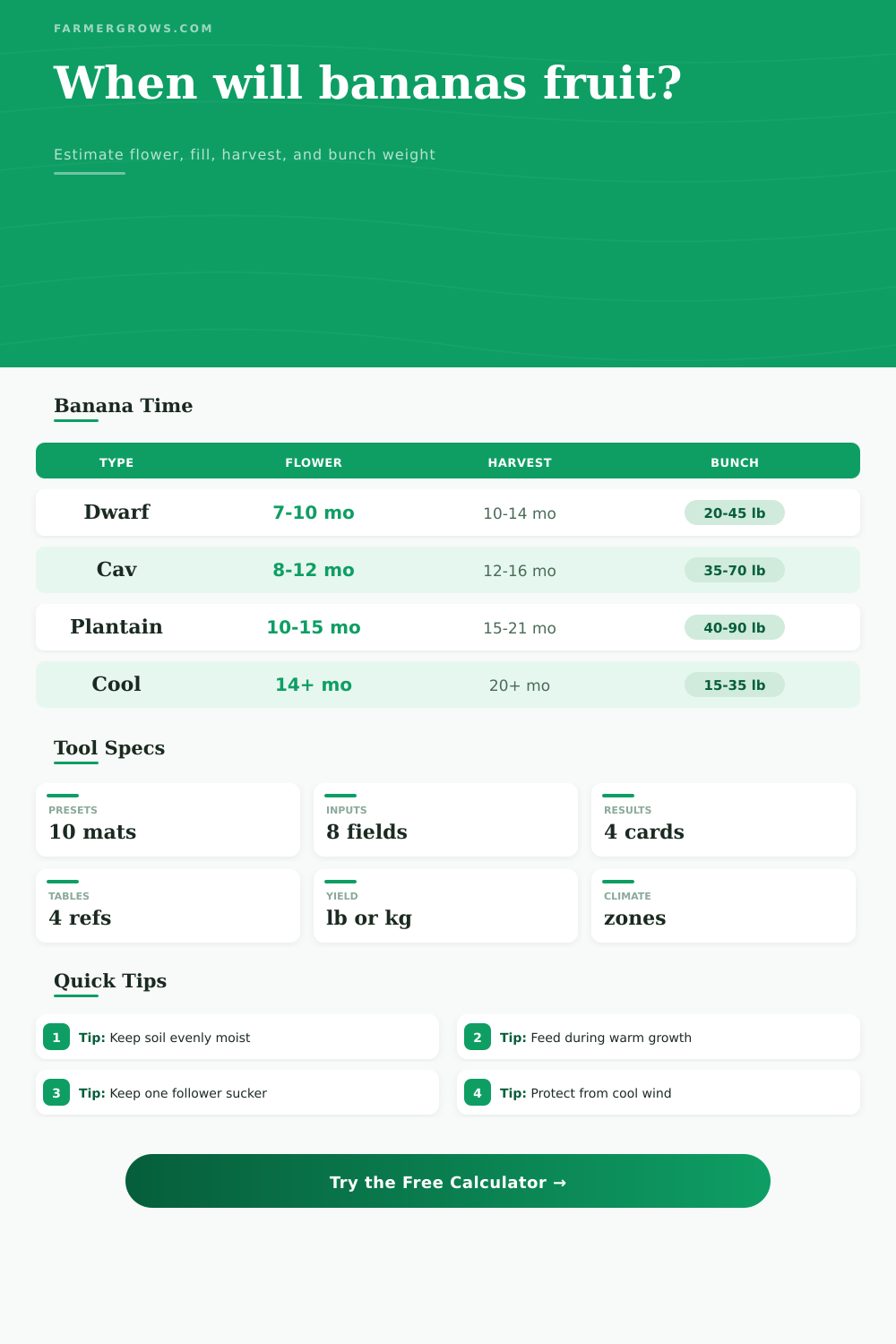
| Banana type | Flower range | Harvest range | Bunch range |
|---|---|---|---|
| Dwarf dessert | 7 to 10 months | 10 to 14 months | 20 to 45 lb |
| Cavendish | 8 to 12 months | 12 to 16 months | 35 to 70 lb |
| Lady Finger | 9 to 13 months | 13 to 18 months | 25 to 55 lb |
| Plantain | 10 to 15 months | 15 to 21 months | 40 to 90 lb |
| Climate | Timing effect | Best practice | Risk signal |
|---|---|---|---|
| Tropical | Fastest growth | Feed often | Storm damage |
| Warm subtropical | Near normal | Mulch heavily | Cool winters |
| Zone 9 edge | Slower by months | Use shelter | Frost reset |
| Greenhouse | Steady if warm | Manage humidity | Mite pressure |
| Care factor | Good target | Delay if weak | Yield impact |
|---|---|---|---|
| Water | Even moisture | 1 to 4 months | Small hands |
| Feeding | Monthly in warmth | 1 to 3 months | Light bunch |
| Sun | 7+ hours | 1 to 4 months | Thin stem |
| Wind | Sheltered leaves | 0 to 2 months | Leaf loss |
| Stage | Keep | Remove | Why it matters |
|---|---|---|---|
| Young mat | Main plant | Weak pups | Build stem size |
| Pre-flower | One follower | Extra suckers | Protect yield |
| Bunch fill | Leaves and prop | Dead leaves | Fill fruit |
| After harvest | Follower | Spent stem | Reset the mat |
Bananas grow fastest when roots stay moist but not waterlogged, with mulch keeping the root zone stable.
During warm months, regular nitrogen and potassium support a thick pseudostem and better bunch fill.
Keep one strong sword sucker as the follower so the next crop is ready after the current stem is cut.
Wind, cool nights, and frost can pause growth, so sheltered microclimates often shorten the real wait.
If you hoped to have bananas ripening soonish after planting, sorry: it’s more like slow time. There is no instant fruit wand called a banana (though some bananas grows fast because of how their metabolism works). Success depend on the right genetics in your variety, consistent watering, and some thermal energy. Rather than a vague guess, the calculator will tell you what’s possible given your local conditions, and when.
Growth is going to be based off the kind of banana you choose. In ideal conditions, a dwarf Cavendish will flower between seven and ten months; a cooking banana (like a plantain) may take as long as fifteen to twenty-one. That is biological, not because of impatience. To account for it, the tool prompts you to specify what sort of banana you’re growing. It then resets its own timer based on that information and factors in your local environment.
What Makes Bananas Grow Fast
Don’t expect a plantain to behave like a dessert banana even if you fertilize heavily. Knowing where that starting point stands avoids setting yourself up for disappointment after the calendar rolls over and there’s still no sign of a flower.
The single largest variable is how warm the climate is. Bananas are tropical plants that grow actively as long as temperatures remains above seventy degrees Fahrenheit. Steadily, relentlessly, it’s growth all-the-time in a true tropical zone. In subtropical areas with cool winters, the plant effectively hits pause during the colder months.
The calculator asks about the wind exposure and how warm the climate is because wind tears leaves, and every torn leaf means less energy-making engine to drive the fruit fill. Keeping those leaves warm and intact shaves months off your wait time in a sheltered microclimate. This is often the difference between waiting another season or having a harvest next year.
That’s where the input comes into play. In order of importance: Climate warmth is perhaps the single biggest variable, while water and food act as the gasoline for this growth machine. Bananas want regular moisture; their roots are fibrous and shallow, and they dislike being allowed to get bone dry, yet don’t like soggy feet either. Knowing how to provide plenty of water will give you an idea of just how stressed your banana may be during dry times.
It is just as crucial to know that bananas are heavy feeders, especially craving high levels of nitrogen and potassium while growing most actively (meaning the warm months). Feed lightly but hope for big fruit? You’ll be disappointed. Your chosen level of feeding affects the tool’s estimated yield, because it recognizes that a well-fed plant will produce more fruit than one grown only on compost.
You also need to manage the banana mat, which is the part you don’t think much about when growing bananas. A banana “tree” isn’t really a tree at all but a pseudostem. This stem dies back after harvest once the flower and fruit has appeared. What’s up and coming are suckers at its base, and they’re your entire future as a banana grower. You must manage them: remove weak competition and protect a good strong sucker, called a follower, to ensure continuity. There will always be another stem waiting to bear once the last one has had its moment.
The how-to tables in the tool explain this process in detail, with guidance on keeping or pruning, depending upon stage of development. It’s more than growing a plant; it’s tending the clump for years to come.
Also, as many first-timers don’t know: timing of when to pick is critical, too. The fingers should be round rather than angular. Once they are round, the fruit itself has filled out. That is when it is time to pick them.
The tool asks for input about your local conditions, and it estimates the likely weight range of a given bunch. That way, you can get an idea of what your site conditions support. Whether they’re allowing the plants to produce at their max potential, or maybe something’s getting in the way. Poor wind protection, lower amounts of sun, will show in less-heavy bunches, with smaller hands. It becomes a diagnostic starting point for comparing what you were expecting different than what you got.
Growing bananas, then, has less to do with making good soil than it does managing your expectations. The plant won’t be made to defy its own genetic clock, but you can eliminate any artificial delays imposed by stress. Feed it, keep it well watered and warm, and give it time. Every month will count until nature’s timer goes off.
You could of forced the plant to beat its genetic timer, but you can make sure it moves through its life cycle efficiently. It will live out its life in an orderly way, moving from one stage of development into another without unnecessary delay. Let the biology happen; honor its timetable, and you’ll find that growing a banana is a very satisfing exercise.