🌾 Baler Twine Calculator
Calculate exactly how much baler twine you need — by bale count, bale type, and twine ball size
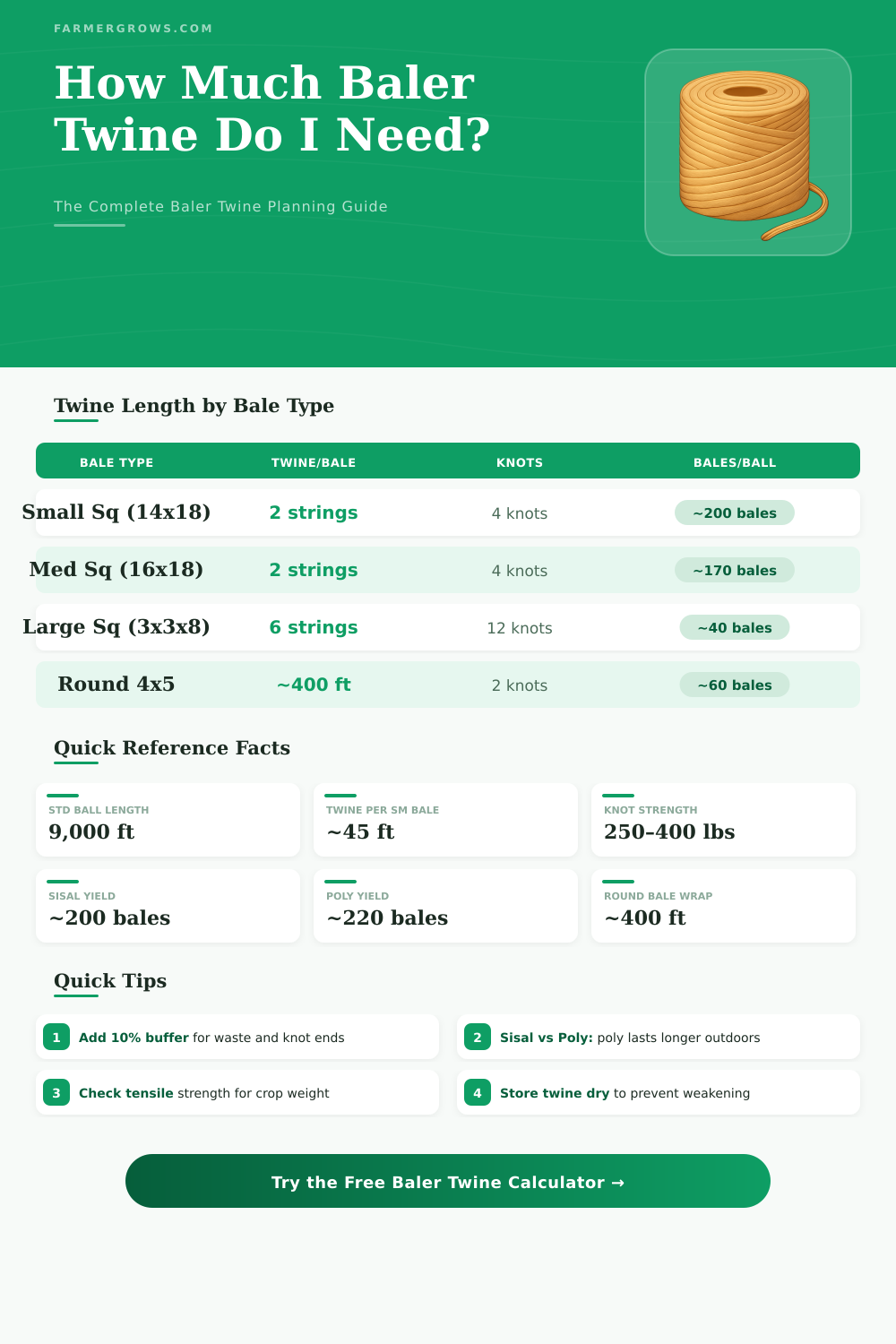
| Bale Type | Strings/Bale | Twine/Bale (ft) | Twine/Bale (m) | Bales/Ball (9,000 ft) | Bales/Ball (12,000 ft) |
|---|---|---|---|---|---|
| Small Square (14x18 in) | 2 | ~45 ft | ~13.7 m | ~200 | ~266 |
| Medium Square (16x18 in) | 2 | ~54 ft | ~16.5 m | ~166 | ~222 |
| Large Square (3x3x8 ft) | 6 | ~156 ft | ~47.5 m | ~57 | ~76 |
| XL Square (4x4x8 ft) | 8 | ~224 ft | ~68.3 m | ~40 | ~53 |
| Round Bale 4x5 ft | 2 | ~400 ft | ~121.9 m | ~22 | ~30 |
| Round Bale 4x6 ft | 2 | ~450 ft | ~137.2 m | ~20 | ~26 |
| Round Bale 5x5 ft | 2 | ~480 ft | ~146.3 m | ~18 | ~25 |
| Round Bale 5x6 ft | 2 | ~550 ft | ~167.6 m | ~16 | ~21 |
| Bale Count | Sm Sq Balls (9k ft) | Sm Sq Balls (12k ft) | Lg Sq Balls (9k ft) | Round 4x5 Balls (9k ft) |
|---|---|---|---|---|
| 100 Bales | 1 | 1 | 2 | 5 |
| 250 Bales | 2 | 1 | 5 | 12 |
| 500 Bales | 3 | 2 | 9 | 23 |
| 1,000 Bales | 5 | 4 | 18 | 45 |
| 2,000 Bales | 10 | 7 | 35 | 89 |
| 5,000 Bales | 25 | 19 | 87 | 223 |
| Imperial | Metric | Imperial | Metric |
|---|---|---|---|
| 1 ft | 0.3048 m | 1,000 ft | 304.8 m |
| 9,000 ft | 2,743.2 m | 12,000 ft | 3,657.6 m |
| 15,000 ft | 4,572 m | 6,500 ft | 1,981.2 m |
| 1 mile | 1.609 km | 5,280 ft | 1,609.3 m |
Baler twine is fiber of little diameter, from sisal either synthetic materials, that serves for bind crowds of grass or straw in more heavily packed and stackable balls. Many ranchers think that all such products match, until happens problem. It should be in any farm or ranch.
In good hands, sisal either polypropylene twine fix fences, attach tractor parts and strengthen stairs. However its mainstream task stays baling.
How to Choose Baler Twine
Two mainstream kinds exist: sisal and plastic (from polypropylene). Sisal baler twine bid strong tension and well keep knots. Its natural fiber divides naturally and are edible, so well replace synthetic.
Special treatment protects it against rodents and insects. Plastic twine usually cost less. In United States, its price is almost half of sisal.
Some agriculturalists like plastic and will not return to sisal. Qualifications in the baler help plastic operate well. Any enabled knots any more appear after course to plastic.
But it unpleasant smells hands and create troubles during feeding to animals or leave residues in the countryside. Some does not accept plastic twine around round balls on his territories, although natural string costs more.
For sheep farms, plastic twine matter, because chips could mingle with the wool. Although some says, that after ten years of usage never you found plastic fragments in the wool.
Round baler twine last tension, sun exposure and heavy weather. UV-protected twine give more reliable result and same for smooth pace through any round baler. It comes in various tensile strengths and spool sizes for different machines and needs.
Knot force is inherent. Some plastic kinds surpass 450 pounds and answer for heavy balers.
Baler twine is the universal assistant for farm families. Even after years without machines, spool stays useful. For fast tie?
Take twine. Pigs break metallic clamps? Tvinoe settle quickly and without danger.
It always finds fresh usages around the farm.
Twine akiriĝas in various colours and lengths. High polypropylene, hemp or sisal answer for little round and square balers. Some marks stress tenderness and flexibility, what extends the life of knotters.
Land of production and qualities of sisal against plastic twine affect results more than you expects.