Bags of Soil for Raised Bed Calculator
Estimate how many bags of raised bed soil to buy from inside bed dimensions, fill depth, bag size, compaction, top-off allowance, bed count, and blend ratios.
Load a real raised-bed scenario, then adjust the bag label, fill depth, compaction, top-off, and soil blend for your actual garden supplies.
Raised Bed Soil Bag Results
Your soil bag estimate will appear here after calculation.
Use one bag type when you want a simple purchase list and consistent texture across the bed.
Good for large beds, but add fiber or aeration if the mineral soil feels dense or sticky.
Higher coir, peat, or leaf mold keeps shallow beds workable and easy to replant.
Compare the final cubic-yard total once several raised beds need more than a cartload of bags.
| Bag label | Cubic feet | Liters | Bags per cubic yard | Coverage at 12 in |
|---|---|---|---|---|
| 0.75 cu ft small bag | 0.75 | 21.2 L | 36.0 bags | 0.75 sq ft |
| 1 cu ft compost bag | 1.00 | 28.3 L | 27.0 bags | 1.00 sq ft |
| 1.5 cu ft soil bag | 1.50 | 42.5 L | 18.0 bags | 1.50 sq ft |
| 2 cu ft raised bed soil | 2.00 | 56.6 L | 13.5 bags | 2.00 sq ft |
| 3 cu ft large bag | 3.00 | 85.0 L | 9.0 bags | 3.00 sq ft |
| 40 L metric bag | 1.41 | 40.0 L | 19.1 bags | 1.41 sq ft |
| Fill depth | 1 cu ft covers | 2 cu ft bag covers | 1 cu yd covers | Common use |
|---|---|---|---|---|
| 6 in | 2.00 sq ft | 4.00 sq ft | 54.0 sq ft | Herbs and shallow greens |
| 8 in | 1.50 sq ft | 3.00 sq ft | 40.5 sq ft | Salad beds and flowers |
| 10 in | 1.20 sq ft | 2.40 sq ft | 32.4 sq ft | General vegetable beds |
| 12 in | 1.00 sq ft | 2.00 sq ft | 27.0 sq ft | Standard raised beds |
| 16 in | 0.75 sq ft | 1.50 sq ft | 20.3 sq ft | Roots, peppers, tomatoes |
| 18 in | 0.67 sq ft | 1.33 sq ft | 18.0 sq ft | Deep beds and new fill |
| Blend style | Topsoil / loam | Compost | Coir / peat | Aeration |
|---|---|---|---|---|
| Balanced vegetable bed | 40% | 30% | 20% | 10% |
| Square foot style | 0% | 33% | 34% | 33% |
| Tomato and pepper bed | 35% | 35% | 20% | 10% |
| Root crop loose fill | 35% | 25% | 25% | 15% |
| Native soil refresh | 55% | 25% | 10% | 10% |
| Fast-draining berry bed | 30% | 25% | 25% | 20% |
| Bed size | Fill depth | Base volume | With 10% top-off | 2 cu ft bags |
|---|---|---|---|---|
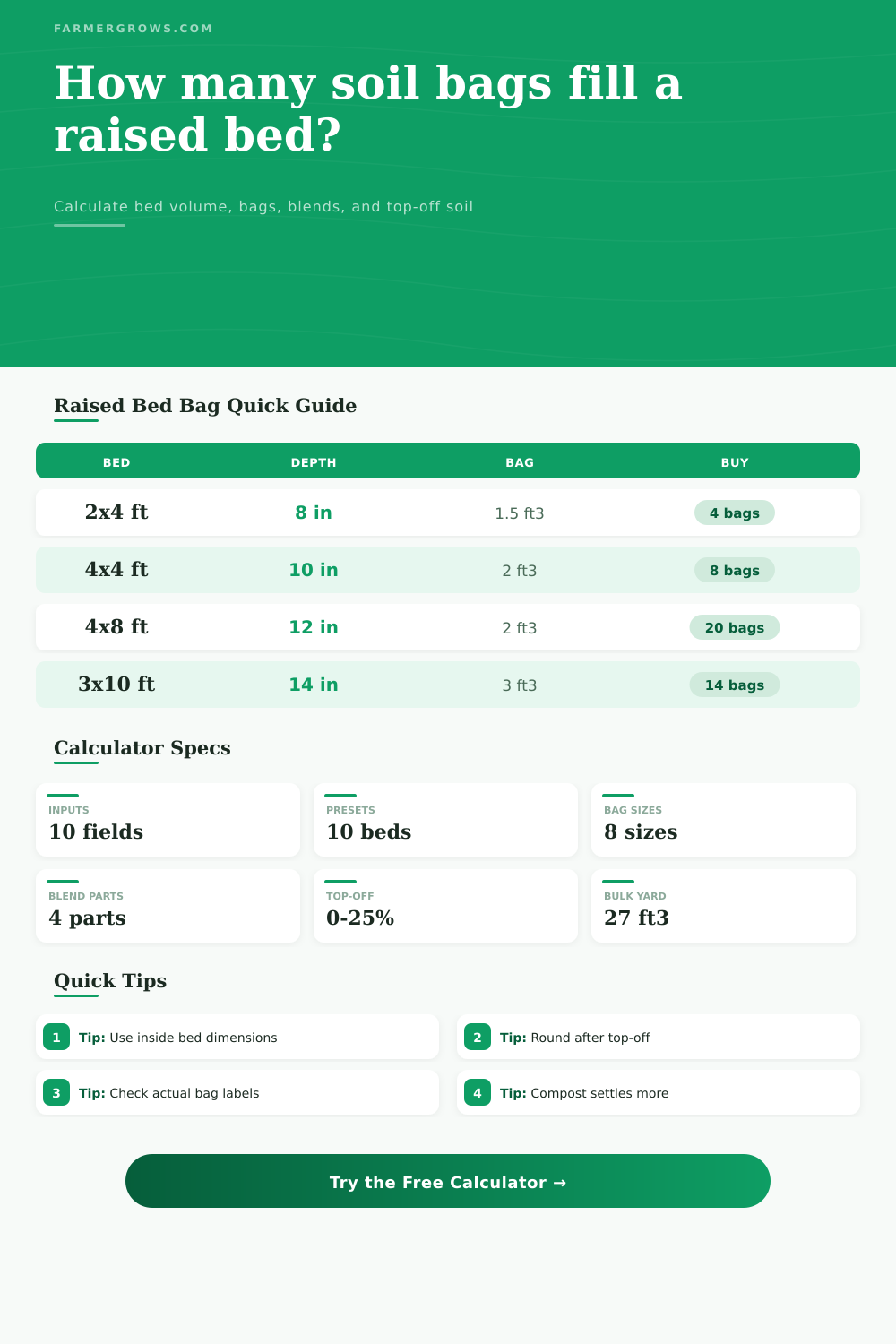
| 2 x 4 ft | 8 in | 5.3 cu ft | 5.9 cu ft | 3 bags |
| 3 x 6 ft | 10 in | 15.0 cu ft | 16.5 cu ft | 9 bags |
| 4 x 4 ft | 12 in | 16.0 cu ft | 17.6 cu ft | 9 bags |
| 4 x 8 ft | 12 in | 32.0 cu ft | 35.2 cu ft | 18 bags |
| 3 x 10 ft | 14 in | 35.0 cu ft | 38.5 cu ft | 20 bags |
| 4 x 12 ft | 16 in | 64.0 cu ft | 70.4 cu ft | 36 bags |
Measure inside the bed: Lumber, blocks, liners, and corner posts reduce the true fill space. Inside length, inside width, and actual soil depth give the bag count that matters.
Buy after allowances: Apply compaction and top-off before rounding bags. Compost-heavy blends can settle after the first deep watering, so a small reserve is useful.
Who hasn’t been up against a wall of bags of soil in hardware store, gazing blankly into mountain of goodness, trying to remember how much you needed and whether you had purchased enough? Get the tape measure out and take measurements of your bed. Multiply them and do some hasty arithmetic in your head to guess how much soil you need when it’s filled. Then go plant the thing and add a little water just to get things started.
You will see dirt settle down an inch or two as nature and gravity work their tricks on you. Turns out that volume of a full bag of soil doesn’t equal the volume of a box you might assume contains it. The calculator above do the calculations for you (once you enter your dimensions), so no more guesswork about conversions and coefficients that vary depending on the type of soil you’re packing. As it happens, the volume of a box is not always the volume of a box of packed-in earth. It’s all about knowing what this thing measures.
How to Calculate Soil for Your Garden
You enter inside dimensions (the length and width) and those are actual measurements of the container. A little tricky is the depth measurement. Most folks measure from ground level to top of their wood frame. Chances are that’s not where your roots will be growing. To get a sense of depth of fill, the tool requests this number (target fill depth). This means you can include any existing stone bases or native soil beneath the surface. So if you built a ten inch high bed but had just eight inches of mix on top after leaving two inches of gravel for drainage, then that’s what the tool does: adjust the cubic footage downward.
Why would you buy soil for entire height if you’re not going to fill the entire height? It’s wasteful to throw money away! The soil settles. And there’s nothing you can do about it. Even the fresh, bagged loam have air pockets that will compress under its own weight, especially when they get wet.
To accommodate this truth of garden physics, the calculator feature a compaction selector. This lets you pick between a fluffy-soil setting or something closer to the tighter-packed side. For instance, the tighter side might be a blend that uses more compost than loam and peat. That adjustment give you a little more wiggle room in terms of how many bags you end up needing, and avoids having a bed that resembles a sinking ship following a good rain. There’s also an allowance percentage for top-off purposes; think of it as a little insurance policy against what spills out during fill-in time, plus the inevitable settling that occurs within the first few weeks.
Once you get the volume right, you need to select the mix. This device lets you adjust the ratio of ingredients in your blends, such as compost versus coir (or peat moss), topsoil, and an aeration ingredient like perlite. For most well-balanced gardens of vegetables, a ratio of about forty percent mineral soil for structure, thirty percent compost for nutrition, twenty percent organic matter for water-holding capacity and ten percent grit for aeration work well. Depending on your crop, those proportions may shift slightly. Tomatoes does well with a little added compost because they’re heavy feeders; root crops should have less compost and more aeration ingredients so they don’t rot as much. It’s all spelled out in the reference table on the page for each type of planting style.
Once you get over a certain number of cubic yards, buying in bulk makes more sense financially. Lugging around three dozen bags of two-cubic-foot soil (not to mention all those trips) is heavy work; you will most likely need a wheelbarrow and will have to make many trips. For multiple big bed, then, where you’re comparing prices per cubic foot, a bulk estimate by the yard will be cheaper than bags. A caveat: It’s also very hard work to spread evenly unless you have equipment, but it will probably save you money too. The calculator figures out how many cubic yards all those bags add up to so you can comparison-shop bag vs. Bulk side-by-side, no division required.
Weight is another quiet element in such calculations. Depending off how dense your composted materials are, a cubic foot of well-moistened garden soil will weigh about forty-five pounds. If that’s what you’re aiming for, a full 12-inch layer; in a four by eight bed you’ll be hauling more than nine hundred pounds of material. Plan, plan, plan. You will have no injuries to your lower back and no embarrassing moments asking someone for assistance (unless there must be). It also gives you an estimate of the total amount you are looking at lifting, so you know the work involved before buying.
Bottom line: Successful raised beds require careful planning. Get it right up front. Ensure you get just the right amount of soil. Make sure the soil has proper texture for growing your desired crop. And make an honest evaluation about the effort required. It’s all easier when done correctly (less strain), less expense, less time-consuming at the end of the season. This is where the calculator takes the guesswork out of the beginning stage, so you can spend more time worrying about things that matter.
Good soil means healthy roots, and the soil needs to be loose, well-draining, and not soggy-wet. Do the math correctly, measure carefully first, and let your garden thank you for taking extra-good care early-on. You should of checked everything twice! Actualy, you’ll need a moddern approach to gardening. It looks more luxurius than old ways. And it dissapears quite fast if you don’t plan.