Bags Of Potatoes Per Acre Calculator
Estimate potato bags per acre from yield, packout, bag size, culls, storage shrink, seed rate, and field size for fresh market, storage, or direct-sale planning.
🥔 Potato Crop Presets
Choose a starting point, then adjust the bag weight, packout, and yield to match your own field records or buyer specifications.
📏 Field And Yield Inputs
Potato Bag Estimate
Your potato bag estimate will appear here.
Calculation Breakdown
📊 Field Planning Snapshot
🧺 Common Potato Bag Sizes
| Bag size | Bags from 1 cwt | Bags from 300 cwt/ac | Typical use |
|---|---|---|---|
| 5 lb | 20.0 bags | 6,000 bags/ac | Small retail packs and farm stands |
| 10 lb | 10.0 bags | 3,000 bags/ac | Retail consumer bags |
| 25 lb | 4.0 bags | 1,200 bags/ac | CSA, restaurants, and bulk buyers |
| 50 lb | 2.0 bags | 600 bags/ac | Farm market, wholesale, and storage lots |
| 100 lb | 1.0 bag | 300 bags/ac | Processing, feed, or large wholesale sacks |
🌿 Potato Yield And Packout Reference
| Crop situation | Gross yield range | Typical packout | 50 lb bags per acre after 5% shrink |
|---|---|---|---|
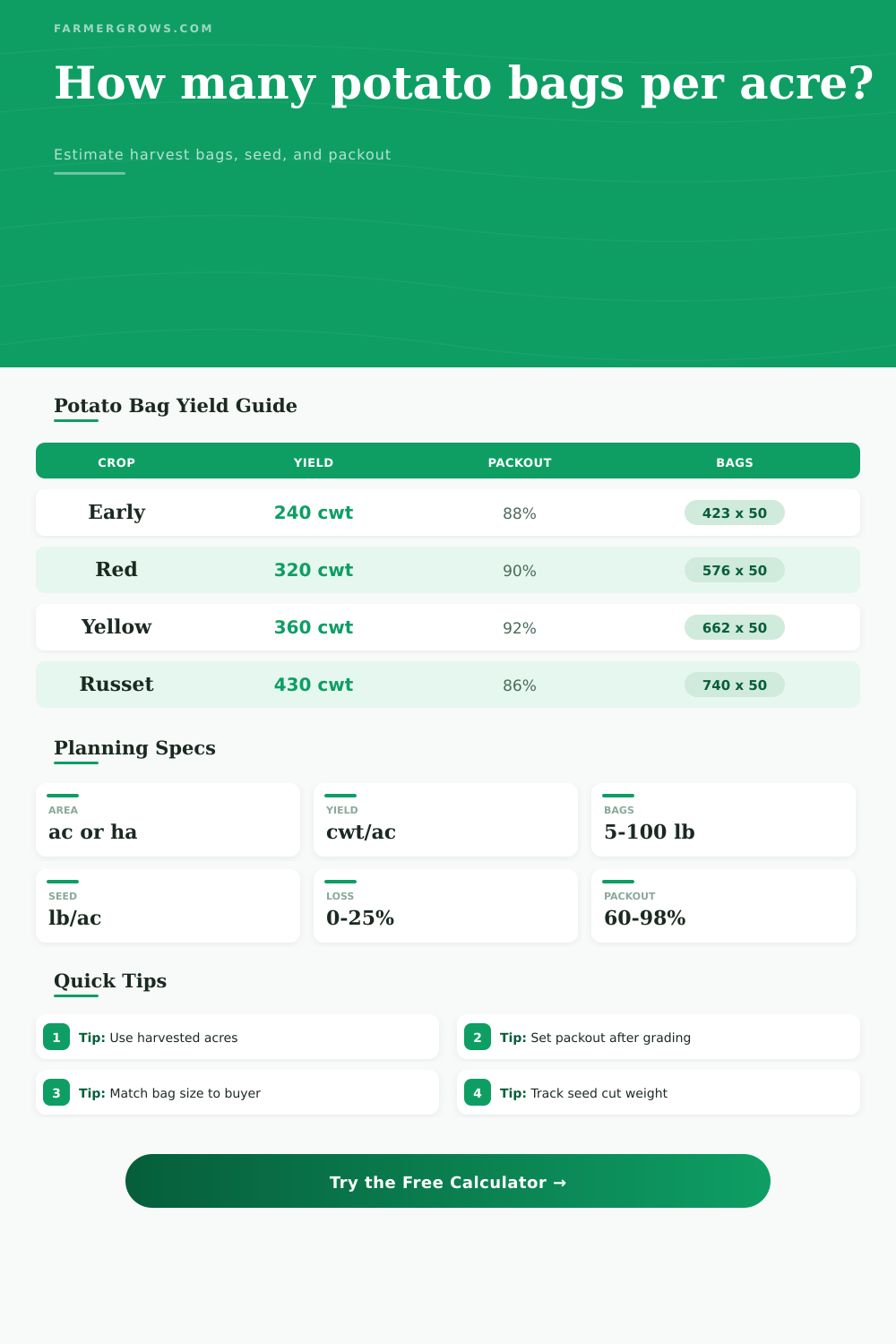
| Early new potatoes | 180 to 260 cwt/ac | 85% to 92% | 291 to 455 bags |
| Red or white table crop | 260 to 380 cwt/ac | 86% to 94% | 425 to 678 bags |
| Yellow premium fresh market | 300 to 430 cwt/ac | 88% to 95% | 502 to 776 bags |
| Russet storage crop | 350 to 520 cwt/ac | 78% to 90% | 519 to 889 bags |
| Organic or low-input field | 160 to 320 cwt/ac | 75% to 90% | 228 to 547 bags |
📦 Bags Needed By Yield
| Marketable yield | 10 lb bags | 25 lb bags | 50 lb bags |
|---|---|---|---|
| 200 cwt/ac | 2,000 bags/ac | 800 bags/ac | 400 bags/ac |
| 300 cwt/ac | 3,000 bags/ac | 1,200 bags/ac | 600 bags/ac |
| 400 cwt/ac | 4,000 bags/ac | 1,600 bags/ac | 800 bags/ac |
| 500 cwt/ac | 5,000 bags/ac | 2,000 bags/ac | 1,000 bags/ac |
🌱 Seed Potato Planning
| Seed rate | 50 lb seed bags/ac | 100 lb seed bags/ac | Notes |
|---|---|---|---|
| 1,600 lb/ac | 32 bags | 16 bags | Light rate for close seed control |
| 2,000 lb/ac | 40 bags | 20 bags | Common direct-market planning rate |
| 2,400 lb/ac | 48 bags | 24 bags | Moderate rate for larger seed pieces |
| 2,800 lb/ac | 56 bags | 28 bags | Heavier rate for aggressive stand targets |
💡 Practical Checks
Separate gross harvest from saleable bags. A field can lift a strong tonnage but still fill fewer bags if grading removes undersize tubers, cut tubers, sunburn, or storage shrink.
Use full bags for orders. The calculator floors the quoted bag count after the reserve deduction, so the final number behaves like bags you can actually stack, ship, or sell.
It’s a crisp September morning, and you’re digging the first row. Everything looks great: The soil comes off easy, exposing a fat line of strong tubers, the kind of harvest that justifies all the sweat equity of summer. You can practiacally imagine the stacks of crate in your cooler, or the fifty-pound sack ready for the wholesale buyer.
But then the excitement quickly fade as you realize how difficult it will be to turn those dirt-covered pounds into something that sells. That’s where most potato farmers come up short: between the potatoes harvested from the earth and the ones served at your customers’ tables.
How to Calculate Your Potato Harvest Profit
Plug in your expected yield, the field area, and your assumptions about losses from storage, handling, and grading. This calculator does all math for you, so you don’t have to guess how much weight is lost along the way.
Most farmers obsess over their gross yield-per-acre because it’s the yardstick of whether they had a good or bad year. But gross yield are a vanity metric unless you can accurately predict what your net marketable weight will be. How many bag are you able to actualy sell? It’s not just about how many tons you grew.
The one variable that matters most is packout. Think of it as the percent of tubers surviving the culling process once they’re out of the field. Anything green, significantly blemished, sprouted, or too small in diameter doesn’t make the cut under Grade 1 specs. If your packout is high, your potatoes is clean and uniform, which fetches a higher dollar. If it’s low, well, you’ve got a bunch of culls going to compost or the processor.
You can tweak the number for your field conditions and specific variety to get an accurate bag count (not one based off hope).
Bag size is more complex than you might think. Storage and bulk operations use a 50-pound bag as standard; retail markets are all about the ten-pounder… The main seller. It makes sense: while 50-pound sacks is standard for wholesale, ten-pound bags is the bread and butter of retail markets.
But that means you’ll end up with a lot more bags to fill, your bag count rise if you make this transition to a retail operation. But there’s a catch: Filling and tying those bags takes extra time. Packing little bags is tedious stuff, on a big piece of land, that time adds up fast. You should of weigh the number of bags you can fill against the time it takes.
The tool also excels at seed planning. Few farmers realizes exactly how much seed potato they’ll need for an acre until it’s time to plant, by then it’s too late. Running out of seed potato will either result in thin stands or skipping a hill, which ultimately reduces final yield. With the tool, you enter your preferred planting rate and bag size; it calculates how many bags of seed you need. For me, that connects my financial planning with field logistics, ensuring I have enough seed stock before the planting window is closed.
There’s another stealth budget killer called shrink. Even if potatoes are stored perfectly (meaning they aren’t losing moisture or breathing), they’ll still lose weight over time… Several percent of their original weight over several months. When calculating the size of your final bag for a winter sale crop like russet potatoes, you need to account for shrink. Enter a shrink percentage into the tool, and it’ll show you what the final bag estimate should look like, the one that’ll weigh out on the scale come January, not the one you harvest in October.
One common error is to not consider field loss. Mechanical handling cause damage, dirt adds extra weight, and digging causes bruises. These factor mean less weight can actually be recovered before grading. Separating out field loss from packout makes it necessary to consider each step in the post harvest process as a separate step. That level of detail allows you to see where improvement might come, because more gentle handling during packing or better digging methods will contribute to better recovery at both stages.
And in the end, knowing how many bags you’ll have means you won’t waste any space or miss out on potential sales. It helps you store efficiently; negotiate better contracts; operate with accuracy where there was once a guess. It takes a messy harvest and transforms it into a fine-tuned business. Sure, you still hope for that large haul…but one that’s all accounted for as part of your bottom line. These tools help make sure that what you dig becomes what you sell.