Bag of Topsoil Weight Calculator
Estimate a single bag weight, total topsoil load, bed coverage, bags required, and carrying trips from bag volume, moisture, soil texture, compaction, and load limit.
Pick a named bagged topsoil starting point, then adjust volume, moisture, density, texture, compaction, and count for the bags you have on hand.
Topsoil Bag Weight Results
Results update from your bag size, moisture, soil density, bed area, and carry limit.
Often used for small patching, containers, and top-dressing narrow beds.
A frequent topsoil bag size; about 36 to 55 lb depending on moisture and blend.
Good for estimating because each bag equals one cubic foot before settling.
Reduces bag count but can become awkward when stored damp.
Common for soil blends; check carry and vehicle limits before loading many bags.
Metric labeled bags convert cleanly for bed depth and total load planning.
Use when comparing bagged topsoil with bulk delivery volume.
Round project bags up because partial bags rarely spread evenly after settling.
| Bag size | Cubic feet | Bags per cubic yard | Coverage at 2 in | Coverage at 3 in |
|---|---|---|---|---|
| 20 quart bag | 0.67 cu ft | 40.4 bags | 4.0 sq ft | 2.7 sq ft |
| 0.75 cu ft bag | 0.75 cu ft | 36.0 bags | 4.5 sq ft | 3.0 sq ft |
| 1 cu ft bag | 1.00 cu ft | 27.0 bags | 6.0 sq ft | 4.0 sq ft |
| 1.5 cu ft bag | 1.50 cu ft | 18.0 bags | 9.0 sq ft | 6.0 sq ft |
| 2 cu ft bag | 2.00 cu ft | 13.5 bags | 12.0 sq ft | 8.0 sq ft |
| Moisture condition | Moisture input | Weight multiplier | 1 cu ft loam bag | Use when |
|---|---|---|---|---|
| Dry stored | 5% | 0.94x | 53 lb | Bag feels crumbly and light |
| Typical shelf | 12% | 1.00x | 56 lb | Normal sealed retail bag |
| Damp bag | 20% | 1.10x | 62 lb | Outdoor pallet or rain exposure |
| Very wet | 30% | 1.26x | 71 lb | Bag holds water or clumps |
| Project bed | Area | Depth | Compacted volume | 0.75 cu ft bags |
|---|---|---|---|---|
| Small border strip | 24 sq ft | 2 in | 4.5 cu ft | 6 bags |
| 4 ft × 8 ft raised bed top-off | 32 sq ft | 3 in | 9.0 cu ft | 12 bags |
| 10 ft × 10 ft garden patch | 100 sq ft | 2 in | 18.7 cu ft | 25 bags |
| 12 ft × 16 ft lawn repair | 192 sq ft | 1 in | 17.9 cu ft | 24 bags |
| 20 ft × 20 ft topdress | 400 sq ft | 0.5 in | 18.7 cu ft | 25 bags |
| Load limit | Typical use | 45 lb bags | 65 lb bags | Planning note |
|---|---|---|---|---|
| 80 lb | Hand carry pair limit | 1 bag | 1 bag | Use short trips |
| 150 lb | Small cart | 3 bags | 2 bags | Watch wheel rating |
| 250 lb | Wheelbarrow | 5 bags | 3 bags | Allow slope margin |
| 800 lb | Car trunk load | 17 bags | 12 bags | Check payload rating |
| 1500 lb | Small trailer | 33 bags | 23 bags | Balance axle weight |
Use the wettest likely weight. If bags sat outdoors, increase moisture before planning car, cart, or trailer loads.
Calculate volume after settling. For beds that will be walked on, use normal or firm compaction so the finished depth does not end up shallow.
The cost may sound low so you figure you can load up your car with 20 bags of topsoil. And, chances are good, you’ll assume all those bags weighs the same amount. Wrong. Soil texture, as well as moisture content, make for a big difference between something you can manage as a do-it-yourself landscape project…and a trip to the auto repair shop for a new axle.
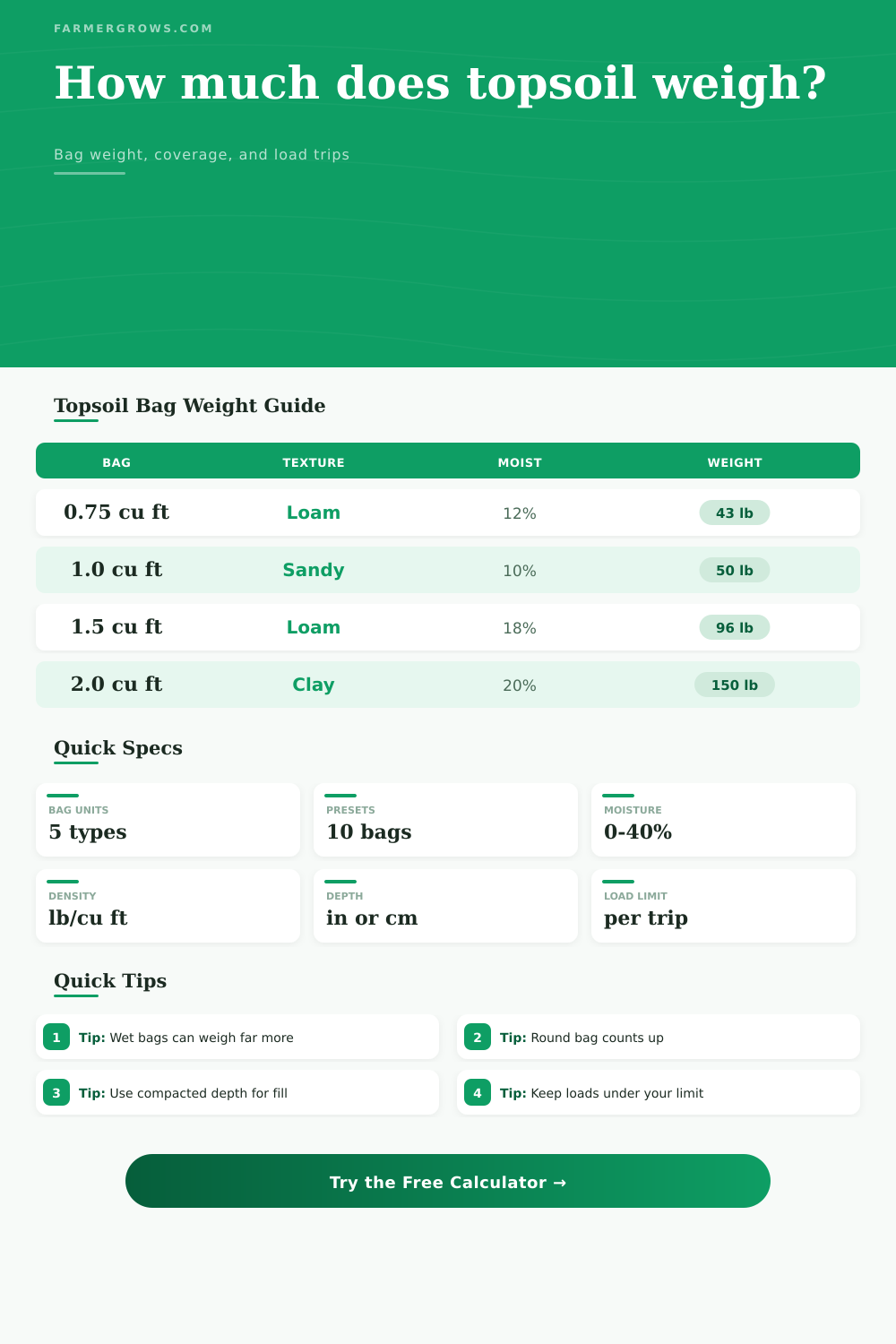
If a seemingly lightweight bag has been sitting out in the rain it will be heavy when you go to lift it…if you know ahead that that’s what is going on, you can plan accordingly. Before you pick up a single bag, use the calculator on this page to figure out how much it weigh. Enter size of the bag (the volume) and it will calculate total weight based off the type of soil inside and its moisture content.
How to Calculate the Weight of Soil Bags
That’s why most people skip entering the moisture content; they don’t think about it. Wrong! Water is heavy. A cubic foot of loam can gain several pounds by adding just ten percent moisture. And if those bags has been sitting around in damp conditions, things get even heavier in a hurry. You can account for that with the calculator which keeps you and your vehicle/back healthy.
Water isn’t the only consideration, soil matters too, such as its texture. Light soils (sandy) drain rapidly; heavy soils (clay) hold water and get packed down dense. If you’re filling a raised bed with purchased topsoil, do you know what kind of soil you have? The calculator presets includes some popular soil types: organic mixes and loam.
Because organic soil tends to be lighter (more air pockets), it will affect the weight estimate. Similarly clay are heavier and denser. Using the incorrect preset can throw off your weight estimate by ten to fifteen percent. Ten to fifteen percent can be the difference between one trip and three trips.
Coverage is another variable. When spread out, a cubic foot of soil isn’t as big as it sounds. It’s about six square feet at two inches thick; four square feet at three inches. The calculator takes compaction into account (the settling that occurs after rain or walking on the bed). So does loose fill settle a lot? Yes. Plan to buy enough soil to achieve your target depth, but allow for 12-18 percent compaction (your bed won’t be so shallow!).
Most projects go wrong here: load planning. You figure the number of bags to fit into your trunk based on volume rather than weight. Sure, you can get thirty bags in there physically, but perhaps its maximum payload is only eight hundred pounds. Thirty fifty-pound bag total fifteen hundred, which is both dangerous and generaly illegal. Setting a hard weight limit helps you work with your vehicle’s capabilities.
Whether you’re carrying it all yourself, using a trailer, or dragging along a wheelbarrow set that limit. It’ll tell you exactly what trips are required. For most common bag sizes, the reference tables is used to compare quickly. How many bags equal a cubic yard? What size do I need to cover X depth? If you are considering getting bulk deliveries, this will help you check your math.
Sometimes it’s less expensive to buy in bulk. Other times, not so much. The cost difference rarely justifies the extra labor of hauling fifty bags. So knowing exactly how much you need lets you determine whether or not it’s worth the trouble to buy bags.
To begin: Measure the area where the bed will go, including how deep you want it. Next, estimate how wet the soil is. Do the math. Does it say “twenty trips” on the bottom? Call in the reinforcements or rent a trailer. Are we talking four trips? Maybe you can do this yourself.
You’re not trying to be surprised. You don’t want a surprised back; that hurts. Get the weight right up front, and save yourself some awkward “the-bag-won’t-move” moments. You should of checked the math first.