Bag of Mulch Coverage Calculator
Estimate how many square feet your mulch bags cover after target depth, bag volume, bed shape, existing mulch, tree-ring exclusions, settling, overage, and slope loss.
Load a common bagged mulch job, then adjust the bag size, count, depth, shape, and site-loss factors for your bed.
Mulch Bag Coverage Results
Your coverage summary will appear here.
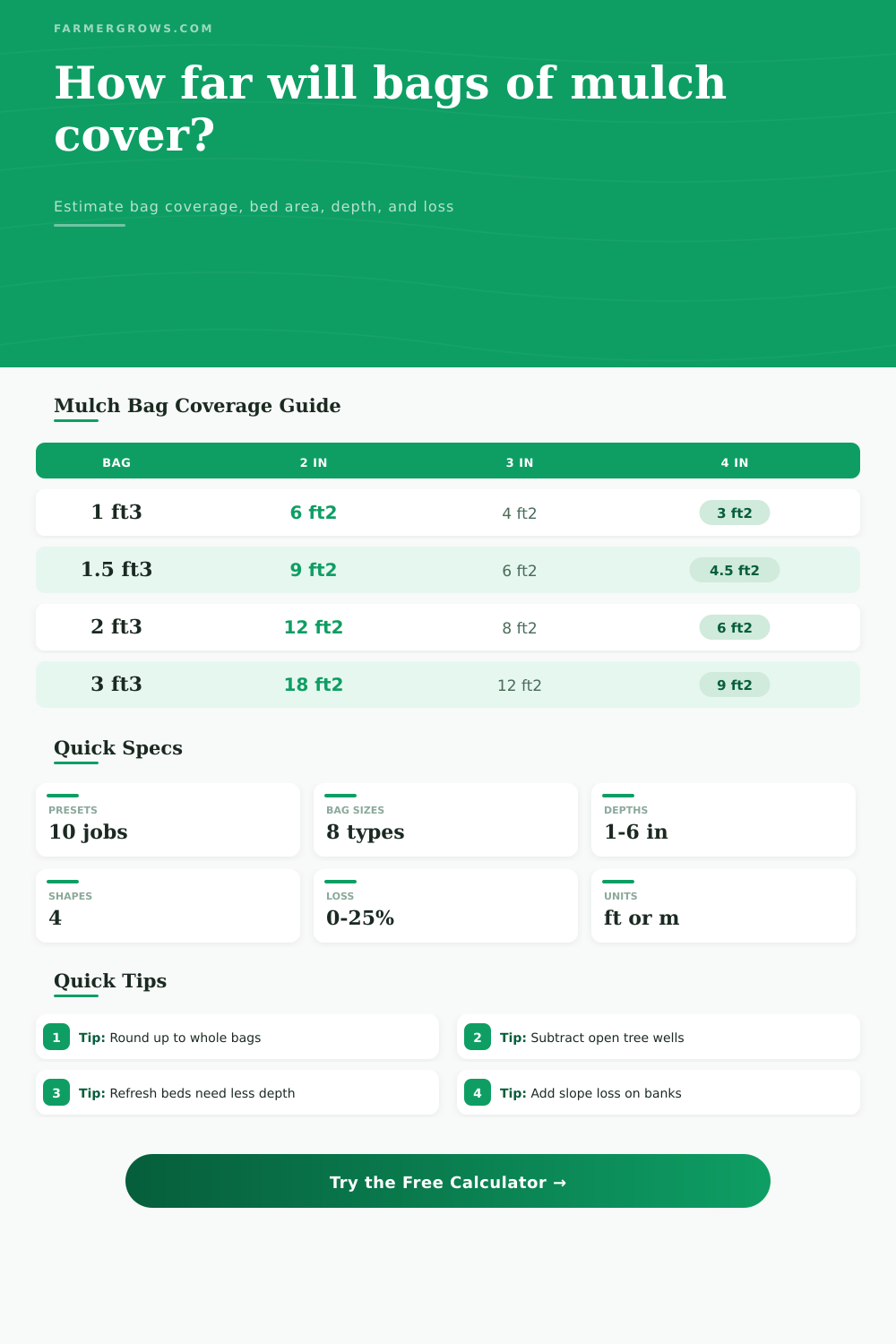
Covers 12 sq ft at 1 inch, 6 sq ft at 2 inches, 4 sq ft at 3 inches, or 3 sq ft at 4 inches.
Covers 18 sq ft at 1 inch, 9 sq ft at 2 inches, 6 sq ft at 3 inches, or 4.5 sq ft at 4 inches.
Covers 24 sq ft at 1 inch, 12 sq ft at 2 inches, 8 sq ft at 3 inches, or 6 sq ft at 4 inches.
Covers 36 sq ft at 1 inch, 18 sq ft at 2 inches, 12 sq ft at 3 inches, or 9 sq ft at 4 inches.
| Finished depth | 1 cu ft covers | 2 cu ft covers | 1 cubic yard covers |
|---|---|---|---|
| 1 inch refresh | 12 sq ft / 1.11 m² | 24 sq ft / 2.23 m² | 324 sq ft / 30.1 m² |
| 2 inch maintained bed | 6 sq ft / 0.56 m² | 12 sq ft / 1.11 m² | 162 sq ft / 15.1 m² |
| 3 inch weed control | 4 sq ft / 0.37 m² | 8 sq ft / 0.74 m² | 108 sq ft / 10.0 m² |
| 4 inch new planting | 3 sq ft / 0.28 m² | 6 sq ft / 0.56 m² | 81 sq ft / 7.5 m² |
| 6 inch play zone | 2 sq ft / 0.19 m² | 4 sq ft / 0.37 m² | 54 sq ft / 5.0 m² |
| Bag size | Bags per yd³ | Coverage at 2 in | Coverage at 3 in |
|---|---|---|---|
| 0.75 cu ft mini bag | 36 bags | 4.5 sq ft | 3 sq ft |
| 1 cu ft bag | 27 bags | 6 sq ft | 4 sq ft |
| 1.5 cu ft bag | 18 bags | 9 sq ft | 6 sq ft |
| 2 cu ft bag | 13.5 bags | 12 sq ft | 8 sq ft |
| 3 cu ft bag | 9 bags | 18 sq ft | 12 sq ft |
| Project | Net area | Volume at 3 in | 2 cu ft bags |
|---|---|---|---|
| Tree ring, 6 ft diameter | 28 sq ft | 7.1 cu ft | 4 bags |
| Small bed, 10 x 20 ft | 200 sq ft | 50 cu ft | 25 bags |
| Playground, 15 x 15 ft | 225 sq ft | 56.3 cu ft | 29 bags |
| Long border, 4 x 60 ft | 240 sq ft | 60 cu ft | 30 bags |
| Full yard bed, 50 x 50 ft | 2500 sq ft | 625 cu ft | 313 bags |
| Adjustment | Typical range | Use when | Calculator effect |
|---|---|---|---|
| Existing mulch credit | 0 to 2 inches | Loose mulch still covers the soil | Reduces added depth |
| Settling allowance | 5% to 15% | Fresh shredded mulch is fluffy | Adds extra volume |
| Overage buffer | 5% to 20% | Beds have curves or uneven edges | Adds reserve bags |
| Slope loss | 5% to 25% | Mulch is spread on banks | Reduces practical coverage |
Depth check: For refresh jobs, measure the loose mulch that is still useful and subtract it from the target depth instead of spreading a full new layer.
Tree wells: Keep mulch away from trunks and crowns. The exclusion input removes those open circles from the coverage area before bags are estimated.
There is a specific kind of panic because of what you can’t see: The difference between a cubic foot, and how that would look spread out across your yard, whether it’s enough to finish your whole flowerbed, or only partway around…that’s why you’re always feeling unsure at garden center. You aren’t purchasing an area, but instead, volume, which is tricky business. Volume gets squished down. Volume settles. Volume vanish into the nooks and crannies of your irregularly shaped bed.
When you enter your desired depth and your bed dimensions into the calc above, the math works itself out. No conversion, no coefficients…no more guessing! But that’s just half of it; knowing why the inputs matter makes all the difference between a patchy mess and a pro look. Here’s how:
Why You Should Use a Mulch Calculator
First is depth. Depth is important, and many people thinks of mulch as merely a visual layer, so they spread thin layer. In fact, mulch is a working layer, it keeps moisture in and stops weeds. For maintenance, two inches is the magic number. For aggressive weeds or a brand new bed, three inches are preferred. Less than two inches simply blows away or evaporates before the end of the season. Why do people get it wrong? They spread thinly so the bag will stretch further. Next thing you know, it’s August and the weeds has won, and they’re back out there spreading again.
Then there is the shape of the bed. Few people have a true square in their landscaping at home. More often than not, the beds surrounds a foundation, follow a curved walkway, or are shaped like an L. And if you treated these as perfect squares when measuring them out, you’d probably overestimate how much usable space they provide. To accommodate this, the tool allow you to specify exactly what you’re leaving open (like tree wells where the trunk can’t be touched with mulch). Mulch protects the tree from pests and rot, so protecting the trunk’s bark isn’t just about style, it’s about keeping the tree healthy. You don’t want to damage your tree by piling mulch up against its trunk. It is a little thing, but it makes a huge difference.
The other thing to be aware of is that the density (weight) of the material matter. A cubic foot of shredded hardwood weigh more than a cubic foot of pine bark nuggets, even though their bags weigh the same. Why? Because pine bark nuggets has air spaces between them. That’s why they’re light. And that makes a difference. How easily you can pick up a bag and how much it settles into place. When you take the mulch out of the bag, its fluffy. It doesn’t hold together well and it settles rapidly as it disintegrates. That is what the settling allowance input takes into account.
Why is there settling allowed for? It creates a buffer around your estimate, so that come midsummer you won’t find yourself being short three inches of coverage because the mulch settled. It’s a buffer against mulch compacting, which organic materials does. If you don’t allow for settling, by July your bed will appear thin.
Then there’s the other variable that doesn’t fit into any geometric solution: Slope. Mulch doesn’t move around on flat surfaces. It moves around on banks. The wind takes care of the rest. That’s why the formula for calculating slope loss include this physical fact. Not only do you have to cover the space, you’ve got to keep the stuff where you put it. A steeper bank might require anywhere from twenty percent more to twice as many materials than a flat patio edge. Gravity demands this correction.
And lastly, remember: Don’t confuse a new installation with a top-up or refresh. One inch of fresh mulch doesn’t mean three inches if the bed has two inches of previous mulch on it. Take away how much you’ve got, and then add up to the amount you want. No more waste, no extra spending. Just simple subtraction; and we all skip that part when caught up in the heat of the moment. The calculator forces you to examine what’s in place first, before you spend more money. And that helps turn a hazy sense that more mulch is needed into an exact order.
That’s not why we use the minimum amount of mulch. We’re using it to do the best job, whatever that job may be. The clean-edged, even layer makes the garden look as if somebody care. And that’s what it’s all about: all the math and measuring. You are not just filling in the gaps; you’re creating a frame around your plants. Do the up-front work, and the rest of the season feel like a victory lap.
You should of used this earlier to avoid the stress. The moddern way to garden is much more easy. It actualy works well.