Avocado Trees Per Acre Calculator
Estimate avocado trees per acre, total orchard trees, row count, pollinizer mix, replacement trees, canopy fit, drip emitters, and lateral length from field size and spacing.
Choose a spacing pattern, then adjust field shape, headland buffer, rootstock vigor, mature canopy, pollinizer share, replacement allowance, and irrigation emitter count.
Avocado Tree Spacing Results
Spacing results will appear here.
| Spacing pattern | Trees per acre | Trees per hectare | Typical use |
|---|---|---|---|
| 24 x 24 ft | 76 trees/ac | 187 trees/ha | Large vigorous trees, steep land, or blocks needing generous access. |
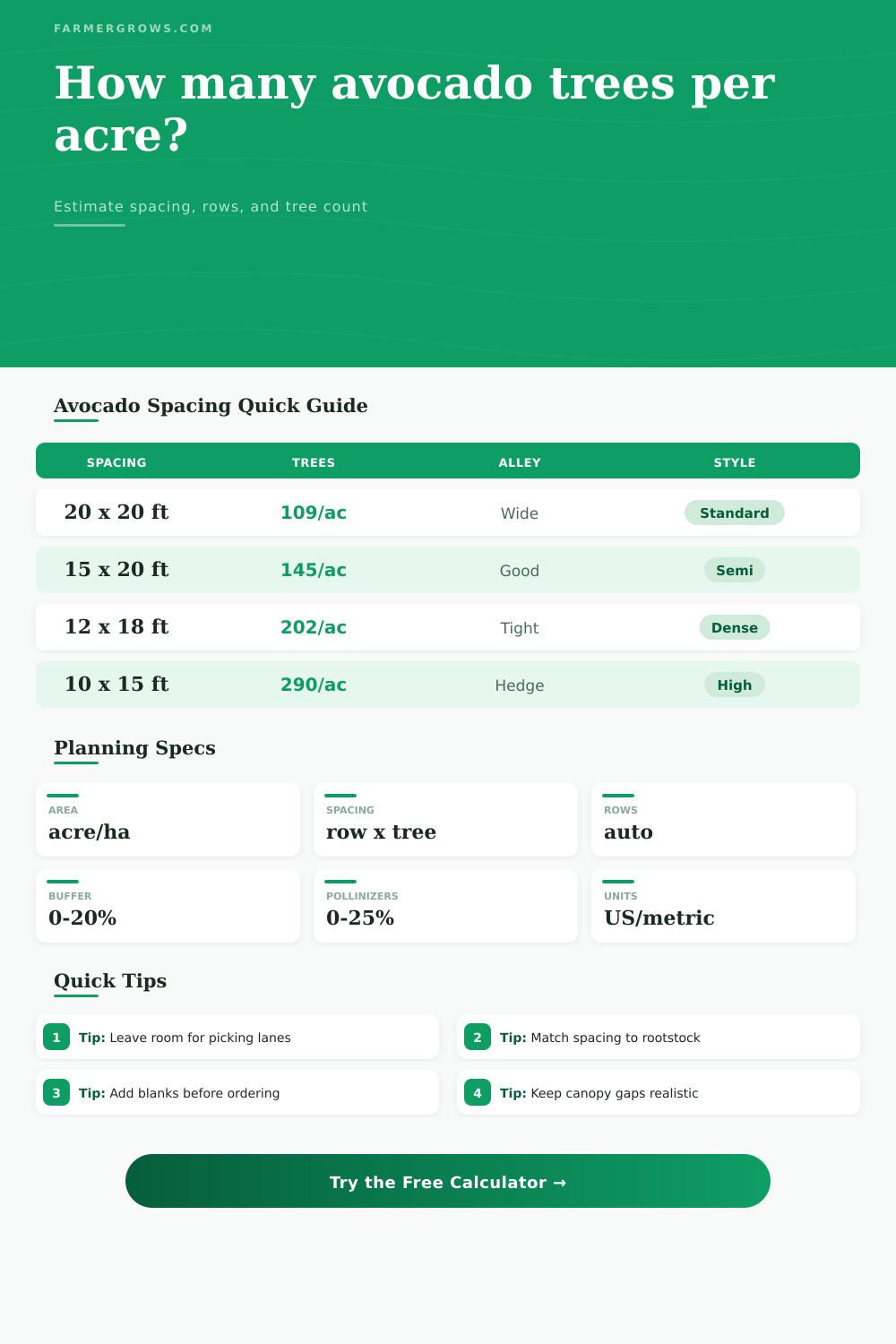
| 20 x 20 ft | 109 trees/ac | 269 trees/ha | Traditional standard orchard spacing with open centers and wide equipment lanes. |
| 15 x 20 ft | 145 trees/ac | 359 trees/ha | Semi-dense layout that balances early yield and machinery movement. |
| 15 x 15 ft | 194 trees/ac | 478 trees/ha | Dense square planting when pruning keeps canopy size controlled. |
| 12 x 18 ft | 202 trees/ac | 498 trees/ha | High-density block with a clear row alley and closer in-row spacing. |
| 10 x 15 ft | 290 trees/ac | 717 trees/ha | Hedgerow management where regular topping, side pruning, and light interception matter. |
| 8 x 12 ft | 454 trees/ac | 1,121 trees/ha | Very high-density trial spacing, normally used only with a strong pruning plan. |
| Example block | Spacing used | Tree count before buffer | Ordering note |
|---|---|---|---|
| 1 acre small farm | 20 x 20 ft | 109 trees | Order 115 trees if using a 5% replacement allowance. |
| 5 acre semi-dense block | 15 x 20 ft | 726 trees | At 10% pollinizers, plan around 73 Type B trees. |
| 10 acre high-density block | 12 x 18 ft | 2,017 trees | Headlands can easily remove more than 150 planting spots. |
| 0.25 acre backyard planting | 12 x 12 ft | 76 trees | Canopy pruning and access paths matter more than raw density. |
| 20 acre hedgerow block | 10 x 15 ft | 5,808 trees | Order extras only after confirming nursery grade and rootstock availability. |
| Planning item | Common starting range | Calculator input | Field check |
|---|---|---|---|
| Type B pollinizer share | 5% to 15% | Pollinizer share (%) | Adjust for variety mix, bloom overlap, climate, and bee movement. |
| Replacement allowance | 3% to 8% | Blank allowance (%) | Use more when trees are small, shipping stress is high, or planting is hot. |
| Emitters per tree | 2 to 6 | Drip emitters per tree | Increase as root zone expands or where soil intake is uneven. |
| Laterals per row | 1 to 2 | Drip laterals per row | Two lines can wet both sides of larger avocado root zones. |
| Headland deduction | 5% to 15% | Unusable area (%) | Include roads, turning zones, drains, slopes, and utility setbacks. |
Measure plantable ground. Avocado blocks lose real space to headlands, drainage, pump access, roads, and steep corners. Deduct those before ordering trees.
Plan the mature canopy. High tree counts can work only when pruning, harvest access, light penetration, rootstock vigor, and irrigation uniformity are part of the layout plan.
When planting an avocado orchard, it’s important to keep in mind that distance between plants will impact your bottom line. How much of an acre do you want to dedicate to a tree? Not enough room? You’re paying for empty real estate. Too tight a squeeze? The canopy block the light from neighboring trees and the fruit runs the risk of disease. It’s about finding the sweet spot between making the most of space and yield.
Most growers spaces their trees at a generous twenty by twenty feet apart. That gives them plenty of room for wide canopies and large equipment, but it also means they has fewer trees on the ground (one hundred and nine trees per acre). The downside: that’s slower returns, since the trees will be slower to blanket the ground. To get some quicker cash flow, try moving closer. For example, go with fifteen by twenty feet. You’ll have more trees on the ground (about one hundred and forty-five) and that’ll help your economics in year one through year five.
How to Space Your Avocado Trees
On this page the geometry is done for you by a calculator. All you do is type in dimensions of your field and how much space you want between rows. Then it tells you how many row, how many trees total, what mix of pollenizers, and how long of a piece of drip tape you need.
That’s right: How much irrigation? A lot of folks don’t plan that out. They end up purchasing too little lateral line or not enough emitters because they didn’t realize they needed them until after they ordered their trees. Plan ahead; order your trees first, then the irrigation network.
Another consideration is selecting pollinators. Hass avos (Type A) have male flowers in the afternoon and female ones in the morning. Pollination may be impaired on a cold or overcast day at that female stage. To help ensure success, include 10-15 percent of another variety, which would of provide insurance, like Zutano or Bacon (both Type B). With the tool, you can specify how many percentage points you want to add to reach desired density. This helps keep costs down.
Reduced useable area: Headlands (property setbacks, drainage ditches, tractor turns) will decrease the usable area of any plot. For instance, a 10 acre field isn’t going to contain 10 acres of trees. Don’t forget about the perimeter, if you don’t subtract it out, there’ll be holes in your block. Subtract between eight and twelve percent prior to calculation so that your yields is accurately predicted.
Spacing has to do with strength of rootstock as well. The root system may be small and allow for closer planting (for instance, ten by fifteen feet between plants). Other are expansive and fight over the water source. Vigorous rootstock planted too close will result in loss of nutrients from roots that reach out too far and cause root rot. The canopy width visualizer on the calculator will help you see how big the tree gets. Eighteen foot wide but only twelve feet? That means lots of pruning! It is not so bad if you can afford it, but just make sure it is not unintentional.
First, measure your equipment. Your sprayer’s only 20 feet across? You won’t be able to space rows at eighteen feet apart. Run some numbers; have a look at your soil profile. There are no universal rules for the ideal density, just a balancing act of three factors: physics, biology and economics. It is actualy more complex than that. Spacing decisions depends on many things, such as moddern farming techniques or how much room you want to leave for equipment. You should of checked your soil first too.