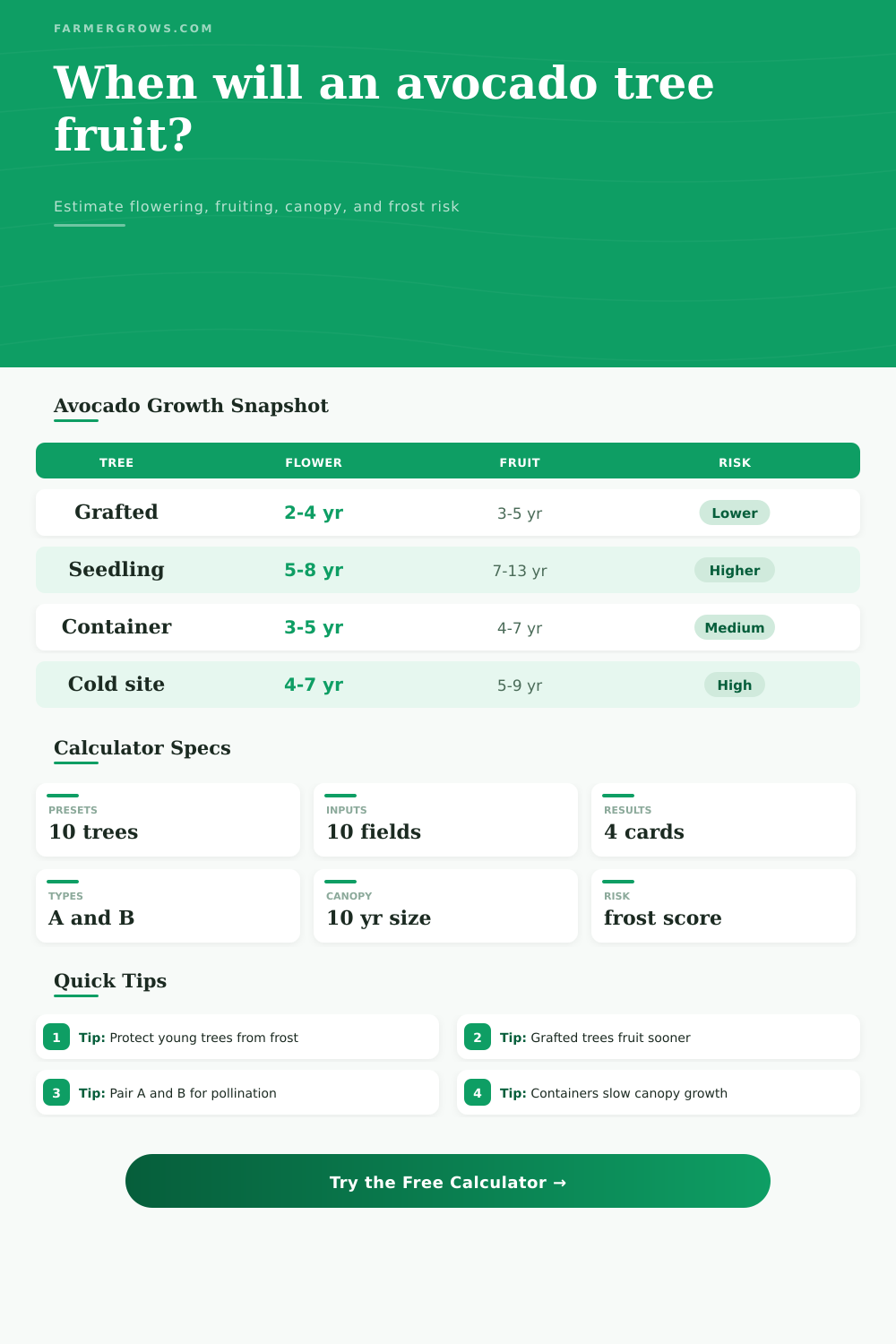
Avocado Tree Growth Time Calculator
Estimate avocado flowering age, first meaningful fruit, canopy growth, harvest season, and frost risk from grafted or seedling trees, Type A or B cultivar behavior, climate, container size, and planting conditions.
Load a common avocado planting scenario, then adjust the tree age, cultivar group, climate zone, frost exposure, and root space for your site.
Often flower young because the scion wood is mature. First useful crops still need root and canopy strength.
Juvenile seedlings can take many years to flower, and fruit quality is unpredictable until the tree matures.
Can self-fruit in good weather, but nearby Type B bloom usually improves set when flowering overlaps.
Root limits keep canopy smaller and can delay heavy crops, even when flowering begins on schedule.
Estimated Avocado Growth Timeline
Enter your avocado planting details to estimate flowering, fruiting, canopy size, and frost risk.
| Cultivar | Flower type | Grafted fruit age | Canopy tendency | Climate note |
|---|---|---|---|---|
| Hass | Type A | 3 to 5 years | Medium, upright-spreading | Reliable in mild coastal and warm inland zones. |
| Fuerte | Type B | 3 to 5 years | Large, spreading | Good partner for Type A bloom where winters are mild. |
| Reed | Type A | 3 to 5 years | Upright, large fruit | Likes warmth and room; less ideal for small containers. |
| Bacon | Type B | 3 to 5 years | Vigorous, upright | Often chosen for cooler edges and pollination support. |
| Wurtz Little Cado | Type A | 3 to 6 years | Compact, container-suited | Best for patio culture with large root volume. |
| Mexicola | Type A | 3 to 5 years | Medium, hardy tendency | More cold tolerant than many Guatemalan types. |
| Situation | Flowering effect | Fruit-set effect | Calculator adjustment |
|---|---|---|---|
| Grafted named tree | Scion is already mature | May flower young but crop light at first | Earlier flowering and fruiting baseline. |
| Seedling tree | Long juvenile phase | Fruit quality and timing unknown | Adds multiple years before flowers and fruit. |
| Opposite A/B partner | Better overlap in suitable weather | Improves set during spring bloom | Reduces fruiting delay and risk note. |
| No nearby avocado | Self-fruit possible in some sites | Crop may be lighter or irregular | Adds a small fruit-set delay. |
| Protected greenhouse | Stable warmth can help bloom | Hand pollination may be needed | Lower frost risk but pollination flagged. |
| Climate setting | Typical fit | Growth effect | Frost planning cue |
|---|---|---|---|
| Coastal mild 9b to 10b | Best all-around avocado climate | Steady flowering and moderate canopy growth | Protect young trunks during rare cold snaps. |
| Warm inland 10a to 11 | Fast growth with irrigation | Canopy fills quickly; heat may stress bloom | Shade young bark in summer and mulch roots. |
| Cool edge 9a to 9b | Possible with cultivar choice | Slower fruit maturity and more winter setbacks | Use frost cloth, mound planting, and wind shelter. |
| Humid subtropical | Works where drainage is strong | Vigorous growth but disease pressure matters | Avoid wet feet and improve airflow. |
| Cold fringe with protection | Experimental outside ideal zones | Fruit timeline depends on winter survival | Use containers, wraps, lights, or greenhouse cover. |
| Planting style | Root space | 10-year canopy | Timing note |
|---|---|---|---|
| In-ground open canopy | Best root expansion | 18 to 35 ft, cultivar dependent | Fastest path to strong annual crops. |
| Raised mound | Good drainage and oxygen | 16 to 32 ft | Helpful in heavy soil or wet winter gardens. |
| Large container | Limited but movable | 6 to 14 ft | Useful for frost protection but crops stay smaller. |
| Protected container | Limited, warmer winter | 5 to 12 ft | Can survive marginal climates with pollination attention. |
| Pruned small-space tree | Ground or large box | 8 to 16 ft maintained | Pruning controls size but can reduce next bloom if severe. |
Do not judge by flowers alone: Young grafted avocado trees may bloom before they can hold much fruit. A stronger canopy usually matters more than the first bloom date.
Pair bloom types when possible: Type A and Type B flowers can overlap enough for self-fruit, but mixed types often improve set in spring weather swings.
Frost changes the calendar: One hard freeze can reset canopy growth on a young tree. Protect trunks, graft unions, and young flushes before cold nights.
Containers need patience: A patio avocado can flower, but root restriction, heat swings, and watering stress often delay fruiting and keep crops small.
This calculator estimates planning windows. Local rootstock, irrigation, pruning, wind, salinity, soil drainage, spring bloom weather, and winter lows can shift real avocado timing.
When you buy an avocado tree, what you’re buying is a lengthy wait. From the nursery sapling you plant in spring, expecting creamy green paste, it’s three years before anything happens; maybe four. The tree isn’t failing; it are just living at its own pace which rarely matches your impatience.
That’s where calculator above comes in: Plug in your site conditions and your choice of cultivars, and it does the math on when to expect it to happen. So you don’t have to guess if something is taking too long or if that is even normal because it might be some kind of disease.
Why Your Avocado Tree Takes So Long To Fruit
Sun and soil are not as big a variable here than where the tree came from prior to getting into your hands. A grafted tree is an old guy in young-man’s clothing. It has been around the block, all right; it’s had its chance to grow up with the scion wood. It will flower just a couple of years after transplanting.
Not so with a seedling tree: Those are a whole different beast, the kids of the plant world in every way. They’ve got that pesky juvenile period to get through, years of refusing to bloom despite all the fertilizer you throw at them. Most people don’t realize this when they complain that their slow-growing seedling isn’t producing fruit like the next-door neighbor’s productive grafted Hass.
Those timelines also rely heavily on climate. Though avocados can withstand slightly cooler conditions than most people think (especially if you’re growing them in a mild part of Florida or along California’s foggy coast), they’re still tropical at heart. Your avocado in a mild climate will mature sooner then one shivering on the edge of USDA zone 9a, where cold stress forces tree to focus on survival rather than reproduction. Any cold stress will cause a tree to expend some of its energy trying to stay alive instead of reproducing.
To compensate for that, tool shifts the expected fruiting window based off the amount of frost and expected low winter temperatures. A young tree exposed to a difficult freeze may not set back just one year but two; or reset its entire internal clock.
There’s also this quiet thing called pollination. Then there’s the odd way avocado flowers work. They bloom as female in the morning, then close back up and act as male later. There are Type A cultivars like Hass that do one pattern, and there are Type B trees like Fuerte that does the opposite. If you have both kinds in your yard, the times when the females is ready will overlap with the times the males is ready, creating a better time for pollination. Sounds complicated, but it means you’re more likely to get actualy fruit (not just empty flowers) if you have two different type nearby.
Which type of tree is it? Where is just as important. If planted in the ground, it has room for its root system to extend into the soil and expand freely in all directions. This anchors even a giant tree that can bear heavy crop loads under a big canopy. For container-grown trees, there’s a maximum limit to rooting space; no matter how large a pot, your tree-in-pot cannot support equivalent amount of fruit compared to an in-ground one. The chart on the page spells this out, showing direct relationship between root volume (pot or bed) and final size (and thus yield potential).
Then there are frost risks, which you must plan for in advance. A snap down to thirty degrees can damage a grafted tree’s graft union, or even girdle its trunk if it’s young and has thin, tender bark. No amount of watering will save it; the entire tree will be dead. In marginal climates: no mulching around the base? No protection on cold nights with some kind of fabric wrap? It is non-negotiable. A small effort that’ll save years of growth.
After all, growing an avocado is as much about common sense as it is waiting; you must make sure the conditions are right, even though the biology itself is out of your control. Get a grafted tree if you’re looking for speed. Select a variety that’s compatible with your winters. Provide plenty of space so it has room to grow if you wish to eat what it produces.
It takes time, too long, to get to harvest, and once there: all too short a moment. You should of waited longer.