Avocado Tree Time to Bear Fruit Calculator
Estimate the likely years to first bloom, reliable fruit set, and first harvest for an avocado tree using planting type, cultivar group, climate, pollination, pruning, container size, and care conditions.
🥑Avocado Fruiting Presets
Choose a real growing scenario or enter your own tree details. Presets fill the form and recalculate immediately.
⚙Tree And Site Inputs
Estimated Avocado Fruiting Timeline
Your avocado tree timing appears here after calculation.
Timing Breakdown
📊Fruiting Factor Comparison
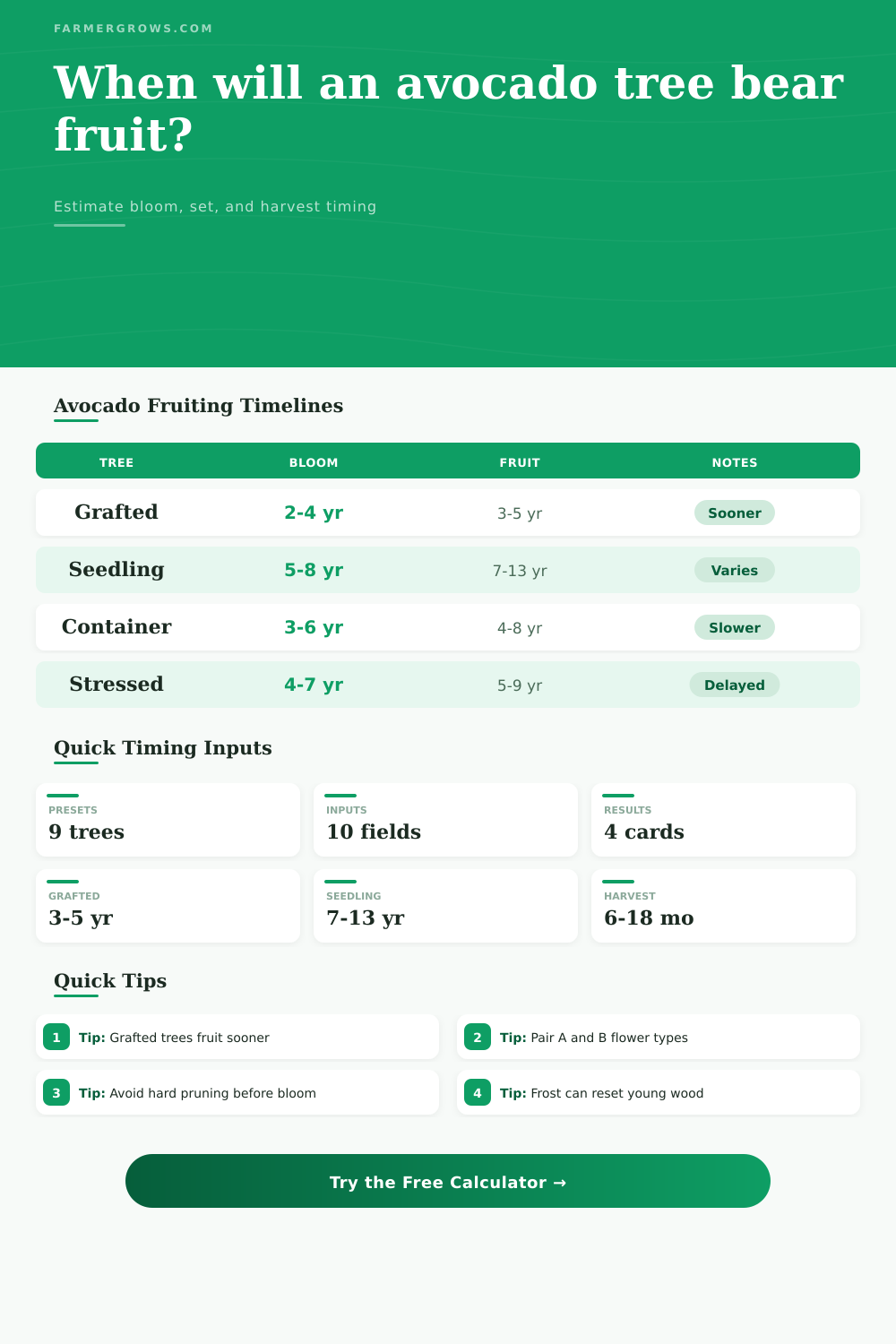
Usually carry mature cultivar wood and commonly begin bloom sooner than seedlings when roots establish well.
Need a longer juvenile phase. Fruit quality and exact bearing age are less predictable than named grafted cultivars.
A and B flower types nearby can improve fruit set, especially where weather narrows daily bloom overlap.
Frost, salt, dry roots, hard pruning, and small containers often delay the first reliable crop.
🌱Avocado Bearing Factor Grid
📘Reference Tables
Use these tables as practical reference ranges. Local climate and cultivar behavior can shift real-world harvest dates.
| Tree Origin | First Bloom | First Fruit Set | First Harvest Notes |
|---|---|---|---|
| Grafted nursery avocado | 2-4 years | 3-5 years | Fastest path when tree is vigorous and not frost damaged. |
| Clonal or air-layered tree | 3-5 years | 4-6 years | Often earlier than seedlings, but root strength matters. |
| Seed-grown avocado | 5-8 years | 7-13 years | Long juvenile phase and variable crop quality. |
| Unknown origin | 4-7 years | 5-9 years | Estimate depends on whether the tree is grafted. |
| Cultivar Group | Flower Type | Typical Maturity | Timing Note |
|---|---|---|---|
| Hass / Lamb Hass | A type | Spring to fall, location dependent | Reliable but can hold fruit long on tree. |
| Reed | A type | Summer to fall | Often productive once canopy has size. |
| Fuerte / Zutano | B type | Winter to spring | Useful partner for A-type bloom overlap. |
| Bacon / Mexicola | Mostly B or variable | Fall to winter | Often selected for cooler sites. |
| West Indian types | Varies | Summer to fall | Faster in tropical warmth, poor in cold sites. |
| Site Condition | Effect On Bloom | Effect On Fruit Set | Calculator Adjustment |
|---|---|---|---|
| Ideal mild climate | Promotes steady spring bloom | Improves fruit retention | Little to no delay |
| Cool coastal site | Bloom may stretch longer | Set can be weather limited | Adds a modest delay |
| Hot inland site | Heat can stress flowers | Young fruit may drop | Adds a heat stress delay |
| Frost-prone site | Can damage bloom wood | May reset young growth | Adds the largest delay |
| Small container | Restricts canopy growth | Limits crop load | Adds root-volume delay |
| Visible Tree Clue | What It Suggests | Fruiting Meaning | Action To Improve Timing |
|---|---|---|---|
| Strong flushes and dark leaves | Good root function | Tree can build flowering wood | Maintain steady moisture and mulch. |
| Lots of flowers, no fruit | Pollination or weather issue | Bloom age reached, set is weak | Add a partner tree or attract pollinators. |
| Heavy pruning each year | Flowering wood removed | Harvest may be pushed back | Prune lightly after harvest instead. |
| Leaf burn and tip dieback | Salt, drought, or drainage stress | Tree may stay juvenile longer | Improve water quality and drainage. |
| Fruit drops marble-size | Normal drop or stress | First crop may still be light | Thin stress, not every small fruit. |
💡Fruiting Timing Tips
Not all avocados follow one track for fruit production. Water your tree, nurture the tree, and behold as the tree grows…but the tree has no branches until? Until the initial growing conditions dictates what’s going to happen. Here’s the biggest variable: how was the tree propagated?
If it’s a nursery-grown tree that’s been grafted, it skips much of the juvenile phase, because it contains mature genetic material from the parent plant. With a grafted tree, you’ll be looking at two to four years before bloom. When watching videos of fast-growing trees online, many folks overlook this nugget: They didn’t check the origin label. But that is a different story.
Why Your Avocado Tree Takes Time to Fruit
What about growing a tree from seed? That’s different, because you’re now starting a longer wait. Seven to thirteen years later, a seedling tree could have fruit, but don’t count on its flavor resembling parent avocado. It’s a gamble, and wrapped in soil.
And then there is mother nature. The environment strongly affects delayed maturity. If the flower were grown on mature wood (they are), they came from the shoots produced last season. Anything that kills that wood set the clock back on their production. Frost damage will kill young trees’ progress and hard pruning prior to bloom cuts out the very structures that bears the fruit. The tree go back into a vegetative growth mode instead of sending itself down the road to making more trees.
Most gardeners do not appreciate just how much root volume matter. A tree in too-small container will send all its energy to survival rather than reproduction. It often waits until the root system is large enough to feel secure supporting a crop before setting fruit. Enter a calculator and let them figures out the math; you don’t have to guess at how those variables compound based off your site conditions.
Add another wrinkle (with little eye candy): Avocados’ flowers present a challenge: they actualy open twice within the same two-day window. And they’re “type A” or “B,” meaning that each flower acts as female in the morning and male in the afternoon for type A, while type B flowers does the reverse. Self-pollination is possible on a single tree, but mating an A-type with a B-type increase the number of pollen grains ready at any given time when their stigmas are receptive. That means higher odds for successful fruit set if you have early bloomers.
When pollination succeeds, the fruit remains attached long enough to ripen. The timeline from bloom to harvest is actualy longer for avocados different than for most stone fruits or berries. When you notice a few little white blooms, don’t begin marking off days till dinner. Depending on your climate and variety, avocados may take as long as 18 months to mature, though six months are typical. Because they develop over so long a period, some of the fruit you’re picking open today would of been pollinated a year ago, when those blossoms first emerged.
Some years, a certain amount of “physiological thinning,” as the orchardists call it, occurs in mid-summer, with small marble-like pieces of fruit falling from the trees. This is not necessarily an indicator of bad care or disease; it is just the tree’s way of saying, I’ve got other things to do besides feed all these furnitures.
Knowing those timelines shapes how you approach the tree. Use less fertilizer to force growth and do less panic-pruning. Give more attention to making sure it gets plenty of water through fruit-fill season and protecting older wood. Learn to read its flushes of fresh foliage for signs of health rather than expecting each one to lead straight into harvest any minute now.
Patience ceases being just a virtue; it becomes part of your strategy. When you slice open that first homegrown avocado, you’ll feel some satisfaction that nothing in the supermarket could match, because you have the inside story on what all went into it. All that waiting wasn’t wasted time; it was the tree learning to make itself capable of giving you what you wanted.