
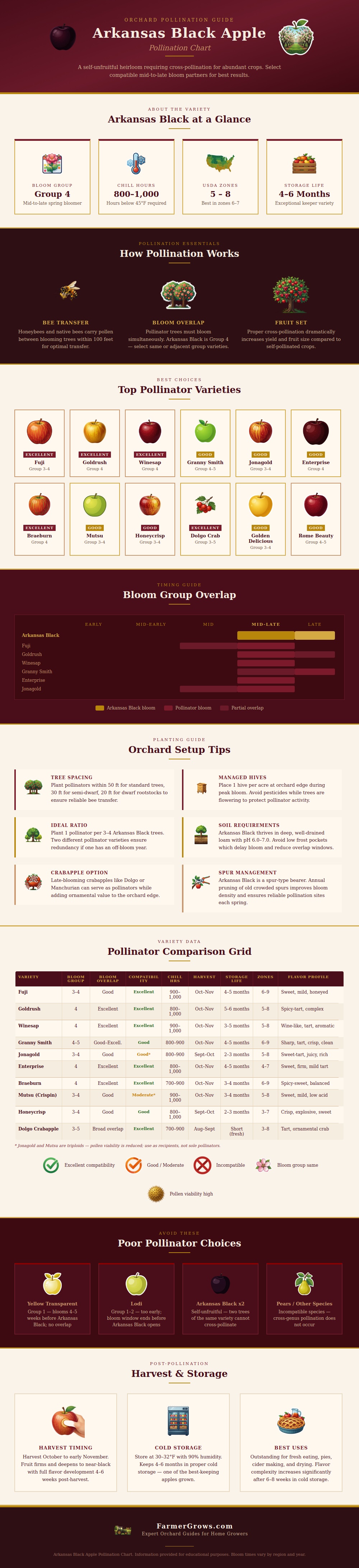
Planting heritage fruit trees is the most costly home gardening error. Most home gardeners make the costly error of planting just two of the same type of fruit tree, thinking two’s company and four’s a crowd when it comes to pollination. With the Arkansas Black apple, that kind of thinking doesn’t work at all. It’s called self-unfruitful. That means it can’t pollinate itself or another apple tree of its own variety. You will get no harvest, just gorgeous spring blooms.
Learning whom this old-time variety likes to keep company with are the key to success, or an otherwise empty orchard. But back to the problem of timing: Apples require cross-pollination from another similar variety whose bloom period overlaps theirs. Here’s where the chart above help clarify things, illustrating which varieties overlap the Arkansas Black’s mid- to late-spring blooming period. If the other apple doesn’t flower at the same time, the bees won’t carry anything across for them to use, so you’re looking for partners that will be flowering at the same time.
How to Plant Arkansas Black Apples Correctly
As you can see, both Goldrush and Fuji fills out great here (both have good genetic compatibility and overlap in their bloom window). Winesap is also a good option because of that specific timing (Group 4). These apples ensures there is enough pollen available to your Arkansas Black during those all-important couple of days when it’s ready to recieve.
The location of these trees counts, too. A bee will typically stay within about a hundred-foot distance of its nest or hive, so if you have a pollinator tree that’s out of reach, the DNA never gets transported back to the desired flowers. With normal-sized trees, the best bet is to keep companions within about fifty feet for assured transport. Trees on dwarf or semi-dwarf rootstock (whose canopies tend to be smaller) can be spaced more closely together. The idea is to form a thick grouping of complementary bloomers, not to scatter trees across a large property where bees might skip certain varieties entirely.
Beyond the apple trees, however, consider the bigger picture of how things work in an orchard. For instance, you might consider using late-blooming crabapples (such as Dolgo) as well. They provide good pollination support since their flowers lasts from early to mid-season. It is also nice to have an insurance policy against bad weather that could cut short main crop’s bloom period. The crabapples help the yard biodiversity; they also look pretty, and lure native insects. So win-win.
Don’t fall into typical pitfalls such as Lodi or Yellow Transparent apples. Those bloom weeks earlier then the Arkansas Black. By the time your primary crop flowers, all of those trees’ blooms has already fallen off. There is no intersection. There is no overlap and no pollination at all. DON’T expect any assistance from pear trees (or any other tree) either, because apples and pears don’t pollinate across genus lines, even if you plant them right next to each other. To get results, you’ll need to go with true apples in a compatible group of blooming times.
And then there’s the Arkansas Black, which really gets going once pollinated. It is one of the better keepers among all heritage apples and can be stored in a cold environment for up to six months. It also gets tastier as it ages. The flavor becomes more complex, it firms up further, and the taste intensifies as time goes by after harvest. Because it stays fresh so long, this apple could of been sold well after the season ended at other orchards, which was an important feature when the variety was first being bred. Now it means you’ll have this unique sweet-and-tart taste to get you through well into the new year.
Following these pollination guidelines from the start will save you years of heartache when planning out your orchard. Pick varieties that pollinate well together, plant them close enough to allow for bee traffic, and add backup pollinator trees such as crabapples for good measure. The payoff is a hardy system that pays dividends in bountiful, superior fruits, if you’re patient, that is. And not only will you reap an apple crop, but a continuous succession of winter crops and springtime flowers that will keep giving back for years to come.