Apple Tree Spacing Calculator
Plan apple tree spacing by rootstock, row length, and orchard width. The calculator estimates tree count, row count, density, and usable planting area before you set stakes.
Pick a real orchard pattern to seed the fields. Each preset loads typical apple spacing for a rootstock, row width, end setback, side setback, and canopy buffer.
Apple Tree Spacing Output
Calculated from orchard dimensions, spacing, setbacks, and canopy buffer.
| Rootstock | Tree Size | In-Row | Row Spacing | Notes |
|---|---|---|---|---|
| M.9 / Bud.9 | True dwarf | 3-5 ft | 10-12 ft | High density, support recommended |
| M.26 | Dwarf to semi | 8-10 ft | 12-14 ft | Small blocks and home blocks |
| G.41 / G.935 | Compact dwarf | 4-6 ft | 10-12 ft | Modern intensive planting |
| MM.106 | Semi-dwarf | 12-15 ft | 15-18 ft | Balanced access and canopy |
| MM.111 | Large semi-dwarf | 15-18 ft | 18-22 ft | Wider rows for vigor |
| Seedling | Standard | 18-25 ft | 20-25 ft | Traditional wide orchard spacing |
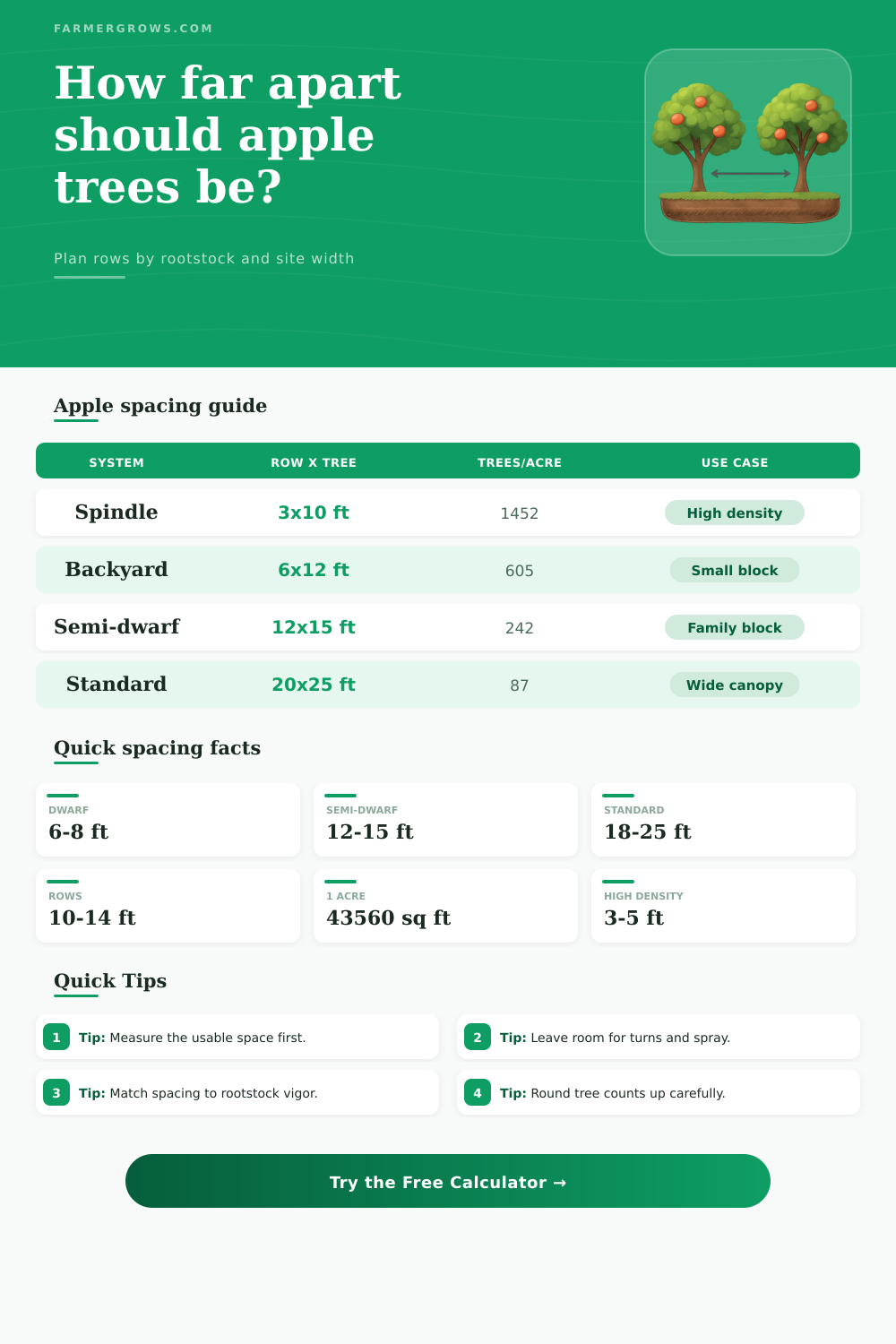
| System | Spacing | Density | Use Case |
|---|---|---|---|
| Tall spindle | 3-4 x 10-12 ft | 1,100+ | Very high light interception |
| Vertical axis | 4-6 x 12-14 ft | 500-900 | Intensive commercial blocks |
| Free-standing dwarf | 6-8 x 12-15 ft | 300-600 | Backyard and small orchard |
| Semi-dwarf block | 12-15 x 15-18 ft | 170-240 | Family orchard with access lanes |
| Standard orchard | 18-25 x 20-25 ft | 70-120 | Wide canopies and older trees |
| Row hedge | 4-5 x 10-12 ft | 900-1,300 | Thin canopies and quick turns |
| Spacing | Trees/Acre | Acres/Tree | Comment |
|---|---|---|---|
| 3 x 10 ft | 1,452 | 0.000689 | Intensive spindle spacing |
| 4 x 12 ft | 908 | 0.001101 | Common dwarf orchard |
| 5 x 14 ft | 622 | 0.001607 | Good narrow block spacing |
| 6 x 15 ft | 484 | 0.002066 | Popular semi-dwarf layout |
| 8 x 16 ft | 341 | 0.002933 | Easy maintenance access |
| 10 x 20 ft | 218 | 0.004587 | Wide home orchard spacing |
| Plot Size | 6 x 12 | 8 x 16 | 10 x 20 | Notes |
|---|---|---|---|---|
| 40 x 60 ft | 33 trees | 18 trees | 12 trees | Small backyard block |
| 60 x 80 ft | 66 trees | 37 trees | 24 trees | Compact family orchard |
| 100 x 100 ft | 138 trees | 78 trees | 50 trees | Square planting area |
| 0.25 acre | 151 trees | 85 trees | 54 trees | Quarter-acre orchard |
| 0.5 acre | 302 trees | 170 trees | 109 trees | Half-acre planting block |
| 1 acre | 605 trees | 341 trees | 218 trees | Use row access wisely |
When planning to create an apple orchard, determining the correct spacing for the trees are a critical first step. The spacing of the apple trees is critical to the health of the orchard; if the spacing isnt correct, the trees may not be able to receive enough sunlight to performing photosynthesis, or the trees may develop disease from the lack of air circulation between the trees. Several factor must be considered when determining the spacing for the orchards apple trees.
One of the factors to consider is the type of rootstock for the apple trees. The rootstock will determine the size of the apple trees. Rootstocks that are dwarf varieties, such as M.9, will result in small apple trees.
How to Space Apple Trees
These types of trees can be planted more closer together. Rootstocks that are semi-dwarf, such as MM.106, will result in medium sized trees. Semi-dwarf trees will require more space between each tree than dwarf trees.
Rootstocks that are of a standard variety will result in very large apple trees. These trees will require a large amount of space to allow for the large size of the trees. Another factor to consider is the size of the planting area.
You should measure the area where the orchard is to be planted to determine how much usable space there is for the orchard. The length and width of the area should be measured, but you should subtract each area for setbacks. Setbacks are spaces that must be created between the orchard planting area and other features of the location.
For instance, space is needed for turning equipment around at the end of each row. Once you measure the area and subtract the setbacks, the area can be divided by the distance that the trees will be spaced from each other and from the rows of trees. This will provide the total number of apple trees that could be planted in an orchard.
The type of orchard that is to be created will affect the spacing of the trees. Orchards that uses high-density systems, such as the tall spindle system, use dwarf apple trees. Orchards of this type are used to produce a high volume of fruit from a set orchard, but require frequent pruning to manage the orchard.
Other orchard systems use less space between each tree. These orchards are beneficial to create if the orchard is to be low maintenance, but will contain fewer apple trees than orchards that use high-density systems. In addition to other factors, the environmental factors of the orchard will affect the spacing of the trees.
For instance, if the soil is clay, it may be beneficial to create wider rows to allow for water to drain from the orchard. However, if the soil is sandy, the trees may allow the roots to grow closer together. Additionally, if the orchard is in an area that is known to be windy, you may need to adjust the spacing of the orchard or windbreaks.
Finally, the amount of sunlight that falls onto the orchard area should be considered. Trees planted on the north side of other objects may not receive the same amount of sunlight as those on the south side, and may require different spacing to allow for the same growth rate. Finally, the number of trees that are to be planted in the orchard should be calculated.
You can calculate the number of trees through the steps described above. However, the number should be rounded down to the nearest whole number of trees. This prevents the situation of attempting to plant a fraction of an apple tree.
Additionally, if the orchard is to be of a high density, the orchard will need to perform heavy pruning of the trees. However, if the orchard is of a low density, there will be more growing and resting space for the orchard, but few apple trees to produce fruit. Considerations of the type of rootstock of each tree and the size of the orchard will assist in creating an orchard that is capable of effectively producing apples.
It would of been better to plan alot of the spacing early. Actualy, most people dont consider the rootstocks size. Youll need to recieve the trees from a moddern supplier.