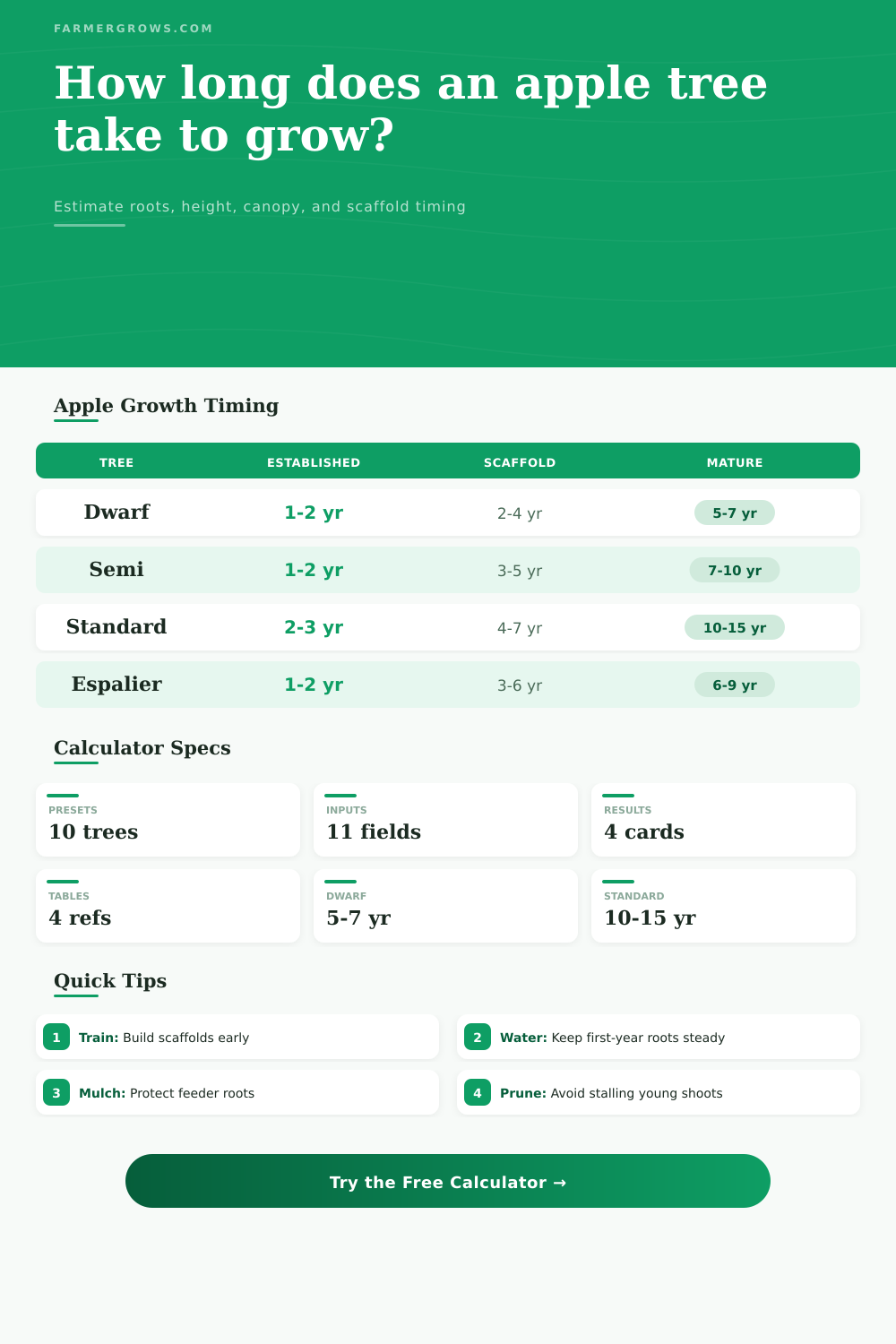
Apple Tree Growth Time Calculator
Estimate how long an apple tree takes to establish roots, extend annual shoots, form scaffold limbs, fill a target canopy, and reach mature structure using rootstock vigor, nursery age, planting style, site quality, pruning, water, soil, and sun.
Load a common apple planting scenario, then adjust nursery age, rootstock, leader height, annual extension, training style, and site stress for your tree.
Dwarf roots fill a small canopy fast. Standard roots grow taller for longer before their permanent frame is finished.
A feathered two-year tree usually saves a season compared with a small whip, as long as roots establish quickly.
Central leader, spindle, columnar, and espalier trees have different height and scaffold milestones.
Consistent moisture and drained loam keep shoot extension moving; drought, wet feet, and compaction slow the calendar.
Apple Growth Timeline
Growth estimate will update as you change the inputs.
| Apple tree type | Established roots | Framework stage | Mature structure | Growth note |
|---|---|---|---|---|
| Dwarf rootstock | 1 to 2 years | 2 to 4 years | 5 to 7 years | Small target canopy, fast fill, needs staking. |
| Semi-dwarf rootstock | 1 to 2 years | 3 to 5 years | 7 to 10 years | Balanced growth for home orchards. |
| Standard rootstock | 2 to 3 years | 4 to 7 years | 10 to 15 years | Longer structural phase with larger canopy. |
| Seedling apple | 2 to 3 years | 5 to 8 years | 12 to 18 years | Highly variable vigor and final size. |
| Training system | Early goal | Mid-stage goal | Mature target | Timing cue |
|---|---|---|---|---|
| Central leader | Straight leader and first scaffolds | Second and third limb tiers | Pyramidal tree with light penetration | Usually 4 to 8 seasons depending on rootstock. |
| Tall spindle | Leader tied and feathers managed | Narrow growth wall | Compact high-density canopy | Fast when planted with feathered nursery trees. |
| Espalier | First tier tied flat | Second and third tiers extended | Wall-trained canopy | Often takes 3 to 6 years to look complete. |
| Renovation | Remove hazards and water sprouts | Rebuild chosen limbs | Balanced older canopy | Spread major changes over several seasons. |
| Factor | Fast condition | Slow condition | Why it changes growth time |
|---|---|---|---|
| Sun | 6 to 8+ hours daily | Less than 4 hours | Light drives leaf area and shoot extension. |
| Water | Deep, even moisture | Drought or saturated soil | Root tips stop growing under stress. |
| Soil | Drained loam with mulch | Compacted, shallow, or sealed soil | Air and feeder-root room control vigor. |
| Weed competition | Mulched, weed-free circle | Grass to the trunk | Grass competes hard with young apple roots. |
| Annual extension | What it suggests | Pruning response | Growth timing effect |
|---|---|---|---|
| Under 8 inches | Stress, shade, poor roots, or heavy crop | Fix site stress before heavy pruning | Adds time to scaffold and height targets. |
| 8 to 12 inches | Low but usable growth | Prune lightly and improve mulch and water | Slow but steady framework building. |
| 12 to 30 inches | Good young apple growth | Select scaffolds and guide leader | Best range for predictable training. |
| Over 30 inches | Very vigorous vegetative growth | Use bending, spreading, and summer moderation | Height arrives fast but structure may need control. |
Water roots, not leaves. The first two seasons decide much of the growth calendar. Deep watering and mulch help roots occupy the planting hole edge.
Build structure early. Pick scaffold limbs with wide crotch angles and avoid cutting every shoot back hard each winter.
Match tree size to space. A dwarf tree can look mature quickly because the target canopy is small. A standard tree is not slow; it is building a larger frame.
Watch extension growth. Measuring last season's shoot length is often more useful than guessing whether the tree feels vigorous.
This calculator estimates structural apple tree growth for planning. Real timing shifts with rootstock identity, winter injury, soil depth, irrigation, pruning style, pests, crop load, and local weather.
In early spring you buy a bare-root apple tree, plant it carefuly, and wait. Nothing happens; nothing visible at least, except that the roots is rooting underground the first year. You get some leaves the second year (but no fruit). Then by the third year you’re checking for signs of life more often then you check your mail. Impatience is an emotion shared by all new orchardist.
In our rush to get things growing, we confuse structure with reward; we expect trees to follow our human schedule. When we realize how long they take, and that they won’t be rushed, we can adjust our expectations, and then wait (rather than impatiently guess). The calculator will help you do just that: convert biological factors into a real-world calendar, so that you’ll have a way to measure your progress instead of guessing.
How to Grow Apple Trees Successfully
This timetable comes down mainly to one thing: rootstock. If you’re a home gardener, you’ve probably selected either semi-dwarf or dwarf trees, but perhaps don’t really understand what that means in terms of structure. When you limit a tree with a dwarfing rootstock to a certain ultimate size, the tree must fill out its canopy fast, it doesn’t have far to go. A tree on standard rootstock take longer to establish a framework. Its goal is to get much bigger physically. Does this mean the standard tree will be slow growing? No. It simply needs to go further.
Understanding this can save you some frustration when your rambunctious young tree appear not to be getting taller as fast as an old neighbor’s orchard. This genetic potential is a brake or accelerator depending on watering and other soil factors. For young trees like apples in particular, they should be kept well-watered for the first couple of years. No, they won’t drink 24/7; instead, their rooting tips cease growth when it’s dry, forcing tree to expend energy toward surviving rather than expanding. Frequent dryness forces the tree to divert energy from expansion to survival, lessening any progress on its growth. Keeping soil moist (versus dry) with mulch that protects those tender feeder roots also ensures an even temperature.
The information about watering and sun exposure shows how environmental stresses slow down any structural milestones. Less light = less photosynthesis. This literally means fewer shoots extend upward. And without solid shoots, there can’t be scaffold limbs thick enough to bear the weight of what will one day become harvest. Interestingly, pruning intensity also affects pace.
A heavy heading cut may appear to force growth by redirecting energy. It can yield weak watersprouts instead of a sturdy scaffold. When you give a tree balanced cuts as part of its training, you let the tree’s underlying architecture do the work; not shock it into it. A wide crotch angle mean more durable wood. An open center lets light penetrate. You want both. A well-trained tree with correct pruning will have a good start on all this faster then one simply hacked back each year. The page’s reference table explain how different training systems impact such milestones. Because their flat shape is easier to create, espalier trees mature at a quicker rate.
The best diagnostic is shoot extension length. A picture (of leaf color) is not a thousand words; a measurement of how long last year’s shoots extended is. It grows under a dozen inches annually. Something’s amiss. Maybe too-shady conditions, poor soil drainage, or compaction. Perhaps three feet or even four feet, if it’s a strong grower. That sounds like a lot, but unless managed carefuly the tree can get top-heavy and leggy. And this measurement will help you dynamically refine your time estimates.
Slow growth, despite proper care? So you adjust your mental calendar (instead of thinking you failed). The single greatest input in any orchard equation is patience. Not all apples come from trees that bear fruit. First, there’s structure, then fruit. Pushing a young tree to produce heavy crops before the time when its limbs and its root system are able to support such weight will stunt its future vigor; or break off branches. Build the frame, then fill it in with foliage. Don’t obsess about immediate results; obsess about form.
Observe a growing tree, and what are you witnessing? It is an investment in longevity. You’re adding a permanent part of your landscape. You are not striving for a fast result, but for something that will last a lifetime and provide good yield for decades. An apple tree is about small things that change over years, not weeks or days, a lesson in patient management.
Make reasonable plans (with the help of tables and tools). And then rely on the biology. Water well. Prune carefuly. Wait for the scaffolds. The tree will signal readiness. In the meantime, appreciate the slow growth as roots stretch outward and branches reach upward. That slow, still progress yields decades of crops.