
When you choose an apple tree, you don’t just pick variety of fruit you’ll be eating. You are also picking genetics that provides defense from diseases. This is the difference between surviving and struggling.
A lot of us who grow trees at home look at a glossy photo of a red apple in a seed-catalog and say, “I like that,” and buy the thing. What we don’t know is that we has signed up for a complicated piece of biology.
Choosing the Right Apple Tree
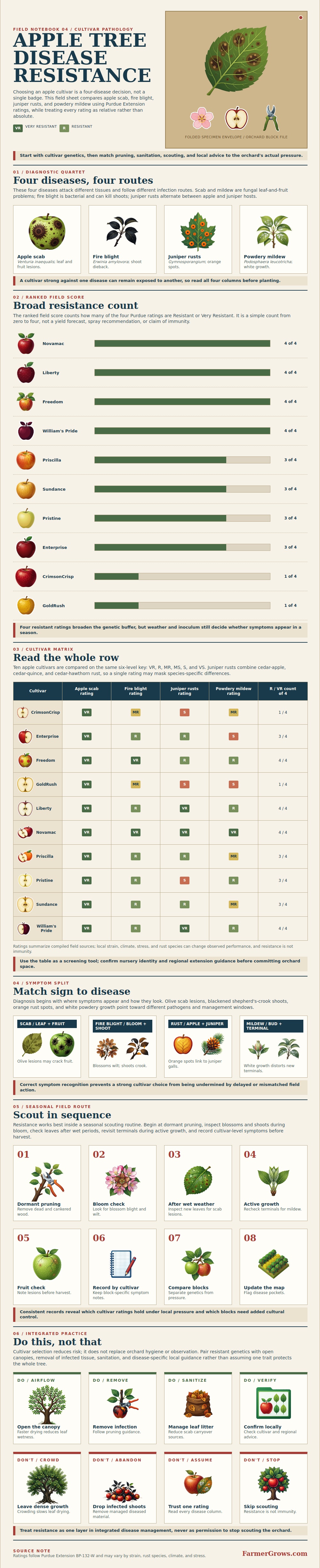
It’s true: there is no such thing as a disease-resistant apple tree. Instead, there is a multi-step selection process involving four different kind of potential attacks, each with its own set of vulnerabilities. Knowing about those attacks alters the way you think about planning your garden; a resistant tree may resist one but not another.
The chart above compares varieties to powdery mildew, apple scab, fire blight, and juniper rusts. The scale is from very susceptible to very resistant… But the beauty of it are getting the full picture at one glance.
Maybe there’s a variety that’s resistant to fungal scab (the leaves turn all black and withered masses). But then maybe that same plant are not resistant to fire blight (curled-and-dying shoots is the symptom). That’s where the mistake many gardener make, they get fixated on what they can see first hand, and don’t consider everything else.
Before making a plant choice, read all four columns. There are also some cultivars that rate highly on all four measures. The ones with strong resistance to all four is: Freedom, Liberty, William’s Pride and Novamac. That’s wide-spread resistance; so less spraying (or severe pruning) should of be necessary. This means the tree will work with you, though it still needs your attention.
There are other varieties that do very well at one thing but poorly than another. For example, CrimsonCrisp resists scab but is prone to powdery mildew and fire blight. Is the flavor of fruit worth taking on those extra chores to control particular diseases? Again, no failure of fruit here, just a trade-off.
The “resistance” is not absolute, but rather relative. Meaning: The rating indicates that a resistant tree will have higher odds of survival when compared to other trees subjected to average pressure, but it doesn’t indicate invulnerability. This process is heavily dependent off weather. Even the best-resistant genetics cannot handles a wet and humid spring. Your location matter here, too. Inoculum levels in your area will determine whether your resistant apple may succumb anyway if your nearby neighbors has untreated, rust-infected juniper trees.
To combat this, the guide recommends pairing genetic selection with cultural practices: Keep canopies open (allowing air circulation) so they dry more quickly, which makes foliage less appealing to fungi. Clean up fallen leaves and remove any infected wood to reduce next year’s infection source.
The last element is scouting. If you don’t know what you don’t know…you can’t manage it. That’s why the graphic suggests a season-long routine (shown above), starting with dormant pruning, followed by checking for bloom issues, and finally inspecting the leaves post-rain. Then I catch issues early while there is still time to manage them. Waiting till harvest? Too late.
I’m trying to build conditions in which the tree’s own defenses will function. Minimizing the risk factors, or reducing the odds against it. And that’s what good garden design does… When you combine sound choices in cultivars with regular inspection and smart sanitation. Then you’re no longer just reeling from one crisis after another; insted you are pre-empting them.
Genetics is one thing, but managing them is another in growing apples. Your eyes and your hands has to do the work, too, and this chart gives you the tools to do that work wisely. You set yourself up for a healthier orchard by knowing that resistance is never guaranteed (it’s a spectrum), which allows you to select the best tree for the job and provide the conditions it needs to thrive. That’s how you get the fruit on the tree and the rot on the ground.