
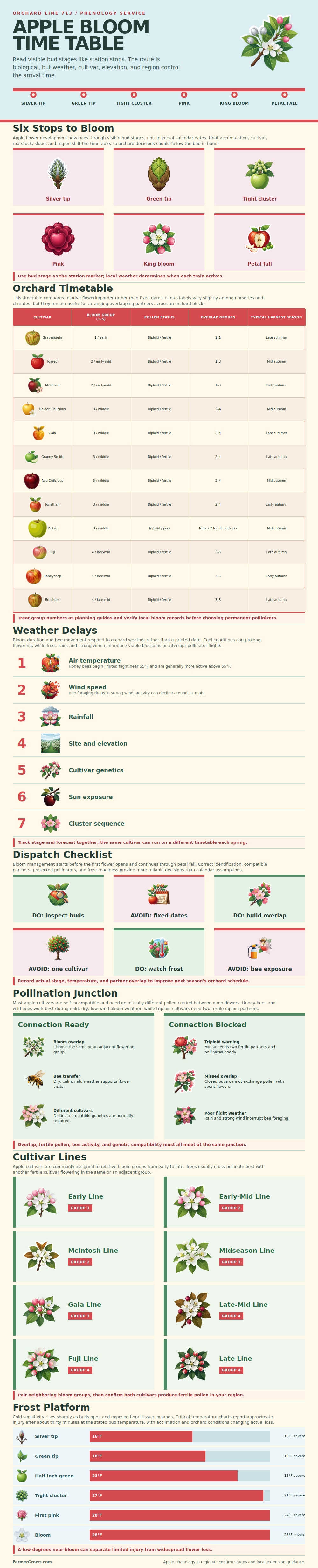
Don’t get out your calendar and mark down April fifteenth to assume when apples will bloom. The trees aren’t going to do that. An orchard’s natural timetable bears no relationship to the Gregorian calendar; one of the rookie mistakes beginning growers make is forcing it to align with their own.
Instead of rigid dates, flower development occur in a series of observable bud stages. You have to know how to read what the tree tells you. It’s like getting on a train at one stop and knowing where each subsequent stop is. The stops are fixed; its just that arrival time changes based off local conditions.
How to Watch Apple Tree Buds
Silver tip begins the process. At this point, those protective scales starts to separate. Then comes green tip. Then comes a tight cluster. Finally, pink starts to show through. Next is king bloom and lastly, it’s petal fall.
Why do these happen in this order? Because there is a window of chance and risk. Cold snaps don’t affect early stages so much. Once the pink opens and those petals spread, the tissue are quite vulnerable. A slight drop in temperature that was insignificant during the silver tip period will wreak havoc on crop when it’s out in the open. Understanding that timeline allow you to anticipate frost risk. Instead of reacting to damage, you can plan ahead.
Once you know what stage you’re in, think about who’s going to do the pollinating. Apples often cannot fertilize themselves. That means a tree won’t be able to fertilize itself with its own pollen. You’ll need another tree nearby, of different type but one whose bloom period matches your tree’s. Bloom groups can help you plan for that. These break down varieties into early, mid and late categories. This helps you plan where to place your trees to make sure they has overlapping bloom periods. Planting an early one beside a late one, for example, without a middle bridge is likely to produce no fruit. Their bloom windows won’t meet.
But then again, having the right trees is only half the battle. And then there’s the matter of how bees get from one tree to another. The conditions they work under matter. Honey bees won’t venture out until it gets above fifty-five degrees Fahrenheit in their hive. Rainy days or high winds will also limit its activity. Even when you’ve got the ideal genetic matches, a bad day for weather can stall pollen transfer between plants. Good management can fail when there is a gap between the weather and the moment the plant are ready. Planting the optimal combination of cultivars isn’t everything. Without knowing what the weather in your particular area is like, you’re just gambling, not doing any science.
And then there’s the fact that some varieties are triploids (meaning they have three sets of chromosomes instead of two). These produce poor pollen and require two distinct diploid partners in order to be fertilized. This isn’t solitary tree-planting; this is system-building. See the orchard as an interconnected network rather than just a collection of individual assets to make something: a crop.
Observe the buds, not the calendar. Spring comes, but don’t go by the calendar anymore. Go outside and check the branches. What’s that, the very first sign of silver? Watch the trend in temperatures. Is it about time for your companion trees to be here, too? It becomes a practice of observation, of managing blooms, not just hoping for them.
The transition: from hoping for apples to actualy growing them.