Apple Seed Sprouting Time Calculator
Estimate apple seed cold stratification, refrigerator days remaining, warm sprout phase, planting target, moist medium risk, scarification effect, sprout probability, and expected emergence window.
📋Apple seed presets
Choose a named apple seed scenario to fill the calculator with realistic cold days, age, medium, warm temperature, scarification, and planting target assumptions.
🍎Seed lot and cold stratification
Apple seeds are dormant at harvest. The estimate combines cultivar tendency, seed age, moist cold days already completed, refrigerator temperature, medium choice, and interruptions.
💧Moist medium and warm sprout phase
Moisture and warmth change both the timing and the odds. Apple seeds often crack first in a bag or towel, then finish emergence after planting in a warm mix.
Apple seed sprouting estimate
Calculated estimate will appear here.
Calculation breakdown
🌱Sprouting plan metrics
🔍Comparison grid
Use these quick comparisons to see how the same seed batch shifts with common apple-starting choices.
Fridge first
Direct warmth
Paper towel
Potting mix
📚Apple sprouting reference tables
| Seed source | Cold target | Warm phase | Notes |
|---|---|---|---|
| Honeycrisp | 75 days | 14-28 days | Moderate dormancy |
| Gala | 70 days | 12-25 days | Often steady |
| Fuji | 80 days | 14-30 days | Allow full chill |
| Granny Smith | 90 days | 18-35 days | Longer chill |
| Antonovka | 90 days | 14-32 days | Rootstock batch |
| Condition | Range | Effect | Action |
|---|---|---|---|
| Ideal fridge | 34-41°F | Best chill | Keep moist |
| Too warm | 45°F+ | Slow dormancy break | Add days |
| Freezing | Below 30°F | Uneven response | Avoid ice |
| Dried out | Any temp | Resets progress | Re-moisten |
| Wet and moldy | Any temp | Lower vigor | Air, rinse |
| Warm temp | Expected time | Probability | Use |
|---|---|---|---|
| 58-62°F | 25-45 days | Lower | Cool room |
| 63-68°F | 18-35 days | Fair | Window area |
| 69-75°F | 10-25 days | Best | Seed bench |
| 76-82°F | 12-30 days | Good | Watch drying |
| 83°F+ | 18-40 days | Lower | Reduce heat |
| Target | When to plant | Depth | Spacing |
|---|---|---|---|
| Indoor pot | Root tip shows | 1/2 in | 1 per pot |
| Cell tray | After chill | 1/2 in | 1 per cell |
| Nursery bed | After frost risk | 1/2 in | 6-12 in |
| Rootstock | Uniform cracks | 1/2 in | Dense tray |
| Spring outdoor | Soil workable | 1/2 in | Thin later |
The medium should feel like a wrung-out sponge. If water pools in the bag, open it briefly and wick away excess before returning seeds to the refrigerator.
Apple seedlings do not come true to the fruit cultivar. Use the named source for sprouting behavior and planning, not for guaranteed fruit traits.
So you pull a Honeycrisp from the orchard stand, eat it on the drive home, and save the seeds for tomorrow. Aha: You’re feeling like a gardener magician, except that nature made apple seeds biologically stubborn creatures. In other words: not ready to grow now. Not until they get cold first. Which means they insist on wintering first, and will simply remain dormant and unconcerned with all your dreams of a backyard orchard unless they’ve had their fill of chilling.
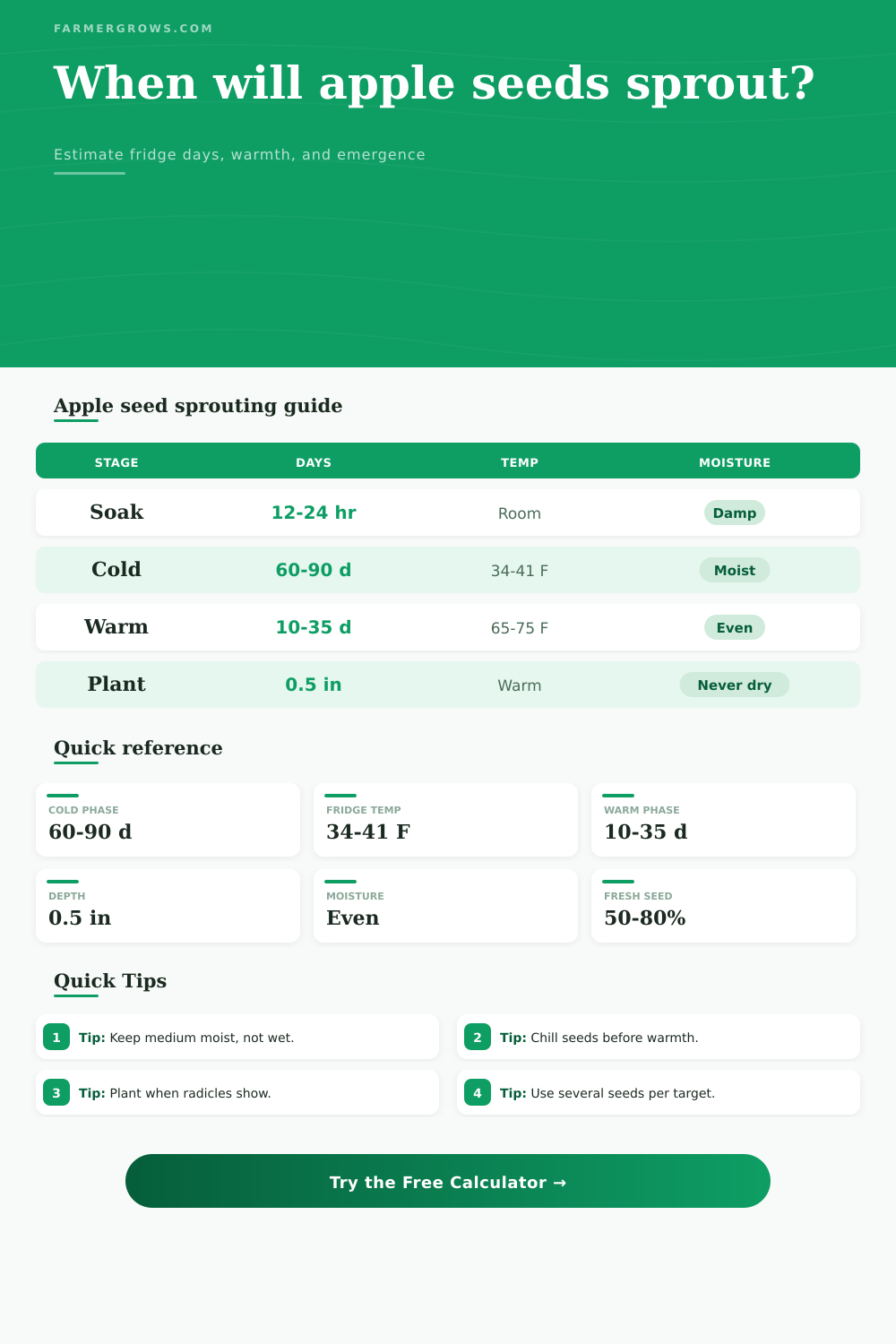
Use the calculator above and tell it what you stored when and how, and it does the math to figure if that time spent in your fridge is time well-spent (or wasted). Cold Stratification: This is another fancy name for fake winter, but it’s really the main part of this whole thing. To break dormancy, most apples requires a minimum of 60-90 days in consistently cold conditions. Chilling, not freezing; temperature makes a difference, and you want it to be between 34 and 41 degrees F. If it freezes solid, the seeds gets damaged inside their cells, killing the embryo. If it stays around 50, no chill occurs and no chill is built up. A tight range, so pay attention to what your fridge is actualy doing, not necessarily what its dial says.
How to Grow Apple Trees from Seeds
Sealing the plastic bag and managing moisture is difficult (this is how most home growers lose their batches). Keep the medium moist, as if you just wrung it out, but not wet enough to form puddles at the base of the bag. Any standing water promotes mold that will rot the seeds before giving them an opportunity to sprout. If the paper towel fully dries out, then you’re reset to day one on the stratification clock. Back to zero days chilled.
This is why we check once a week or so (even though each check exposes them to warmer air for a few seconds), but a quick wipe-down and reseal keeps the humidity steady without triggering condensation floods. A brief wipe-down and seal restores humidity levels without starting another round of pools.
After the chill (that’s the hard part), they want to be warm again, but not too warm, just enough to really awaken them. When you take the seeds out of refrigerator and place them in a warmish spot, like your house that’s maybe 70-ish degrees F, the radicle (the little emerging root tip) start pushing through. It can take two to five weeks, depending on how strong the seeds are and their variety. The fresher the better; this year’s crop has much better germination than the same variety I’ve had languishing in a jar for several years. Old seeds are less viable, and may take longer to start sprouting…so give yourself some time and maybe plan to start with extra seeds just in case you don’t get enough seedling.
Another easy gotcha: How deep do you plant? About half an inch of soil over the seed is ideal; any shallower, it may dry out on top. Any deeper, the teeny little root will have to use precious resources trying to push through to the surface while still underground, without the benefit of any greenery yet to photosynthesize. Half an inch balances the forces of easy germination and just-right-amount-of-protection. When that white root emerges, handle it with care. The tender emerging root can be damaged if it is bumped around while transferring seed to a cell tray or pot.
Remind yourself, too: When you grow an apple from seed, you’re usually not creating a copy of the fruit whose seed it was. Plant a seed from a Honeycrisp and it won’t make a Honeycrisp tree. It’s a genetic mix, probably producing something altogether distinct, that’s part of what makes this sort of thing mainly an experiment or source of rootstock material. The point isn’t any particular trait of the fruit; it’s the act of drawing life out of dormancy. You’re participating in the biological need of the plant itself, honoring it by forcing it to rest first, then coming to life again.
This is all laid out on the page in reference tables where it shows how varying conditions will change the number of days needed to chill. Storing seeds in a humid shed? Your fridge runs warm? Those can add more days than usual. Expecting those realities will help you avoid premature sowing. And disappointment. Rushing things rarely works; patience really does pay here.
Give the seeds the respect they deserve. Keep them airy but always moist. Let the cold do its work, and then introduce the heat. The reward is a vigorous seedling that started growing when it was ready, and not a minute sooner. You’re most likely to succeed starting with new seeds, but even old ones will sometimes take if you provide proper conditions. Don’t expect high yields, but follow the timing of the method. Get the hang of the warm-chill rhythm, and sowing apples from seed is no longer a gamble; it’s a doable thing that works reliably.
Next year you buy another Honeycrisp at the orchard stand, and again you pop out the seeds, but now you know what to do with them till spring arrives.