
An apple blossom is a pretty pink puff signaling that spring is here at last. Yes, but you’d be right only if you stopped there. Look closer and what do you see?
It is a reproductive cluster of amazing complexity, a hierarchy in which each part fits into a strict sequence of events, and a tiny window of opportunity where it must succeed or fail entireley. There is a reason why the central king flower are the first to open, followed by its smaller lateral counterparts; how that unfolds dictates much about the quality of eventual crop, and even the tree’s vulnerability to a late spring frost. Getting to know its structure shifts your perspective in the orchard, from calendar dates to real-time observation, and alters how you manage things.
Why You Should Watch Apple Blossoms Closely
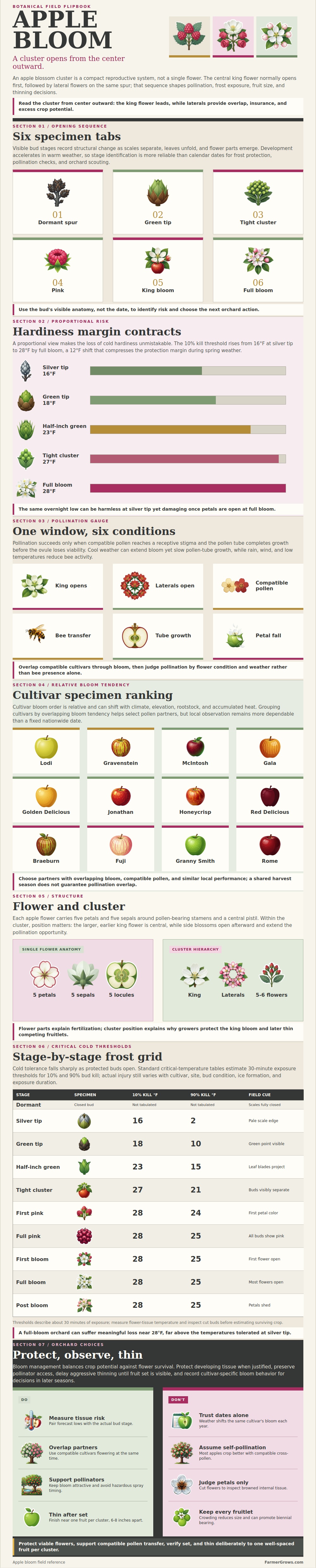
This graph shows how the bud stages moves from dormant spurs to full bloom (visualized above). The important thing to remember: In warm weather, things happen fast, meaning stage identification is much more accurate based off what’s physically happening rather than by referring to the calendar. A warm February can rush a tree to full bloom weeks before a cold one would, so being able to check the physical state of your buds mean that if you’re relying on a set date as “when it’s time to worry about frost,” well, you may have missed it already.
Risk increases with each phase of change, which is why understanding exactly where you are is so critical. But once those buds open, cold hardiness take a nose-dive. A fully opened flower is much easier to damage from temperatures that might only harm a dormant bud. The chart shows how quickly that safety cushion narrows. The tree can tolerate much lower temperatures when the buds is just beginning to swell than when the flowers are fully open. It’s a subtle but important change: a matter of several degrees’ difference between a bumper crop and a complete failure.
Because the blossoms may cool much faster through radiation from cold nights then their surroundings, they’ll also have a different temperature than the surrounding air, and you want to know what that is. Measuring tissue temp instead of simply air temp will save orchard crops each year.
There’s another wrinkle: Pollination. Just having bees around doesn’t do it.” Then there’s the matter of that all-important pollen tube germination, which only has so much time to finish before the ovule goes bad. To add insult to injury, cool temps also prolong bloom. (You’d think that would of been good, but no.) Rainy days? Windy days? Bees aren’t doing much of anything.
As the infographic explains, your chosen cultivars must match-up and overlap in their bloom periods; meaning they have to flower at the same time. Two trees whose apples ripen simultaneously in fall don’t necessarily pollinate one another come spring, when it really counts. And again: You must pick partners who flower in sync. That’s where a home-scale gardener gets tripped up.
Then the fun starts: the actual job of fertilizing. That’s when thinning comes into play. So many people don’t start thinning until it’s already too late, which results in small fruit and crowded branches. We want to leave one nice-sized fruit on each cluster with good spacing, and no more than that. Otherwise the tree exhaust itself, and there is a chance for what is called biennial bearing, when the tree produce heavily one year and doesn’t produce the next as it tries to restock itself.
So it’s a game of both protecting the viable blooms while they’re open and helping the pollen get around to them, but also letting go afterward. It’s like learning to recognize the flower: each year you get better at it. You learn to trust your eyes more than the almanac. You begin to identify the king flower in each cluster, which is the one that starts the charge. You also find the insurance laterals that are there if the first one doesn’t work. You observe the weather (not only the temperatures), but also what favors or inhibits the pollinators. You no longer guess; you manage, because you know how the bloom works, and when to intervene, and when not to.
The apple isn’t simply bearing fruit; it has a complex biological plan happening. And you need to learn to let it do its thing, until it signals that it needs help…and then give it only as much as it wants. The bloom moment is fleeting…but everything you decide in those moments echoes throughout the season.