Anaheim Pepper Growth Time Calculator
Estimate transplant timing, first green roasting harvest, red ripe drying window, pod length, mild heat, plant density, and fresh-to-dry yield for Anaheim and New Mexico chile peppers.
This planner is tuned for Anaheim and New Mexico long green chile types: thick-walled pods picked glossy green for roasting or left red for drying. It is not a poblano, banana pepper, cayenne, or generic hot pepper calendar.
Anaheim Chile Harvest Estimate
Results adjust cultivar timing for green roasting pods, red drying pods, transplant warmth, site, stress, pod length, and frost fit.
| Cultivar | Typical heat | Green roasting stage | Red drying stage | Pod length cue |
|---|---|---|---|---|
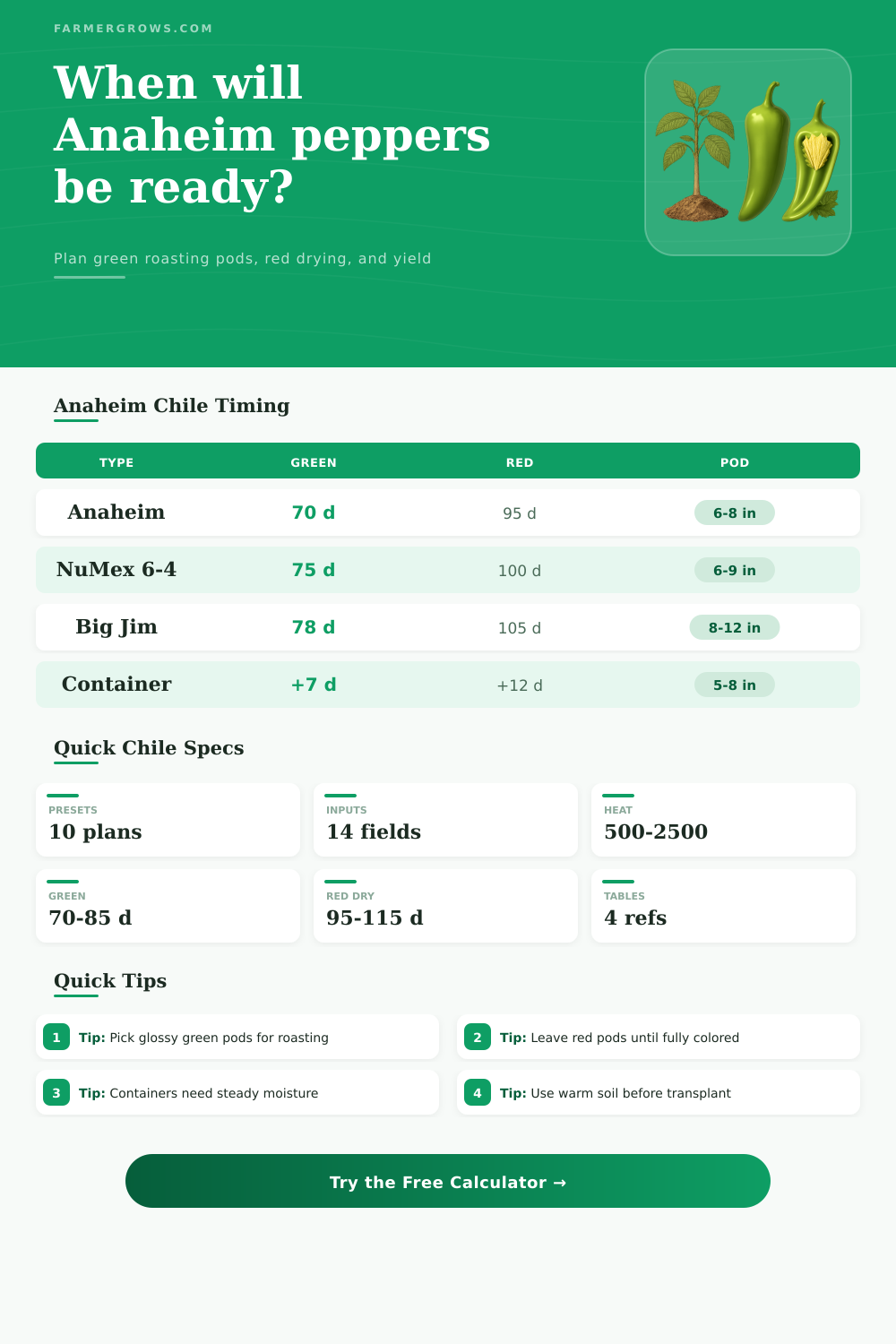
| Anaheim | Mild, about 500 to 2,500 SHU | 70 to 78 days after transplant; glossy green | 92 to 105 days; full red color | 6 to 8 inch tapered pods |
| NuMex 6-4 / Heritage | Mild to medium New Mexico chile | 74 to 82 days; thick green roasting walls | 98 to 110 days; good red chile strings | 6 to 9 inch pods with shoulder width |
| NuMex Big Jim | Mild to medium, larger pod | 78 to 88 days; roast when long and filled | 104 to 118 days; dry only fully red pods | 8 to 12 inch pods, often uneven size |
| Joe E. Parker | Mild New Mexico green chile | 72 to 82 days; uniform market green pods | 98 to 112 days; red pods for drying | 7 to 10 inch pods, straight to slightly curved |
| Highlander | Mild, cooler-season performer | 70 to 80 days; earlier green set | 94 to 108 days; use red pods before frost | 6 to 8 inch pods on compact plants |
| Stage | What to look for | Best use | Timing note |
|---|---|---|---|
| Early green | Pod is long but still narrow or dull | Small fresh chile, not the best roaster | Usually 5 to 10 days before prime green |
| Green roasting | Glossy green, firm walls, full pod length | Roasting, peeling, freezing, rellenos, stew | Main Anaheim harvest, often 70 to 85 DAT |
| Color break | Green pod shows orange or red patches | Fresh sauces or a transition pick | Often 10 to 18 days after green stage |
| Red ripe | Fully red, sweeter, slightly softer walls | Drying, ristras, red chile powder or sauce | Often 95 to 115 DAT, frost permitting |
| Setup | Spacing or pot size | Timing effect | Yield tendency |
|---|---|---|---|
| Field row | 18 to 24 in plants, 30 to 42 in rows | Baseline timing if soil is warm | Strong yields with drip irrigation and mulch |
| Raised bed | 16 to 20 in spacing, rich warm bed | May run 2 to 4 days earlier | High yield per square foot if watered evenly |
| Large container | 7 to 10 gal per plant | Often 4 to 8 days later in hot or dry spells | Good patio crop, smaller total root zone |
| Small container | Under 7 gal per plant | Often 8 to 15 days later and stress-prone | Lower pod count unless moisture is steady |
| High tunnel | 18 to 24 in plants with ventilation | Often 3 to 7 days earlier for green pods | Longer red window if heat is managed |
| Use | Pick stage | Fresh amount | Expected finished amount |
|---|---|---|---|
| Fresh roasted green chile | Full-size glossy green | 1 lb fresh pods | About 0.65 to 0.8 lb roasted and peeled |
| Freezer packs | Green roasting pods | 10 lb fresh pods | About 6 to 8 lb roasted chile |
| Dried red chile | Fully red ripe pods | 5 lb fresh red pods | About 0.8 to 1.0 lb dry chile |
| Powder or flakes | Red pods dried brittle | 1 lb dry pods | About 12 to 14 oz usable powder or flakes |
Pick Anaheim pods when they are long, glossy, firm, and still green. Leaving every pod to red reduces repeat green harvest weight because the plant holds fruit longer.
Use a 7 to 10 gallon container for one Anaheim plant, keep moisture even, and feed lightly but consistently. Small pots push blossom drop and short pods faster than field rows.
At day 70: Your Anaheim peppers is still green, and you’re panicking. Or maybe you have another variety that takes 77 or more days to ripen, and should of been ready for the dry-weather fall drying regimen, or for eating now in early summer. They just don’t want to give up their fruit; they’re looking perky enough.
The calculator removes guesswork (plug in your transplanted-on date; add your soil conditions). Panic becomes plan. Growing degree days are key, and here’s why: You know what? You don’t grow these peppers on calendar days, you grow them on growing degree days (that’s how most gardeners think).
How to Use a Calculator for Your Peppers
The reason they give you a number of days, like “seventy-five days” on the seed packet, is based off an ideal world of warm soil and perfect weather. The real world isn’t that way. The tool starts with their baseline, your seedpacket number… And tweaks it for your own set of conditions.
Planting in a pot? It delays things, which make sense since roots can only take up so much space. When moisture leaves the soil fast, it will dry out even faster than in the ground. A seven-gallon pot dries out faster then the ground during a hot day. The model shifts your expected harvest window later by a week or more, to account for that.
Don’t waste plants that need extra time to ripen. Transplanting is where many people makes mistakes. First they put things outside immediately when frost danger passes. Cold soil is no friend to peppers. Even if the air is hot, your root growth will be stuck until your soil reach 65 degrees F and above. That’s why it shows up as an input on the system, because whether plants survive or feed depends on the soil temperature, not just the air temp. Stall out on the starting gate, and everything else get pushed back. Instead of red pods by mid-October, you might have orange ones at first frost. Plan ahead for that setback, and you’ll have a realistic cushion to work with. Then you will know if it’s time to let those fruits go red for drying, or pick some green one off the plant for roasting.
Key: Red vs. Green picking (also known as harvest): With any yield-management plan, you need to understand this difference: Picking only glossily-green pods tells the plant to keep producing; leaving some pods on the vine to go reddish-brown indicates to the plant: Slow down, people! The calculator gives an estimate of what you will recieve at which stage.
Want both dried ristras, and also roasted peppers? Know that the former comes at the cost of overall volume. It’s a give-and-take: How much do you want to preserve versus how much? Knowing the balance will help you decide how many rows to plant to get what you want in both areas, rather than ending up with small crop.
Varieties differ in pod length; length can sometimes depend on steady care and therefore also tends to be even. Standard Anaheim pods range from six to eight inches; Big Jims can stretch past ten inches. Knowing that will help you judge if your pods is small because of stress, which usually shows up as misshapen fruit or even blossom drop. Or, they might just be that way because of their genetics.
Moisture helps avoid any such problem. Keep the plant fed lightly but consistently, and it stays out of survival mode and focused on producing fruit. With Anaheims (and all other peppers), this is not so much about forcing them to grow as it is about what you expect based off the weather. And the calculator helps shape those expectations. It makes hope into a plan. Know what you should be expecting, when to expect your first green for roasting or your last red for drying, and meal plans can fit into garden calendar. That confidence changes gardening habits with the plants. You don’t fuss; you watch. Then typically they comes when expected.