Alfalfa Hay Bale Weight Calculator
Estimate alfalfa bale weight, dry matter, feedable tons, storage shrink, and the bale count needed for a dry matter goal from bale shape, dimensions, density, moisture, cutting, and leaf retention.
Pick a common alfalfa hay bale situation, then fine tune the actual measured dimensions, bale count, moisture, storage loss, and feed value class for your stack.
Alfalfa Bale Weight Results
Results update from bale size, density, moisture, cutting, leaf retention, storage loss, feed value class, bale count, and dry matter goal.
Often bulkier with more stem. Weight can be strong, but leaf retention decides how much premium dry matter stays in the bale.
Usually finer stemmed and dense. Many dairy and horse hay lots fit the good or prime feed value class here.
Shorter, leafier hay can pack tightly in small squares and dense large squares when baled at safe moisture.
Late cuttings can be very leafy but may be lighter if windrows are thin or if curing conditions limit bale tension.
| Bale format | Typical dimensions | Common dry density | Typical as-fed weight |
|---|---|---|---|
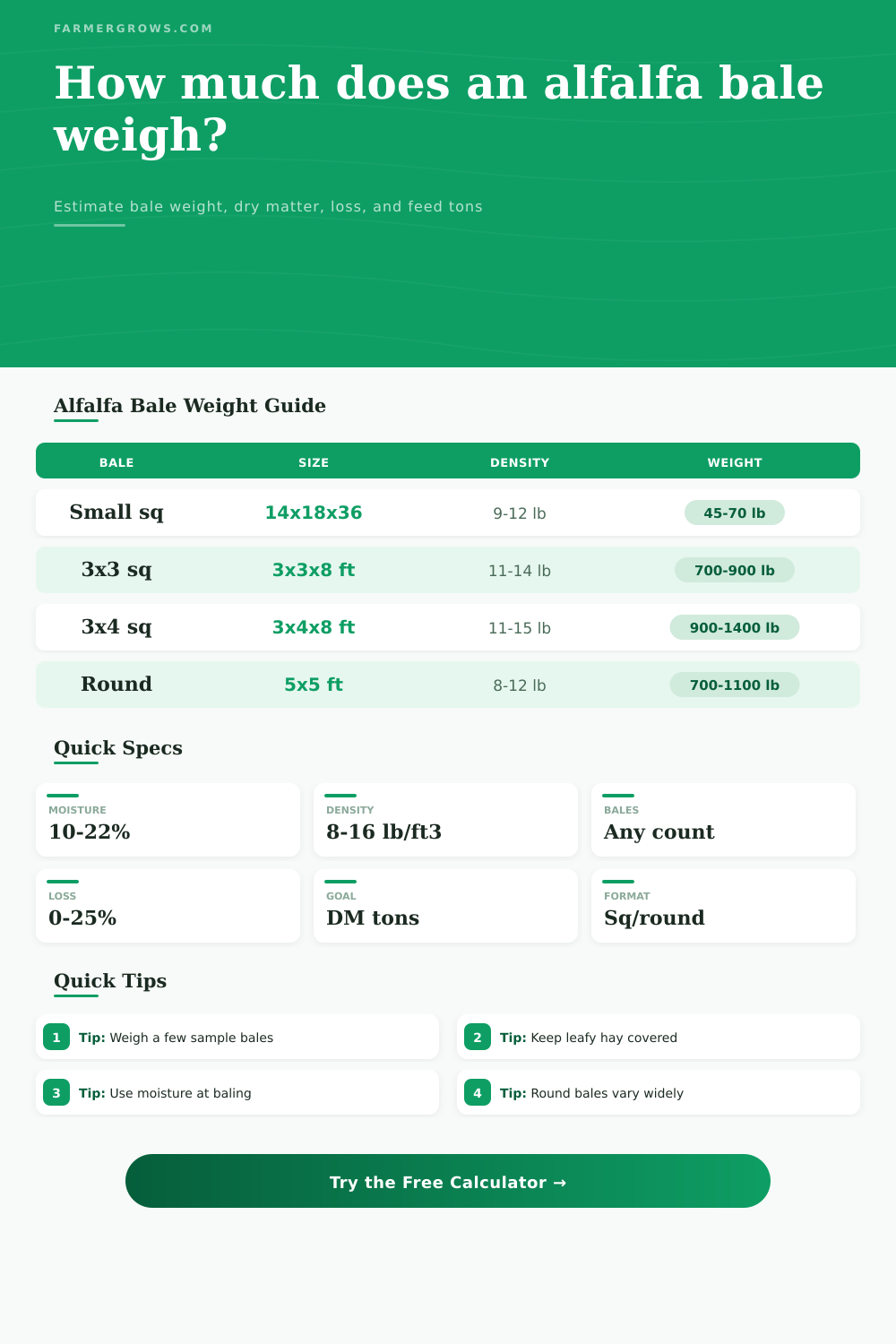
| Small square alfalfa bale | 14 x 18 x 36 inches | 9 to 12 lb per cubic foot | 45 to 70 lb per bale |
| Two-tie long small square | 16 x 18 x 42 inches | 9 to 13 lb per cubic foot | 60 to 90 lb per bale |
| Large square 3 x 3 x 8 | 36 x 36 x 96 inches | 11 to 14 lb per cubic foot | 700 to 900 lb per bale |
| Large square 3 x 4 x 8 | 36 x 48 x 96 inches | 11 to 15 lb per cubic foot | 900 to 1400 lb per bale |
| Round alfalfa bale | 60 inch diameter x 60 wide | 8 to 12 lb per cubic foot | 700 to 1100 lb per bale |
| Moisture level | Dry matter share | What it means for weight | Storage note |
|---|---|---|---|
| 10% moisture | 90% dry matter | A 60 lb bale carries 54 lb DM | Very dry hay, watch leaf shatter during handling. |
| 14% moisture | 86% dry matter | A 60 lb bale carries 51.6 lb DM | Common dry alfalfa planning value. |
| 18% moisture | 82% dry matter | A 60 lb bale carries 49.2 lb DM | Check storage risk, especially in dense bales. |
| 45% moisture | 55% dry matter | A 1200 lb bale carries 660 lb DM | Typical wrapped baleage math, not dry hay. |
| Leaf retention | Calculator density factor | Feed value signal | Handling clue |
|---|---|---|---|
| Excellent | 1.06 | Leafy, fine stemmed, often prime or good | Leaves stay attached when flakes separate. |
| Good | 1.02 | Balanced leaves and stems | Normal handling loss with green leafy flakes. |
| Average | 0.97 | More stem or weathering visible | Some leaf fines collect under bales. |
| Poor | 0.90 | Stemmy, bleached, or shattered hay | Leaf loss lowers dry matter quality even when bales feel heavy. |
| Scenario | Per-bale dry matter | Storage loss | Bales for 2 tons feedable DM |
|---|---|---|---|
| 50 lb small squares at 14% moisture | 43 lb DM | 5% | 99 bales |
| 65 lb dense small squares at 13% moisture | 56.6 lb DM | 6% | 76 bales |
| 850 lb 3 x 3 squares at 15% moisture | 722.5 lb DM | 7% | 6 bales |
| 950 lb 5 x 5 rounds at 16% moisture | 798 lb DM | 12% | 6 bales |
Sample the stack. Weigh several bales from different parts of the field or stack because chamber tension, windrow size, and moisture can shift alfalfa bale weight more than the nominal bale size suggests.
Plan feed on dry matter. Moisture makes bales heavier, but animals are fed nutrients from dry matter, so compare hay lots after subtracting moisture and expected storage loss.
A bale is A VOLUME, not a weight, so you could stand there looking at pile of alfalfa bales and still have no idea how many pounds of food you have. And having pounds isnt the same as having nutrition. That’s important if you’re feeding horses in winter (or budgeting to feed a dairy herd). Buy too little, and you’ll be out of hay come February. Buy too much? No good, either.
Once you input the dimensions of your bales and amount of moisture they contain, the calculator above will do all the math for you, saving you from guessing and guessing again at shrinkage and density. Typically, most people begins by choosing bale size. Although all square bales look alike, their actual sizes vary from harvest to harvest. First cutting bales tend to be stemmy and heavier, so they’ll pack in more air per volume due to thicker stems. Second (or third) cutting bales can has more leaves and thus be denser, so they take up different amounts of space.
How to Use the Hay Calculator
To account for that, the tool allows you to choose type of cut. That changes assumed density, since stemmy hay will be less dense than leafy hay. You don’t want to overestimate weight if you’re treating a lighter first cutting bale as though it were a denser second cutting bale.
There is sometimes confusion around moisture. You may take a bale to the truck scale and it’s a sixty pound bale. You would assume that you’ve got sixty pounds of food, but in reality, it have eight pounds of water in it and roughly fifty-two pounds of dry matter. That depends on how wet or dry field was at the time the baler ran. Water doesn’t contain any nutritional value, yet still carries same weight as hay. So the calculator removes water weight from the equation so you know exactly how much is nutritious. This is where dry matter becomes important in feeding plans. Moisture changes depending on weather and you can’t base a ration based off as-fed weight.
Another consideration is storage loss. Hay doesn’t just sit there, it settles and breathes. If stored in less-than-ideal conditions, hay also can rot. You can enter a storage loss percentage into the tool; this may vary from five percent for ideal storage in a barn down to 25 percent for an outdoor pile that gets rained on. That reduction subtracts from your dry matter total. In other words, you’ll have fewer actual nutrients to feed per bale then you anticipated. A small amount, as percentages go, but over the course of a winter, that loss will add up.
Leaf retention matters more than you might expect. “The alfalfa stem consists primarily of fiber; the leaf contains the energy and protein.” When leaf retention isn’t good, “a lot of people will have a bale that’s heavy, so it feels like there’s a lot in it, but it’s filled with stems and doesn’t has very high value.” There’s a variable on the calculator for leaf quality. That adjusts the value and density estimate. “A bale full of leaves weighs the same as one full of stems, but feeds differently.” So you could wind up with what seems to be a heavy bale, but that has minimal nutritional value.
What will the result be? Think of it as an anchoring plan. It is a way to know if you have enough feed on hand to get through to springtime, how much space is required to hold your feed, and how many bales must be purchased to fill it. A pile of bales becomes inventory, something manageable. No more guesswork, no more feeding by guesstimation. The true benefit is knowing what’s in that weight, and the weight is just starting point.