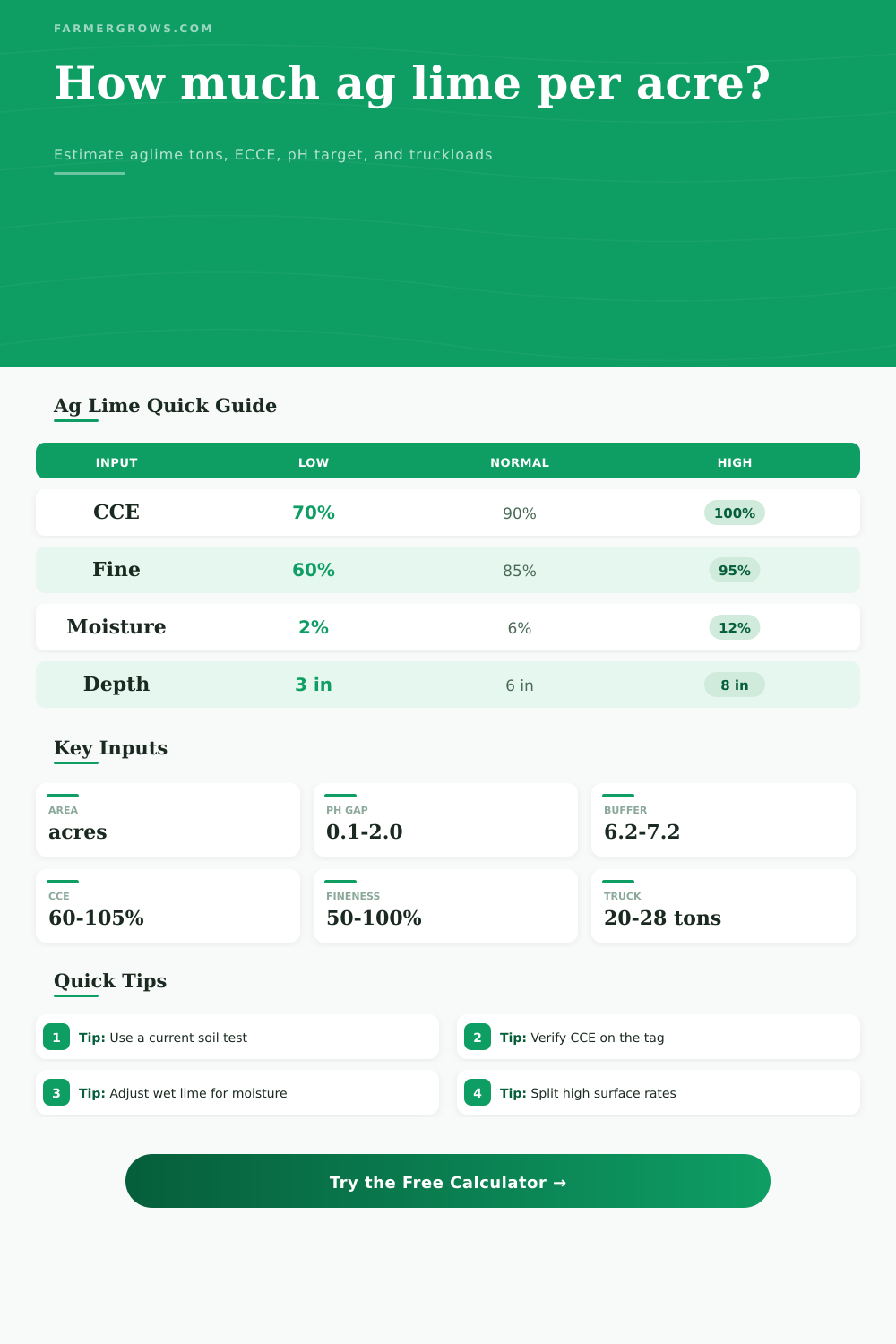
Ag Lime per Acre Calculator
Estimate aglime tons per acre and total truckloads from soil pH, buffer pH, target crop pH, texture, incorporation depth, lime CCE, fineness, moisture, and field acreage.
Pick a field profile, then edit the soil test values and lime tag numbers. The calculator converts pure calcium carbonate equivalent need into as-spread aglime tons.
Ag Lime Estimate
Enter soil test and aglime values to estimate field rate.
Best fit for full-rate correction before tillage, planting, or a rotation reset.
Use smaller passes because lime reacts from the surface downward through rainfall.
Alfalfa and clover need a stronger pH correction before seeding than grass-only fields.
Moisture adds delivered weight without adding neutralizing value, so truckloads rise.
| Crop group | Common target pH | Calculator use | Field note |
|---|---|---|---|
| Corn or grain sorghum | 6.2 to 6.5 | Default target 6.4 | Moderate pH correction supports nutrient availability. |
| Soybeans | 6.2 to 6.6 | Default target 6.4 | Low pH can reduce nodulation and phosphorus response. |
| Wheat and small grains | 6.0 to 6.3 | Default target 6.2 | Often needs less correction than legume rotations. |
| Alfalfa and clover | 6.5 to 7.0 | Default target 6.8 | Correct pH before establishment when possible. |
| Grass hay or pasture | 5.8 to 6.3 | Default target 6.1 | Surface-applied rates may need more reaction time. |
| Soil signal | Typical texture | Lime need effect | Planning note |
|---|---|---|---|
| Buffer pH 7.0 to 7.2 | Sand or low CEC soil | Lower reserve acidity | Small pH changes may need modest lime rates. |
| Buffer pH 6.6 to 6.8 | Loam or silt loam | Medium reserve acidity | Good general planning range for row crop fields. |
| Buffer pH 6.2 to 6.4 | Clay loam or high organic matter | High reserve acidity | More tons are needed for the same pH gap. |
| Buffer pH near 6.0 | Heavy clay or muck influence | Very high reserve acidity | Use local lab calibration before spreading large rates. |
| Lime tag value | Meaning | Calculator formula | Rate effect |
|---|---|---|---|
| CCE | Neutralizing strength versus pure calcium carbonate | Starts the quality adjustment | Higher CCE lowers tons required. |
| Fineness | Share of particles expected to react in the planning period | CCE x fineness percent | Coarser lime raises as-spread tons. |
| Dry ECCE | Effective CCE before moisture correction | CCE x fineness / 100 | Useful for comparing lime sources. |
| Moisture ECCE | Effective value after wet weight is included | Dry ECCE x dry matter | Wet lime needs more delivered tons. |
| Rate situation | Common handling | Truckload note | Retest cue |
|---|---|---|---|
| 0.5 to 1.5 tons/ac | One pass is often practical | Many acres per load | Retest next rotation or in 18 to 24 months. |
| 1.6 to 3.0 tons/ac | One or two passes | Schedule delivery close to spreading | Retest after reaction time and rainfall. |
| 3.1 to 5.0 tons/ac | Two split applications | Check field access and stockpile pad | Confirm pH before the final pass. |
| Above 5.0 tons/ac | Use soil-lab recommendation | Multiple loads likely | Split, incorporate, and retest by zone. |
Match the soil lab first. Buffer pH methods vary by region, so use this calculator for planning and use the lab rate when it gives an official local recommendation.
Compare delivered lime by ECCE. A lower price per ton can lose its advantage if CCE, fineness, or wet stockpile moisture forces many more tons per acre.
You can end up paying more for the cheapest limestone on the market because you have to spread twice as much to get job done. But then again, why would you want that? You have to spread twice as far with that product.
In this way, there’s a paradox to agricultural lime: On the surface, it sounds like a commodity, just get what’s cheapest, and yet you’re going to end up paying more different than if you got the cheapest limestone on the market. Why? Because you don’t know what’s in that truckload. What do you think it contains? Calcium carbonate? Not quite. Moisture content. Particle size. Chemical purity. All of those things affect how much of actual neutralizing power there is in that bag, or truckload; for your dollar.
Why Cheap Lime Costs More
Use this calculator to figure out how much lime you’ll need. Here is what each part of the calculation mean, so you can use it as a plan rather than just a number.
First, find the exact makeup of your lime source by entering your variables into the calculator above; it will do the math for you. Once you have that and your soil test results, pay attention to CCE, which is the chemical strength of the material. The stronger the better… That’s why most folks are looking at that number. Pure calcium carbonate is our standard of comparison; however, in the real world, there is no such thing as “pure” lime. Some limes may be dolomitic, with a slightly different chemical makeup. Byproduct limes from steel mills can differ greatly.
If you’re looking at a high CCE, then your material are going to be chemically strong. If it has a low CCE, you’re going to need to purchase more tons to accomplish the same change in pH. That’s where folks miss the boat. They see a lower cost-per-ton but fail to realize they are going to have to buy more tons to cover the same acreage because of the low CCE.
And then there’s fineness. That’s the size of the grind of the lime. The amount of surface area where lime touches the soil is what cause it to react to soil acidity. Fine powder reacts immediately; large chunks take many years to break down and in turn neutralize the soil. So if you’re going to plant something sensitive (like clover or alfalfa) next spring, you want the quick reaction.
What the ECCE, or effective CCE, does is combine the fineness and chemical purity into a single number. Say you have a lime that’s got 90 percent CCE, but is only 50 percent fine. You’ll be better off with a lime that has 80 percent CCE, yet 95 percent fine. That’s because the two factors multiply each other to create the actual effective value. The reference table on the page explains all this nicely.
One invisible cost is moisture. Wet lime is heavy, but having extra water doesn’t increase the pH. You’re paying to carry water onto your field if you’re bringing in wet stockpile lime. The calculator accounts for this by figuring out how much dry matter there is, so you don’t get cheated with wet tons.
It also will estimate number of total truckloads required based on your intended depth and acreage, helping you plan logistics. Because lime won’t travel very far down into the soil profile by itself, incorporation depth is important. For example, if you want to till in lime six inches deep, you’ll have to account for that volume of soil when figuring out how much lime is needed. Less lime is needed per acre if applied to surface since it’s only treating the top layer, but it takes longer to react and runs the risk of being washed off by rainfall.
The texture of the soil matters as well. Clay soils tend to hold onto and buffer against changes in pH better than sandy soils. For example, it may take significantly more lime to raise the pH of a soil from 6 to 7 in a clay loam field compared to a sandy loam field. Thus, a blanketed recommendation doesn’t usually fit the bill. Lime rates need to be matched with the resistance of the soil.
By plugging your buffer pH into the tool, you are telling the system how much reserve acidity the soil hold. A lower buffer pH means there is more resistance, so more lime is needed to offset it.
Getting to the right pH (and staying there) isn’t a matter of “raising” pH, it’s a matter of getting it in the range where your crop wants it. Legumes are picky; corn’s forgiving. Under-apply, and you reduce available nutrients. Over-apply, and you run the risk of locking up some micronutrients such as iron and zinc. Split applications can be helpful if the rate is very high. They will help distribute the applied material and prevent saturation on the surface.
The tool will allow you to compare various lime sources. Sometimes the higher-priced lime with higher ECCE actually turns out to be less expensive after factoring in the lower tonnage required. You’re paying for neutralizing power, not just tons of bulk materiel.