💧 Air Plant Watering Calculator
Calculate exactly how much water your Tillandsia air plants need based on species, environment, and season
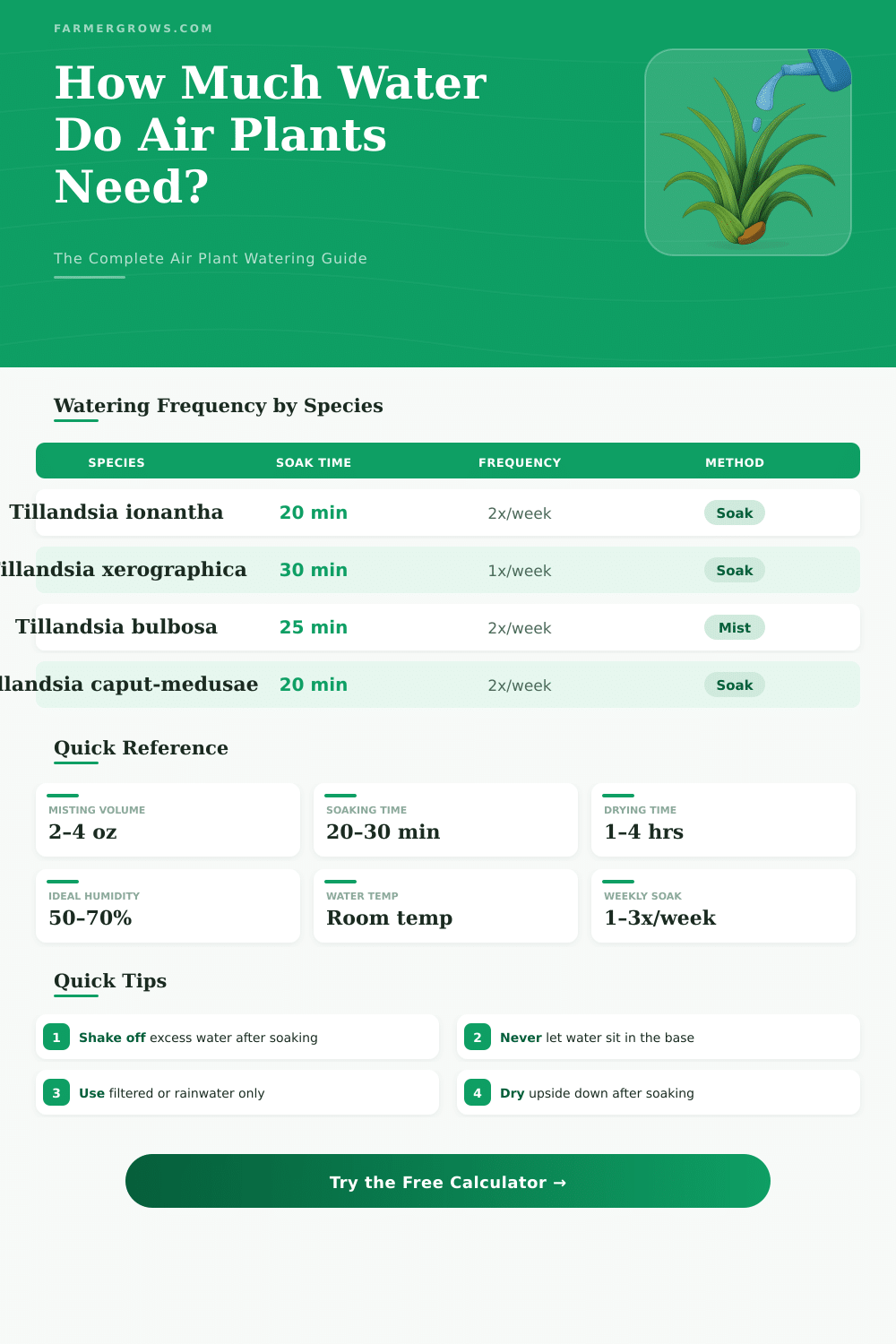
| Species | Soak Time | Water Vol (fl oz) | Water Vol (ml) | Trichome Type |
|---|---|---|---|---|
| T. ionantha | 15–20 min | 6–8 fl oz | 177–237 ml | Mesic |
| T. xerographica | 25–30 min | 10–12 fl oz | 296–355 ml | Xeric |
| T. bulbosa | 20–25 min | 6–8 fl oz | 177–237 ml | Mesic |
| T. caput-medusae | 20–25 min | 6–8 fl oz | 177–237 ml | Xeric |
| T. stricta | 15–20 min | 5–7 fl oz | 148–207 ml | Mesic |
| T. brachycaulos | 20–25 min | 7–9 fl oz | 207–266 ml | Mesic |
| T. funckiana | 25–30 min | 8–10 fl oz | 237–296 ml | Xeric |
| T. abdita | 15–20 min | 5–7 fl oz | 148–207 ml | Mesic |
| T. streptophylla | 30–40 min | 12–14 fl oz | 355–414 ml | Xeric |
| Season | Mesic Species | Xeric Species | Humidity Adjustment |
|---|---|---|---|
| Spring | 2–3x per week | 1–2x per week | +1x if below 40% RH |
| Summer | 3x per week | 2x per week | +1x if below 40% RH |
| Fall | 2x per week | 1–2x per week | No change needed |
| Winter | 1–2x per week | 1x per week | –1x if above 60% RH |
| Method | Volume Per Plant (fl oz) | Volume Per Plant (ml) | Best For |
|---|---|---|---|
| Full Soak | 6–14 fl oz | 177–414 ml | All species, primary method |
| Quick Dunk | 4–8 fl oz | 118–237 ml | Small mesic species |
| Heavy Mist | 2–4 fl oz | 59–118 ml | Supplemental between soaks |
| Light Mist | 0.5–1.5 fl oz | 15–44 ml | Very humid environments |
| Collection Size | Soaking (fl oz/week) | Soaking (ml/week) | Misting (fl oz/week) |
|---|---|---|---|
| 1–5 plants | 24–120 fl oz | 710–3,550 ml | 6–30 fl oz |
| 6–10 plants | 144–240 fl oz | 4,260–7,100 ml | 36–60 fl oz |
| 11–20 plants | 264–480 fl oz | 7,810–14,195 ml | 66–120 fl oz |
| 21–50 plants | 504–1,200 fl oz | 14,905–35,490 ml | 126–300 fl oz |
Air Plants are not like each other. They do not root in ground. Rather, they get Water and nutrients directly through their leaves.
Special tiny structures on the leaves, called trichomes, grab the moisture from air and rainwater. So one must handle the watering of them totally differently.
How to Water Air Plants
Air Plants clearly need Water. Although they last long times without rain they can not grow or live without it. Without enough Water they will die.
So do not even think about ignoring the watering.
The best way to Water Air Plants is to soak them. We fill bowls or vases with Water at room temperature and dip the plants fully. It is enough to soak for 15 to 20 minutes, but in dry conditions one can extend to a whole hour.
The ideal habit is to soak them one time per week or every 7 to 10 days. In very dry places, longer soaks for some hours one time weekly also wrok. After the dip, we shake gently to remove extra Water from the leaves.
Later we leave the plant dry upside down hanging for some hours. Like this Water will not build up at the base, which could create trouble. Before putting the plant back in its jar or terrarium, we check that it is well dry.
Misting is another method, but it does not work as the only Water source. Only with misting the plant probably will not receive enough to truly benefit. It is most useful as extra humidity between the soaks, especially in dry places.
While misting, we care that the hole plant receives the spray. A spray bottle works well for this. One important thing one must recall: avoid spraying directly on the flowers.
Water here can make them slowly lose color. A dip or half soak is better during the flowering.
Also the kind of Water plays a role. Treated tap Water can damage Air Plants. Rainwater or filtered Water is the best.
Because Air Plants receive a lot of their nutrients from the Water, one should use Water full of minerals. Spring Water makes a good replacement if rainwater is not around. When tap Water is the only option, we leave it stand in a bowl for 24 hours, so that the chlorine goes away.
Distilled Water is safer than treated, but it lacks all minerals, which causes the plant to lose nutrients that it usually gets.
Brown leaves can mean that something is not right with the Water used. A low plate full of sand, stones and dry wood creates a nice setup forsuch plants. Watering them is the most important part of their care.