Fertilizer Per Acre for Oats Calculator
Estimate oat fertilizer rates by acres, purpose, yield goal, soil credits, manure nitrogen, fertilizer analysis, lodging pressure, planting season, organic matter, and sulfur need.
Load a practical oat fertility scenario, then edit the soil-test credits and fertilizer grade to match your field. Values are planning estimates, not a replacement for local soil-test recommendations.
Enter the fertilizer grade as percent N, P₂O₅, K₂O, and sulfur. The calculator sizes the product by the largest remaining nutrient gap the fertilizer can supply.
Fertility Breakdown
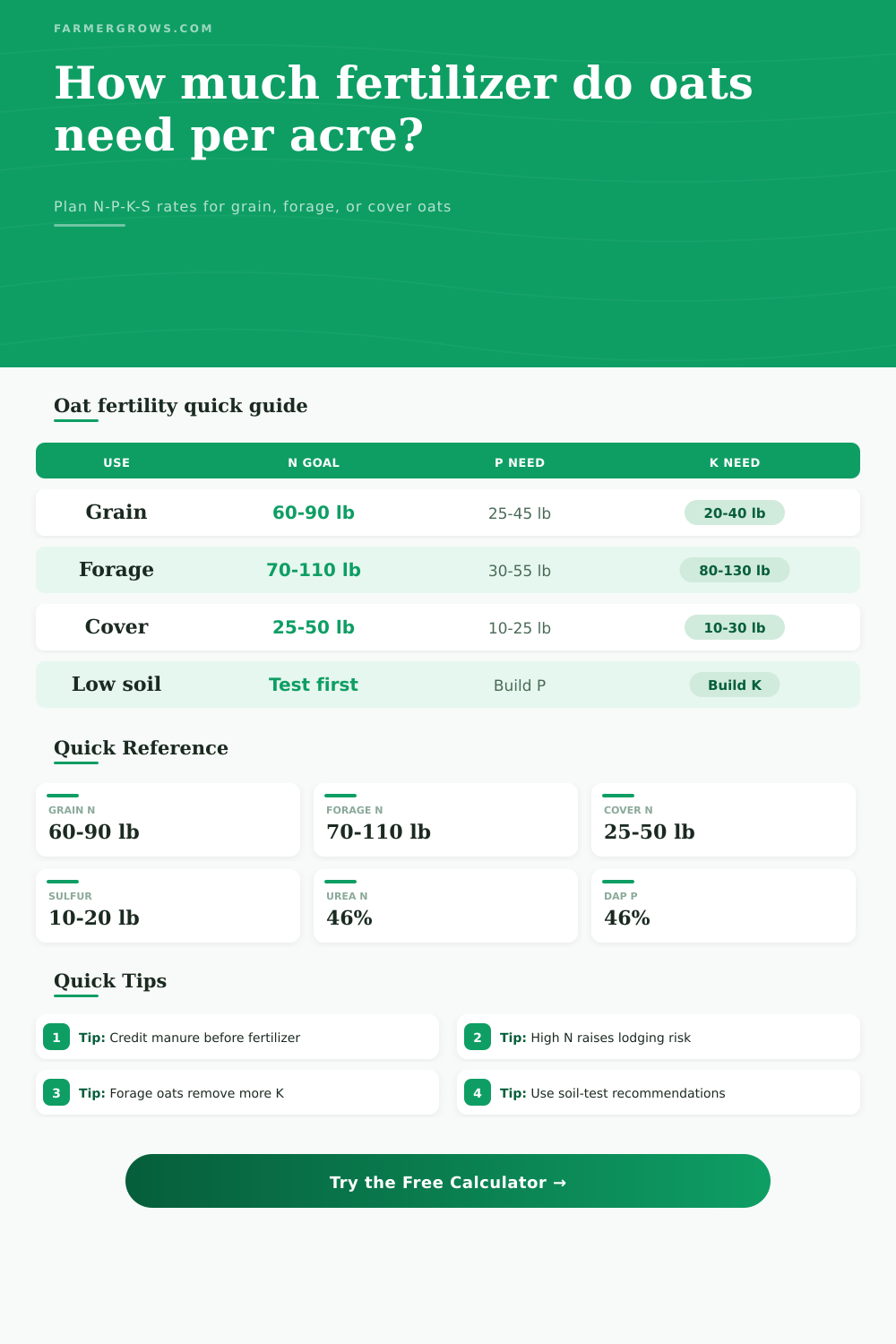
Usually sized around grain yield with enough early nitrogen for tillering, while avoiding excess N that can push lodging near heading.
For hay, silage, or grazing, potassium removal can be heavy because the whole plant leaves the field rather than mostly grain.
Cover crop oats often need only a starter rate unless the goal is fast fall biomass after a low-nitrogen previous crop.
| Oat purpose | Yield basis | Common N target | P₂O₅ target | K₂O target |
|---|---|---|---|---|
| Grain | 60 to 100 bu/ac | 60 to 90 lb/ac before credits | 25 to 45 lb/ac on medium soil | 20 to 40 lb/ac on medium soil |
| Forage or haylage | 1.5 to 3.0 dry tons/ac | 70 to 110 lb/ac before credits | 30 to 55 lb/ac | 80 to 130 lb/ac where forage is removed |
| Cover crop | 1,500 to 4,000 lb biomass/ac | 25 to 50 lb/ac if rapid fall growth is desired | 10 to 25 lb/ac starter range | 10 to 30 lb/ac starter range |
| Nurse crop | Light cover for legumes | 20 to 45 lb/ac to limit competition | Based on companion crop soil test | Based on removal plan |
| Fertilizer source | Analysis | Best oat use | Calculator note |
|---|---|---|---|
| Urea | 46-0-0 | N topdress or preplant N | Enter 46 for N and zero for P, K, and S. |
| Ammonium sulfate | 21-0-0-24S | N plus sulfur | Helpful where sulfur need is flagged. |
| MAP | 11-52-0 | Starter phosphorus | May oversupply P if sized by N. |
| Potash | 0-0-60 | Forage K replacement | Size separately if K gap dominates. |
| Balanced blend | 10-10-10 to 19-19-19 | General starter or maintenance | Useful when all N-P-K gaps are similar. |
| Lodging condition | N caution level | Season factor | Field action |
|---|---|---|---|
| Short straw, firm stand | Low caution below 90 lb available N/ac | Spring seeded grain responds well | Use normal soil-test target and watch weather. |
| Average variety | Moderate caution above 90 lb available N/ac | High spring moisture raises concern | Split or reduce N if stand is lush. |
| Lodging-prone field | High caution above 75 lb available N/ac | Fall forage tolerates more biomass N | Prioritize forage goal or lower grain N. |
| Heavy manure history | Credit N before spreading fertilizer | Warm soils release more N | Use manure tests and avoid double counting. |
| Sulfur situation | Likely S need | Common source | Planning note |
|---|---|---|---|
| Sandy or low organic matter soil | 10 to 20 lb S/ac | Ammonium sulfate or gypsum | Use a sulfur source if the blend has no S. |
| High manure history | 0 to 10 lb S/ac | Manure or starter blend | Manure may cover part of sulfur demand. |
| Cool wet spring | 10 to 15 lb S/ac | Sulfate sulfur | Sulfate forms are quicker than elemental S. |
| Cover crop only | 0 to 10 lb S/ac | Starter blend if needed | Keep fertility proportional to cover crop goals. |
Use credits first. Oats respond to early nitrogen, but manure, soil nitrate, legume carryover, and organic matter can already cover part of that need.
Match fertility to harvest purpose. Grain oats need enough N without pushing lodging, while forage oats need extra potassium replacement because more plant material is removed.
By July the stalks is too high; they just bend over and lie down. That’s what happens to a lot of people who grow oats.” So do the stalks of other crops that might benefit from a headstart; like sweet corn, potatoes, or tomatoes, for example, and so does green shoot growing above ground where you’re standing in the field.
Instead of pushing crop to produce as much as possible, you’ll manage restraint: calculate fertilizer per acre for oats. Enter your soil credits and yield goals into the calculator, and it will do math for you. No need to guess at how much nitrogen are right for your particular field conditions and variety.
How to Use the Fertilizer Calculator
Oats will grow vertically, driven by nitrogen, but they also has their limits. Depending on your soil health and what kind of yield you’re after, grain oats require from 60-90 pounds per acre of nitrogen. Harvesting all of the oats as forage requires more nitrogen (you’ve got a lot more biomass going on), which mean increased risk of lodging. The tool accounts for your organic matter levels and the time of year you’re planting, helping you strike a balance.
High organic matter means your soil is supplying some nitrogen. As it breaks down, microbe do the work. Adding more fertilizers runs the risk of inviting trouble. After all, the earth’s doing its job, too, even if you aren’t applying something directly.
But story is not so simple when we talk about phosphorus and potassium. The whole plant leaves farm, which means that forage fields loses the most potassium. Because grain harvest leaves much of the straw on field, the grain harvest removes far less potassium. These removal rates are made clear in the reference tables on the page. This is why a forage operation require more potash than a grain-only field.
Every acre isn’t treated like it has the same nutrient budget. That changes everything about the harvest method.
Another overlooked element is sulfur, which causes stunted growth and pale yellow leaves. Low organic matter fields are more apt to be deficient in sulfur, as are sandy soils. Because sulfur is so easily leached (rain washes it down) and does not travel very far in soil profile, you must consider it.
If you choose sandy soil types on the calculator, or plug in lower organic matter percentages, it flags the need for sulfur. It alerts you to add ammonium sulfate or another blend containing sulfur. It doesn’t take much in the mix; just enough to make all the difference between a robust stand of plant versus one that’s been stunted.
Growers tend to think they only have to worry about nitrogen if there’s any issue with growth, but sulfur help protein production work efficienty.
The true savings come from the manure and soil test credits. Chances are, if you spread manure in recent years, there’s still some available in form of N (nitrogen), P (phosphorus) and K (potassium), and you’re sitting on those credits. Entering the credits into the calculator removes their value from your total required fertilizer purchases. No more double-counting; no more over-applying or wasting money. The calculator prompt you for these numbers at the beginning, so it can deduct those credits from what you’ll need.
It’s nothing but a subtraction equation…and it will save money while also saving the environment from runoff.
The last consideration before loading the spreader is lodging risk. Dialing back the nitrogen level makes sense if your variety has a tendency to grow extra tall. Less nitrogen are needed after a wet spring that pushes early growth. You can adjust how much lodging risk the tool considers and then it will cap the rate of nitrogen applied if the lodging risk is high.
You don’t want a tangled mess when it’s time to harvest. Leaving some yield in the field is better than none. You want your crop to stand tall enough to come out easily at harvest but not so tall that it fall down from its own weight.
That’s the premise behind a fertility strategy: Plan before you pay. Read the field before you write the check. Consider your goal (the harvest). Consider what nature gave you (think of all those manures). Apply only as much fertilizer as needed to do the job, no more, no less.
You should of not need to push it beyond the breaking point.
That’s why the calculator simplifies the process. It helps make sense off the complicated world of soil science and turns it into a practical, use-it-now plan.
Your fields will be stable and profitable and productive… But they won’t look great till the first stiff wind comes through.