Triticale Seed Per Acre Calculator
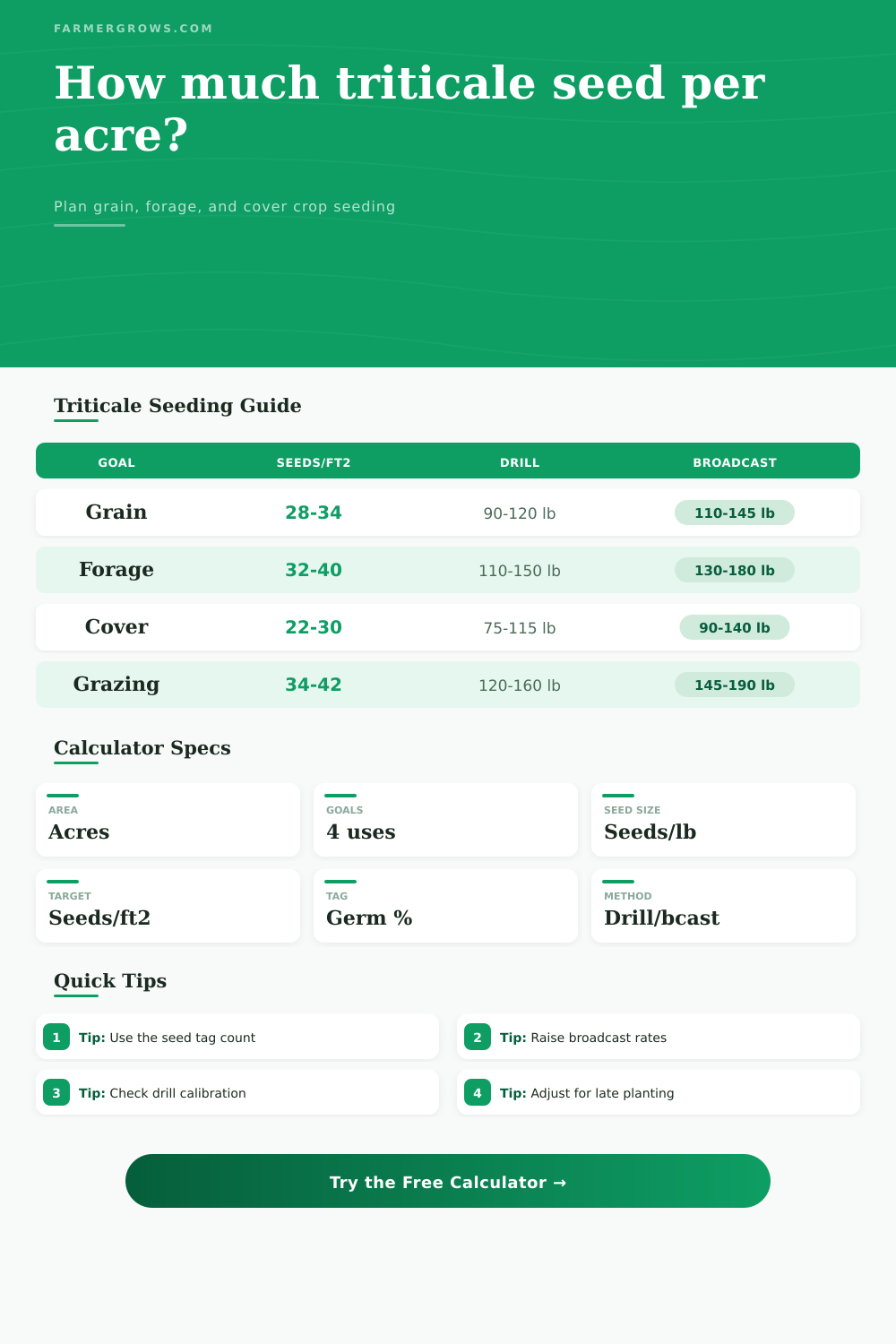
Estimate triticale seed per acre for grain, forage, grazing, or cover crops using acres, seed count, target seeds per square foot, germination, field emergence, planting method, row spacing, planting date, and overage.
Choose a field-ready starting point, then adjust the live seed tag, planting method, target seeds, row spacing, date, overage, acres, and bag size for the exact lot you are planting.
Grain fields often target moderate plant density, strong tillering, and steady row placement so heads mature evenly at harvest.
Forage triticale usually uses a heavier stand than grain to build canopy, stem mass, and spring feed tonnage.
Cover crop stands can be lighter when drilled early and heavier when broadcast late into residue or uneven moisture.
Grazing acres favor a dense stand that tolerates traffic, recovers after clipping, and competes with winter weeds.
Triticale Seed Estimate
Seed order results will appear here after calculation.
| Seeds per lb | 24 seeds/ft² | 30 seeds/ft² | 36 seeds/ft² | 42 seeds/ft² |
|---|---|---|---|---|
| 10000 seeds/lb | 105 lb/ac | 131 lb/ac | 157 lb/ac | 183 lb/ac |
| 12000 seeds/lb | 87 lb/ac | 109 lb/ac | 131 lb/ac | 153 lb/ac |
| 14000 seeds/lb | 75 lb/ac | 93 lb/ac | 112 lb/ac | 131 lb/ac |
| 16000 seeds/lb | 65 lb/ac | 82 lb/ac | 98 lb/ac | 114 lb/ac |
| 18000 seeds/lb | 58 lb/ac | 73 lb/ac | 87 lb/ac | 102 lb/ac |
Table values are raw seed-count math before germination, emergence, broadcast, row spacing, date, and overage adjustments.
| Placement | Typical adjustment | Best fit | Notes |
|---|---|---|---|
| Drilled, 6 to 8 in rows | 1.00x | Grain and forage | Most accurate depth and seed-to-soil contact. |
| Drilled, 10 to 12 in rows | 1.04x to 1.08x | Cover or trial rows | Slight increase helps close canopy between wider rows. |
| Broadcast then packed | 1.15x | Cover and pasture | Works best when followed by cultipacking or light incorporation. |
| Rough broadcast or aerial | 1.25x to 1.35x | Late cover crop | Use when residue, slope, or uneven moisture lowers establishment. |
| Planting timing | Calculator effect | Useful goals | Field reminder |
|---|---|---|---|
| Early fall window | 1.00x | Grain, forage, cover | Good tillering usually allows normal target density. |
| Late fall planting | 1.10x | Grain or forage | Late fields have fewer tillers, so stand density matters more. |
| Spring planting | 1.08x | Forage or cover | Spring triticale may favor forage over grain in many regions. |
| Summer or dormant seed | 1.12x | Cover or wildlife | Moisture and temperature risk can lower field emergence. |
| Seed order unit | Use in calculator | Calibration check | Field note |
|---|---|---|---|
| 50 lb bag | Enter 50 | Good for small to medium fields | Round up to the next full bag before planting. |
| 100 lb mini lot | Enter 100 | Useful for pasture or wildlife plots | Split evenly if applying two half-rate passes. |
| 1000 lb tote | Enter 1000 | Match drill setting after first acre | Weigh remaining seed if the drill chart is only approximate. |
| 2000 lb bulk tote | Enter 2000 | Best for large grain acreage | Keep a small bag reserve for corners and cleanup. |
Use live seed math: A 14000 seeds per lb lot with 90% germination and 85% expected emergence needs more bulk seed than the raw seeds-per-square-foot target suggests.
Calibrate by method: Broadcast triticale and late plantings deserve a separate drill or spreader check because seed loss and uneven depth can change the final stand quickly.
You’re at the edge of a field, holding a cart of seed labeled “triticale.” You have no clue whether you’ll be able to plant a full stand or something that’s going to make you wish you had never gone this far. This strange creature, half rye and half wheat, lives in an uneasy middle ground between forage and grain.
Will it work as a grazing mix? A cover? Will it work as forage? Grain? Sure, but how do you know? Guessing wrong is expensiveer. The answer: Let the calculator do the math for you. It will take your vague hopes and translate them into exact pounds. So you can get back to the dirt, not the numbers.
How to Use the Triticale Seed Calculator
It can account for things like method multipliers, emergence factors, even variations in germination. Knowing what each input mean makes all the difference between getting it right and really nailing it.
So begin with what you want. With that view, remember: you aren’t simply sowing seeds. You’re sowing toward an end. What’s the end?
Are you growing a grain crop, where a moderate stand is typically desired (to ensure even head maturity by harvest, while still supporting good tiller growth)? Or are you cultivating forage or silage? This usually require a thicker population to develop a dense canopy and bulk needed for high tons per acre early in spring when feed is most valuable.
The calculator takes all that into account, shifting the baseline assumptions about how many seeds should go in the ground. Sow for forage/silage, and it expects one thing; sow for grain, and it has a new standard for seed number. It is a subtle difference on paper, but it changes everything about your planting strategy from there.
Next is the seed tag. That’s where folks goof. They do not pay attention to seeds per pound or germination percentage. They rely instead on some generic extension recommendation that assumes perfect seed in perfect conditions. Your seed lot is probably imperfect; your soil is certainly not.
The calculator requires your particular germination rate and expected field emergence. Lower the emergence if your tag shows 90% germination and you suspect the soil will be cold and cloddy. Then it factor up the seed rate accordingly. This is live seed math. You’re buying bulk seed to achieve a number of living plants. Failing to adjust here means you’re buying empty pounds.
Planting style also makes a big difference. A drill with press wheels gets a multiplier of 1.00, meaning no extra seed is needed to make up for poor placement. With broadcast seed, however, you’re scattering it onto hardpan, into uneven moisture and over residue. For this, the calculator adjusts downward significantally. The result? Often adding 15% or more to the rate. Not out of punishment, but because of physics. More seed stay on the surface so some can get down in the soil to take root. Attempting to broadcast at drilled rates is a recipe for creating thin spots, which weeds will fill in immediately.
There is also an element of timing that is subtle but important. The tool asks when you planted. If it was in early fall, then tiller count will be normal and targets for density stay where they are. Late-season planting means the plants don’t have as much time to produce tillers prior to winter. More seed are required initially to achieve the same eventual stand. This is reflected in the calculator by increasing the rate for later plantings. This makes sense because you are losing vegetative growth time, so you compensate by increasing plant density.
Then there is the overage. The real world has corners, headlands, calibration errors. There are no perfect drills. A 10% or 15% buffer accounts for those inevitable errors. It protects against running out of seed three acres from the end.
The tool combines all these variables in one order quantity number. It takes the raw numbers off the table (which is on the page), and it spits out the exact number of totes or bags you should of get. You put in your acreage, your seed quality, your method, and your goal. The tool takes care of all the coefficients. You walk away with a plan that respects the reality of your field and the biology of the crop.
That’s the advantage of letting the tool handle the coefficients while you handle the context.