Ladino Clover Seed per Acre Calculator
Estimate Ladino white clover seed for pure stands, pasture mixes, frost seeding, wildlife plots, and orchard alleys with PLS, germination, grass companion share, method, seedbed quality, overage, and bag rounding.
Pick a Ladino planting scenario, then edit the acreage, seed tag, companion grass share, bag size, and field buffer for the seed lot and stand goal.
Ladino Seed Plan
Seed plan summary appears here after calculation.
Best for nursery, small plot, or controlled forage plantings where Ladino is the main legume and grass competition is absent.
Common with orchardgrass, timothy, brome, or fescue where Ladino supplies grazing quality and nitrogen without taking over.
Useful in open, closely grazed sod. The calculator raises the plan for surface placement and spring grass competition.
Works in deer plots, orchard alleys, and low-growing covers when mowing, fertility, and moisture can support white clover.
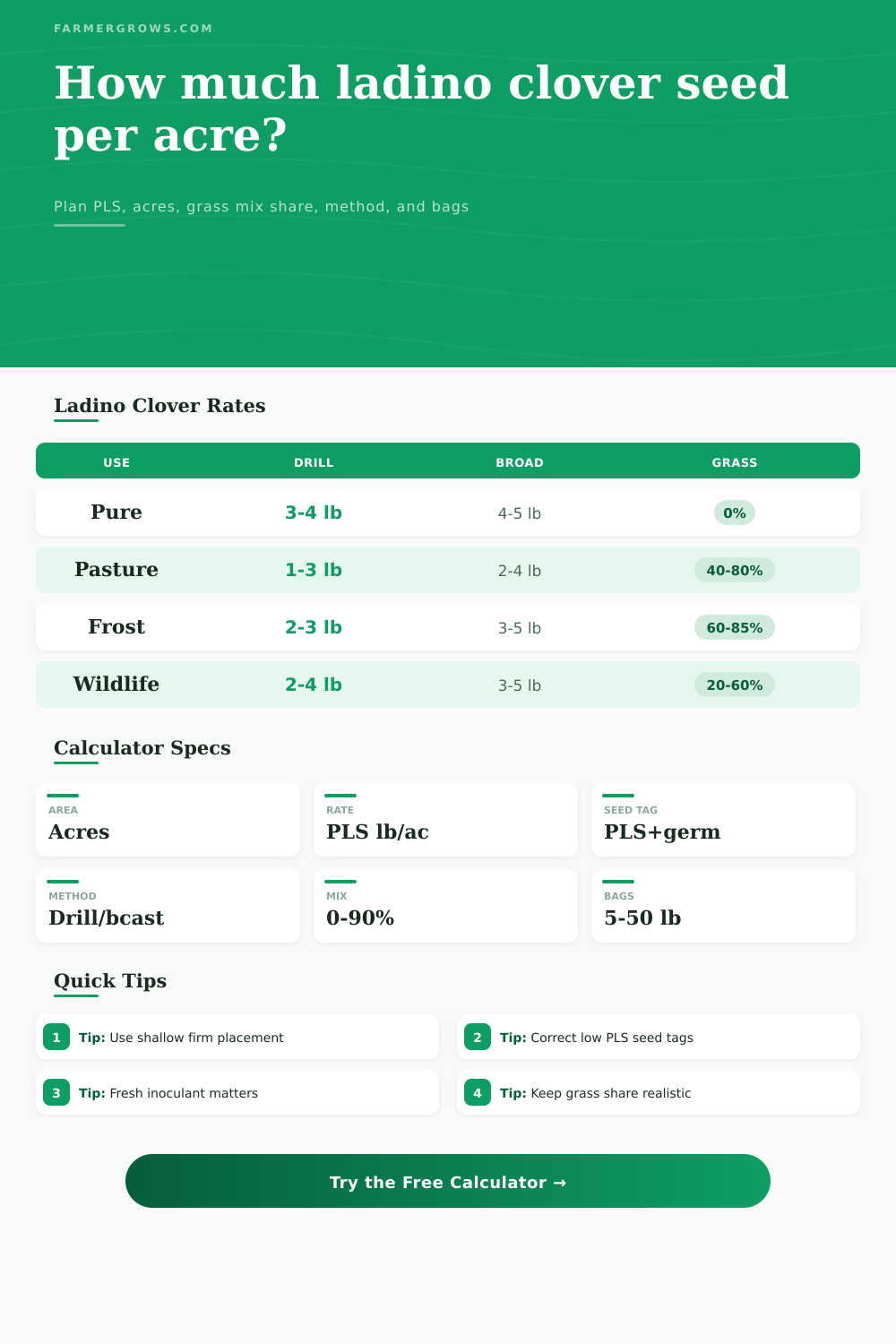
| Ladino use | Drilled target | Broadcast target | Common companion grass share |
|---|---|---|---|
| Pure Ladino stand | 3 to 4 lb PLS per acre | 4 to 5 lb PLS per acre | 0% grass; clover is the planned stand. |
| New grass-clover pasture | 1.5 to 3 lb PLS per acre | 2 to 4 lb PLS per acre | Usually 40% to 80% grass by seed mix weight. |
| Frost seeded pasture improvement | Not typical unless no-till drilled | 2 to 4 lb PLS per acre | Often 60% to 85% existing grass canopy. |
| Wildlife plot blend | 2 to 3.5 lb PLS per acre | 3 to 5 lb PLS per acre | Often 20% to 60% grass, cereal, or brassica companion. |
| Orchard or vineyard alley | 1.5 to 2.5 lb PLS per acre | 2 to 3.5 lb PLS per acre | Low grass share where mowing keeps the alley open. |
| Seed tag example | Effective live seed | Bulk seed for 3 lb PLS | Planning meaning |
|---|---|---|---|
| 95% component and 90% germination | 85.5% effective PLS | 3.5 lb bulk per acre | Clean lot; bulk pounds stay close to the biological target. |
| 90% component and 85% germination | 76.5% effective PLS | 3.9 lb bulk per acre | Common planning example for coated or stored seed. |
| 85% component and 75% germination | 63.8% effective PLS | 4.7 lb bulk per acre | Bulk need climbs; verify tag date and storage conditions. |
| Tag lists final PLS only | Enter PLS, set germination to 100% | Calculator uses the entered value | Avoid double-correcting when PLS is already printed on the tag. |
| Field condition | Calculator factor | Use when | Ladino planting note |
|---|---|---|---|
| Drilled or cultipacker seeder | 1.00 x | Prepared seedbed, no-till drill, Brillion seeder | Most precise placement; do not bury Ladino seed deeply. |
| Broadcast and packed | 1.18 x | Spinner, hand seeding, ATV spreader | Split passes and pack after spreading for better contact. |
| Frost seeded broadcast | 1.30 x | Late winter on open, closely grazed sod | Relies on freeze-thaw action and low spring grass competition. |
| Firm, fine, moist seedbed | 0.96 x | Good moisture and smooth surface | Lets the calculator trim a small amount from the field risk factor. |
| Rough, sod, or dry surface | 1.12 to 1.20 x | Uneven soil, existing sod, dry timing | Raises the plan but still needs shallow placement and moisture. |
| Planning item | Common value | Calculator use | Field note |
|---|---|---|---|
| Ladino seeds per pound | About 750000 | Estimates viable live seed per square foot | Actual count varies by coating and seed lot. |
| Small seed bag | 5 or 10 lb | Rounds total bulk seed up to whole bags | Useful for small plots, orchard alleys, and overseeding. |
| Field seed bag | 25 or 50 lb | Shows staged seed weight after bag rounding | Calibrate the drill or spreader with the actual bagged seed. |
| Clover inoculant packet | Often treats 25 to 100 lb | Bulk pounds divided by packet coverage | Fresh inoculant protects nodulation; extra seed does not replace it. |
Keep the seed shallow and firm. Ladino clover seed is very small. A smooth, packed seedbed with surface moisture usually matters more than adding a heavy seed rate.
Use PLS math before ordering bags. Convert the desired Ladino PLS rate into bulk pounds with the seed tag values, then add only the overage needed for method and field shape.
It’s happened to us: You run out of clover seed. And then what? Panic time! You’re either out in the field with the drill running and you don’t think the math adds up. Or you’ve got the spreader hopper cracked open in the barn, the math doesn’t make sense to you. Is that half-full bag going to stretch to the remaining half-acre, or are we headed all the way back to the farm supply store?
Just plug in your seed tag info and your field size. Our calculator will do the math for you so you don’t have to guess at conversions and coefficients while operating machinery.
How to Calculate the Right Clover Seed Amount
Small thing, yes. The first thing about Ladino clover seed, and the second thing that trips up people used to buying soybean or corn seed, is that it’s realy tiny. When you shake it around in your hand, you’re looking at a speck of dust. It is a speck of dust that contains the entire potential next generation.
It is small enough that the math on your scale feel unreal. “I’m putting down three pounds per acre,” you say. That seems like a lot.” In fact, it’s not even very thick by the time those specks land on the ground, each one representing one of many possible lives.
The tool helps you translate that distant number (weight) into a concrete one (the number of seeds alive and hitting the earth). How does it do that? It tells you exactly how many seeds will land on every square foot of soil, based off the percentage that are able to germinate.
Most people fail to make that leap. They buy seed by bulk weight alone. They don’t realize that their particular bag may contain, for example, only 75 percent viable seed or only 80 percent pure, no matter what the label says.
That all changes with broadcasting versus drilling. When you drill the seed into a moist, firm spot, it stays there. With broadcasting, it’s scattered around atop the soil, vulnerable to birds, rain, wind, etc., before ever having a chance to take root.
Because of that physical fact, the calculator will increase its target rate if you choose a broadcast method. It is not a penalty fee for being lazy. It is a biological insurance policy against lost seed.
Because now you’re counting on winter freeze-thaw cycles to shove that little bit of microscopic seed down into the soil profile if you are frost seeding into existing sod. You are counting on winter physics to do your plowing for you.
The silent variable is inoculation. All those clovers comes with their own little rhizobia bacteria to help the plant fix nitrogen from the air. Otherwise, Ladino clover is just another hungry plant competing with your grass.
The inoculation question isn’t meant as a lecture; it’s there to make sure you’ll get the proper number of treatment packets when you order. It is easy to lose track, since each packet may cover just 50 pounds of seed.
If you’re dealing with a poor seed lot and intend to plant an acre or two, you could require extra bulk weight, more plants per desired area, which means you will need to cover more area with inoculant. The calculator rounds up the number of packets needed so you don’t find yourself half way through the bin, out of luck.
The other big variable is competition from grasses. When growing alone, the clover has plenty of room to get established, getting all the moisture and light it needs. If mixed with fescue or orchardgrass, for example, the grass will grow up fast and tall, shading out the slower-growing clover seedlings.
Often this means you must have more clover seed at the start, to make it through that early bottleneck. You can adjust the companion grass share by changing the percentage of the mix given to the clover. The calculator helps you find the right balance between the two species during establishment. This makes sure no one overwhelms the other.
There’s also something called “seedbed quality” which is equally important but tougher to quantify than acreage. Small seed wants a nice loose seedbed to plant itself into. A fluffy, dry seedbed will float above the soil, then bake before ever sprouting.
To compensate, the tool has a seedbed quality selector, which tacks on a buffer to whatever rate you enter. That buffer takes into account how rough your ground is. Because let’s face it, fields aren’t perfectly rectangular in ideal conditions. They’re clumpy dirt with variable moisture and you’re planting in the real world.
All of this said, sowing Ladino clover is an exercise in precision, and patience. You’re attempting to create a deeply rooted perennial. Hopefully, it will outlive your annuals and fix nitrogen for years to come. Getting the seed rate just right is essential for everything that follows.
Whether you’re creating a new wildlife plot or rehabilitating a rundown pasture, the principle is the same: What you want is a carpet, and plenty of viable seed in the soil to get you there. And that’s where the calculator comes in.
It can help you arrive at that magic number without the panic, so that when you do leave the field behind, you’ll have a stand underfoot well on its way toward becoming what you had hoped it would be.