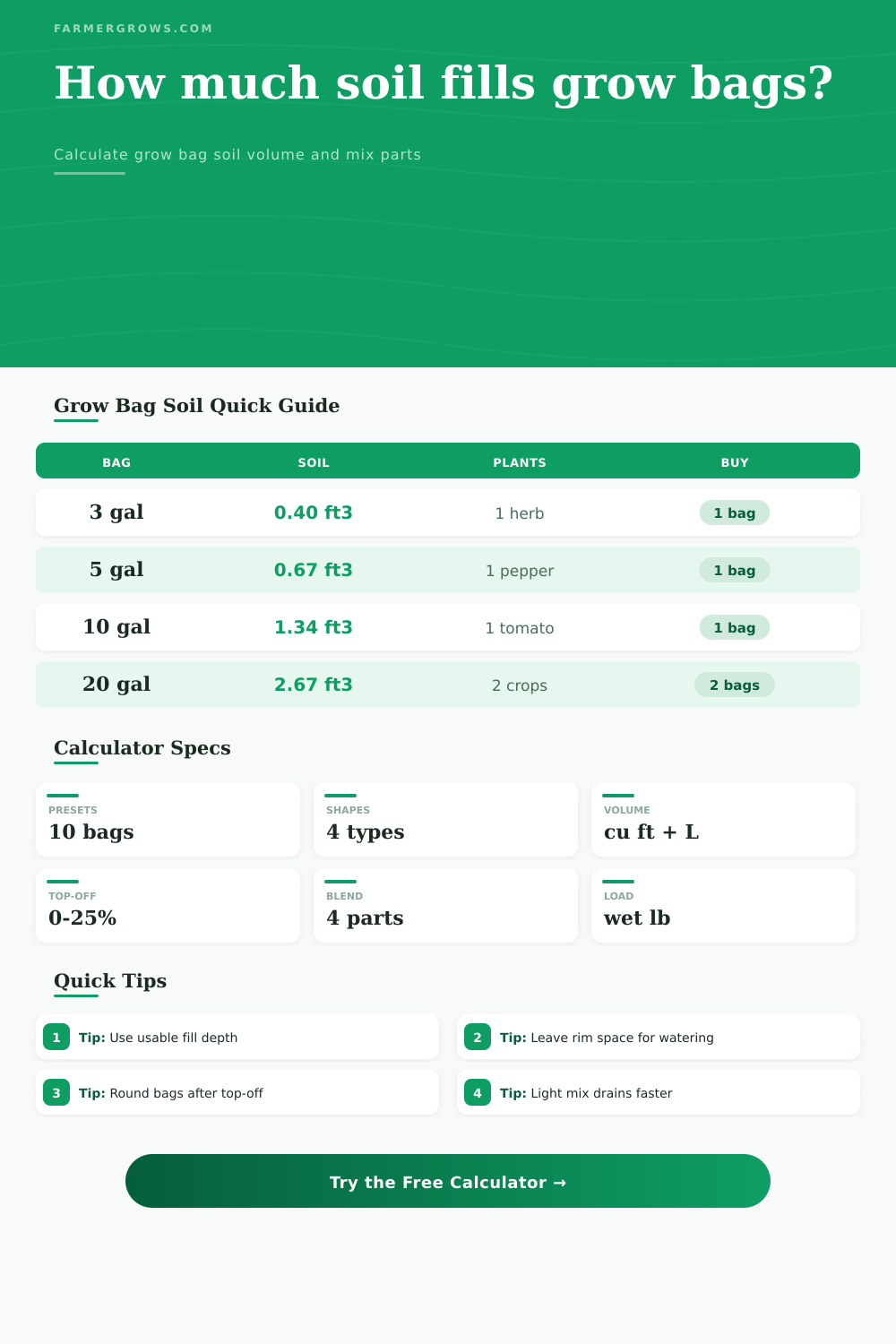
Soil for Grow Bag Calculator
Estimate the potting mix needed for fabric grow bags from stated gallon size or measured bag dimensions, then split the total into soil, compost, moisture fiber, aeration, bags to buy, and wet load.
Grow bags rarely use their full advertised volume once the rim is folded, soil is watered in, and top space is left for mulch and irrigation. This calculator keeps those grow-bag details separate from a raised bed soil estimate.
Best when the grow bag label is trusted and the bag is filled close to its intended height.
Use diameter and filled depth when the rim is folded down or the bag has softened sides.
Uses top diameter, bottom diameter, and filled depth for cone-like grow bags.
Useful for long herb, strawberry, potato, and balcony grow bags with flat bases.
Your Grow Bag Soil Estimate
The estimate separates labeled or measured grow bag volume from settling, top-off reserve, blend parts, and rounded store bags.
| Grow bag label | Cubic feet | Liters | Typical crop fit | Rounded 2 cu ft bags |
|---|---|---|---|---|
| 3 gallon fabric bag | 0.40 cu ft | 11.4 L | Herbs, lettuce, dwarf flowers | 1 bag fills about 5 bags |
| 5 gallon fabric bag | 0.67 cu ft | 18.9 L | Pepper, bush bean, compact tomato | 1 bag fills about 3 bags |
| 7 gallon fabric bag | 0.94 cu ft | 26.5 L | Potato start, eggplant, patio tomato | 1 bag fills about 2 bags |
| 10 gallon fabric bag | 1.34 cu ft | 37.9 L | Tomato, potato, small berry | 1 bag per grow bag |
| 15 gallon fabric bag | 2.01 cu ft | 56.8 L | Dwarf fruit, tomato, pepper pair | 2 bags per grow bag |
| 20 gallon fabric bag | 2.67 cu ft | 75.7 L | Potatoes, squash, multi-crop bag | 2 bags per grow bag |
| 30 gallon fabric tub | 4.01 cu ft | 113.6 L | Dwarf tree, deep potato, small shrub | 3 bags per grow bag |
| Bag shape | Measurements needed | Volume formula | Best use |
|---|---|---|---|
| Stated gallon label | Label gallons and usable fill percent | gallons x 0.133681 x fill percent | Fast estimates for standard grow bags |
| Round cylinder bag | Inside diameter and filled soil depth | pi x radius squared x depth | Fabric pots with straight sides |
| Tapered grow bag | Top diameter, bottom diameter, filled depth | frustum volume from two radii | Soft-sided bags wider at the top |
| Rectangular planter bag | Inside length, width, and filled depth | length x width x depth | Long herb, strawberry, and potato bags |
| Grow bag use | Base potting mix | Compost | Fiber | Aeration |
|---|---|---|---|---|
| General vegetable grow bag | 55% | 25% | 10% | 10% |
| Tomato and pepper bag | 50% | 30% | 10% | 10% |
| Potato grow bag | 60% | 25% | 5% | 10% |
| Herb and lettuce bag | 65% | 15% | 10% | 10% |
| Berry or citrus bag | 50% | 20% | 15% | 15% |
| Hot balcony fast drain | 45% | 20% | 15% | 20% |
| Store bag label | Cubic feet | Liters | Fills 5 gal bags | Fills 10 gal bags |
|---|---|---|---|---|
| 0.75 cu ft small bag | 0.75 | 21.2 L | 1.1 grow bags | 0.6 grow bag |
| 1 cu ft compost bag | 1.00 | 28.3 L | 1.5 grow bags | 0.7 grow bag |
| 1.5 cu ft potting mix | 1.50 | 42.5 L | 2.2 grow bags | 1.1 grow bags |
| 2 cu ft potting mix | 2.00 | 56.6 L | 3.0 grow bags | 1.5 grow bags |
| 3 cu ft compressed bale | 3.00 | 85.0 L | 4.5 grow bags | 2.2 grow bags |
| 40 L metric bag | 1.41 | 40.0 L | 2.1 grow bags | 1.1 grow bags |
A fabric bag can bulge, taper, or lose height when the rim is rolled. For precise soil volume, measure the filled diameter and depth you actually plan to use.
Leaving one to three inches at the top prevents runoff, holds mulch, and makes top-off easier after the first deep watering settles the mix.
The hardware store is A terrifying place to shop. Especially the part with all those bag of potting mix. There you are standing there with a five-gallon fabric tomato pot in hand, gazing down at the two cubic-foot packages of soil. How many do I buy? One bag? Two? Three? The answer: five gallons are optimistic, on a good day.
It’s that discrepancy, between what package claims and how much you actualy have room for, that trips up most garden projects right from the get-go. That’s where the calculator comes into play, to close the gap between theoretical bag capacity and what happens when you fill the bag.
How to Use the Soil Calculator
Because they’re soft sides, grow bags changes shapes once you go near them. Typically, the rim collapse, so there will be at least an inch or two less height once you get your hands on one. From there: You add the soil, then water it in and wait as the air pockets collapses into the mix. When you have bag filled to the top with dry soil, you’re basically asking for trouble (compaction later), and runoff now.
The tool let you specify a usable fill percentage, which is typically about eighty-eight percent for typical-sized bags. It factors all that in so you don’t run out of soil. This saves you the heartbreak of not having enough left to finish planting because you forgot to leave room for the watering lip or for how much soil settle as you work.
It’s not just a question of how many bag to purchase, either, but which combination. With the exception of maybe really hot summers, you don’t generally want plain old potting mix in growing bag. The porous fabric sides will help cool the medium and also prune roots (always a good thing). However, an airy mix will dry out too quick unless there is some structure to hold moisture inside.
About half and half? Try using about 55 percent potting-mix-type medium for the base and 25 percent finished compost. Add 10 percent aerating ingredients, such as pumice or perlite, and another 10 percent moisture-holding ingredient like peat moss or coir. The calculator break down the math to show you the proportions of all four elements, then lets you enter the quantity of each to order the correct amounts of everything.
It’s not just about volume. You need to create a root environment that holds enough moisture to last through a steamy afternoon without staying constantly soaked but still breathes. People forget about weight. Dry soil might not feel heavy, but it’s still heavy stuff to carry around, especially on the back. When that same soil gets soaking-wet, it become downright heavy; five gallons in a bag full of dense, compost-rich soil could weigh as much as thirty pounds (or more).
Depending on what mix you’re choosing to use, the tool will estimate how much its equivalent would weigh when wet. That’s important if you plan on filling up a few of those bags on a balcony or a deck; it’ll affect both your logistics and your safety. You’ll have to deal with more frequent watering, but lighter mixes containing more perlite and coir will also be lighter to manage. Heavy mixes won’t need watering as often, but they’ll put stress on your shoulders and the structure itself. As always, there is a tradeoff here between watering needs and convenence.
On the page, they’ve provided a reference table listing their sizes, along with a reminder: How much do various-sized bags hold? They might list a 3 gallon container of herbs different than a 10 gallon tomato pot, and so on. I think it’s nice to just look at before heading to the nursery, so you can be sure when you leave the place to buy some bags, you haven’t got a half-empty one in your car trunk.
And if you know the exact dimensions (depth, diameter) of the bag once it is filled, it will be even more accurate than relying on the label, which might not list real measurements and may stretch or soften over time. That’s where the trick lies; knowing how the measurement are taken is the big part. Then all the math works itself out from there.
You’ll get to put the plant into the ground, not guess what goes in. The right soil means the right plant and happy plants. And seed doesn’t even enter the picture yet! You should of checked it first.