Canna Bulb Planting Depth Calculator
Estimate canna rhizome planting depth, soil cover over the eyes, row spacing, bed capacity, container clearance, amendment volume, and sprout risk from rhizome size, soil texture, drainage, mulch, and planting style.
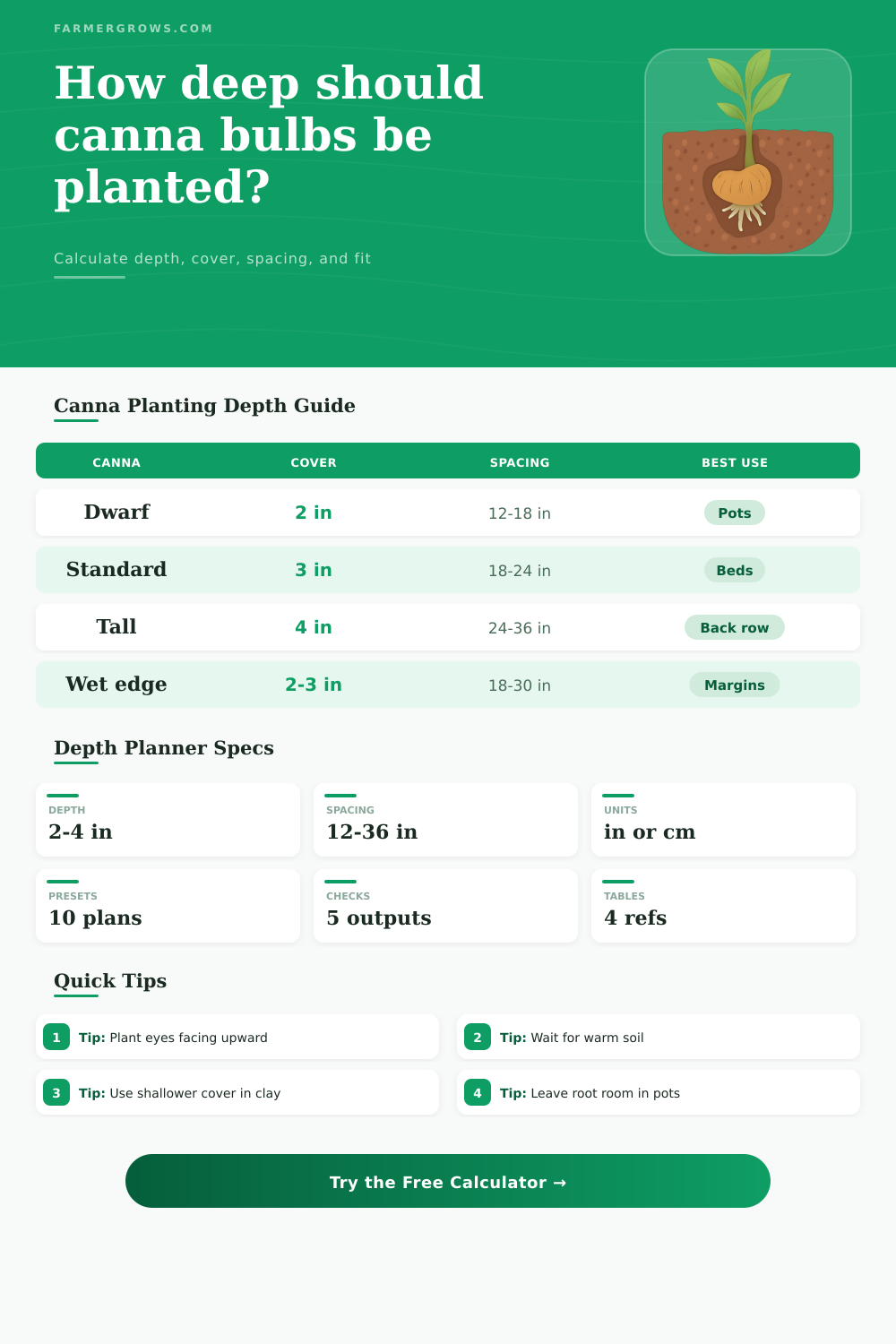
Cannas grow from rhizomes, though they are often sold as bulbs. Most garden plantings work best with the rhizome covered by about 2 to 4 inches of soil, adjusted for drainage, soil temperature, plant height, and container depth.
📋Canna Depth Presets
⚖Canna Depth Rules
🌿Canna Planting Inputs
Canna Planting Plan
Use this result as a planting layout guide. Adjust final depth if your rhizomes are unusually soft, newly divided, or already carrying long shoots.
📏Quick Reference Cards
📚Canna Planting Tables
Depth by Canna Type
| Canna type | Typical cover | Spacing range | Best planting situation |
|---|---|---|---|
| Dwarf patio canna | 2 to 2.5 in / 5 to 6 cm | 12 to 18 in / 30 to 46 cm | Containers, front edging, tight tropical pots |
| Standard garden canna | 2.5 to 3.5 in / 6 to 9 cm | 18 to 24 in / 46 to 61 cm | Mixed beds, borders, annual displays |
| Tall or giant canna | 3.5 to 4 in / 9 to 10 cm | 24 to 36 in / 61 to 91 cm | Back rows, screening, windy garden edges |
| Wet margin canna | 2 to 3 in / 5 to 8 cm | 18 to 30 in / 46 to 76 cm | Rain gardens, pond edges, rich wet soil |
| Pre-sprouted division | 1.5 to 2.5 in / 4 to 6 cm | 18 to 24 in / 46 to 61 cm | Started pots, greenhouse growth, visible shoots |
Soil and Drainage Adjustments
| Site condition | Depth adjustment | Reason | Practical note |
|---|---|---|---|
| Heavy clay or cool wet spring | Reduce 0.5 in | Less cold wet cover around rhizome | Plant into a loosened mound or wait for warmer soil |
| Balanced garden loam | No change | Good moisture and oxygen balance | Cover 3 in is a good standard target |
| Sandy or very fast soil | Add 0.5 in | Protects from drying and gives anchoring | Mulch after shoots are established |
| Raised bed mix | No change to +0.25 in | Loose soil warms quickly and drains well | Firm around rhizomes to remove air gaps |
| Pond edge or wet margin | Reduce 0.5 in | Rhizomes can rot if buried too deep in saturated soil | Keep the crown just below the soil surface |
Spacing and Bed Capacity Guide
| Spacing | Plants per 10 ft row | Plants per 4 by 8 ft bed | Use case |
|---|---|---|---|
| 12 in / 30 cm | 10 rhizomes | 32 rhizomes | Dwarf cannas or dense containers |
| 18 in / 46 cm | 6 to 7 rhizomes | 14 rhizomes | Fast colorful fill in warm beds |
| 24 in / 61 cm | 5 rhizomes | 8 rhizomes | Standard garden spacing |
| 30 in / 76 cm | 4 rhizomes | 6 rhizomes | Large clumps and wet margins |
| 36 in / 91 cm | 3 to 4 rhizomes | 4 rhizomes | Giant cannas or specimen plantings |
Container Depth Check
| Container depth | Depth fit | Best canna size | Planting note |
|---|---|---|---|
| 10 to 12 in / 25 to 30 cm | Tight | Dwarf only | Use shallow cover and watch watering closely |
| 14 to 16 in / 36 to 41 cm | Good | Dwarf or standard | Leaves fair root room below the rhizome |
| 18 to 22 in / 46 to 56 cm | Very good | Standard or tall | Better moisture buffer for summer heat |
| 24 in+ / 61 cm+ | Excellent | Tall and giant | Use a stable wide pot for heavy top growth |
🌱Planting Tips
Measure soil cover from the finished bed surface down to the top of the rhizome. Mulch is useful, but it settles and should not replace firm planting soil.
Cannas sprout fastest in warm soil. If the soil is cool and wet, wait or plant slightly shallower in a raised mound to reduce rot risk.
Close spacing fills a bed quickly but can crowd large leaves by late summer. Give tall and giant varieties more room for airflow.
Containers need depth below the rhizome as well as cover above it. A wide, deep pot helps keep tall cannas upright and evenly moist.
Don’t treat your planting depth as a set rule. Though it’s tempting to think of all things bulb-like as being equal, cannas aren’t true bulbs but rather rhizomes (which is why they have eyes). They require different care depending on your soil type.
They shouldn’t be buried so deeply that moisture gets trapped around the eyes, which can cause rot before a leaf even pushes up. They also shouldn’t be dug in too shallowly, leaving the crown exposed to wind and temperature changes. Once you input your soil type (texture and drainage), along with your rhizome size, the calculator above does the rest for you, no more guesswork about whether to plant shallower in clayey ground different than sandy loam.
How Deep to Plant Canna Rhizomes
But the soil is the most crucial factor, much more so then the actual plant. “A wet, heavy clay will remain sodden long after a spring downpour,” says the man whose tool was designed to calculate best planting depth. He explains this in the video below. This is a cold, oxygen-free habitat hostile to dormant rhizome, and where you want least-covering varieties. Selecting heavy or poorly drained soil types tells the tool to recommend planting closer to the surface.
Fast-draining, sandy soils, on the other hand, bake up fast in the sun’s heat and dry out quickly. Insulation provided by added depth helps keep the rhizome cool and moist till the root system can get established. Deep equals safe, right? A lot of folks believe that, but deep equals dead with cannas unless there is a way for moisture to drain off from around the crown.
Also bear in mind: What’s already in that hole? If a little green shoot is poking through, or if there are even eyes on the rhizome you have, burying it too deeply will crush its beginnings. That’s why the calculator needs to know the height of the eyes from the ground. This helps it know where to place the rhizome so the new shoots has enough room between surface and the rhizome body to push up and break free without being bent out of shape.
Bending ones seldom right themselves. This results in weaker stems than the plant would otherwise make, and they aren’t strong enough to hold up the full foliage load the cannas put forth later in summer. It is a small detail, but it is important to how the plant eventually grows.
Here is another example: spacing is where the math beats intuition every time. Want an instant jungle effect? Don’t cram your rhizomes together. Shove your rhizomes together. Cannas are not exactly narrow things, though. By high summer each standard-size rhizome has spread to form a clump almost two feet wide. If you plant them eighteen inches apart now, you will be digging up the garden in July to make room for airflow.
The page’s reference table spells it out, with the message: Go wider, so no dense canopy and thus no invitation to fungal issues. Better: Fewer plants but with elbowroom; less crowded means no collapse of bed beneath its own dampness.
There are limitations to containers, too. “If you run out of below-ground real estate, don’t try to plant deeper,” says the story, since a pot limits how deeply you can plant. “Rhizomes require plenty of space beneath for the root mat to spread out, and above for canopy cover.” Short on the latter? Then shorten the soil layer on top by an amount that matches what you lack. What’s more, the roots will bump up against the bottom and rot if they’re constantly wet against that plastic surface. This ratio gets checked by the tool, which flags you if you pick a container that doesn’t provide enough of each: neither too little nor too much.
It’s also about timing. No matter how carefully you measure, it’s asking for trouble if you plunge into cool, sodden earth with your spade. Wait till it’s warmed up. Warm soil will prompt rapid emergence. It happens fast enough to use up whatever reserves are stashed in the rhizome’s energy tank fast and root down for new supplies. Cool soil slows things way down, keeping the rhizome tucked away while microorganisms party on in moist darkness.
And really: Isn’t that what gardening is all about, less rules than relationships? How the soil behaves with the elements affects how deep a hole gets dug. Then it’s not so much random math anymore; when you see how temperature and drainage relate to cover depth, it makes sense. And then suddenly you don’t just have an object to plant in but a thing, a living engine called the rhizome. Requiring certain conditions for it to fire up. What your cannas need to be vibrantly alive all season long is that same kind of balance between breathability and protection.