Cauliflower Plant Spacing Calculator
Estimate cauliflower rows, final plant count, transplant cells, plant density, harvestable heads, and yield range for raised beds, garden blocks, tunnels, and field rows.
Use this calculator before setting cauliflower transplants. Cauliflower needs steady growth and enough leaf canopy to wrap the curd, so spacing, margins, head class, and expected transplant survival all change the plan.
Cauliflower Planting Plan
Use these numbers to set row markers, start transplant cells, and plan a realistic harvest count.
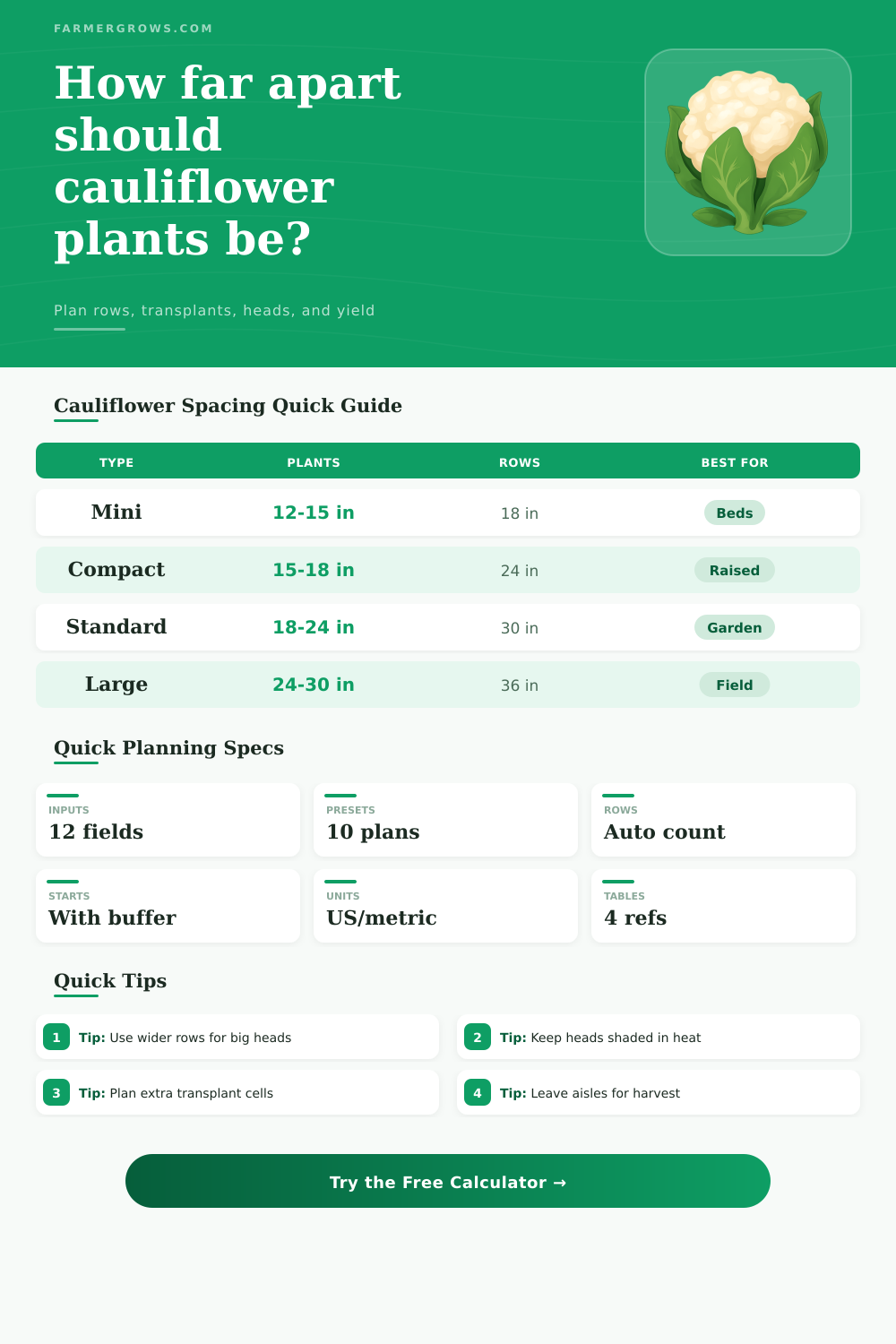
| Cauliflower type | Plant spacing | Row spacing | Plants per 100 sq ft | Best use |
|---|---|---|---|---|
| Mini or baby heads | 12 to 15 in | 18 to 24 in | 40 to 80 | Dense beds, fast harvests, small heads |
| Compact garden heads | 15 to 18 in | 24 to 30 in | 27 to 48 | Raised beds and small home gardens |
| Standard white heads | 18 to 24 in | 30 to 36 in | 17 to 32 | Balanced leaf canopy, curd size, and access |
| Large or exhibition heads | 24 to 30 in | 36 to 42 in | 10 to 20 | Large curds, heavy wrapper leaves, wider roots |
| Overwinter types | 24 to 30 in | 36 to 42 in | 10 to 20 | Long season crops that sit through cool weather |
| Bed width | 18 in rows | 24 in rows | 30 in rows | 36 in rows |
|---|---|---|---|---|
| 2 ft strip | 1 row | 1 row | 1 row | 1 row |
| 3 ft narrow bed | 2 rows | 1 to 2 rows | 1 row | 1 row |
| 4 ft raised bed | 2 rows | 2 rows | 1 to 2 rows | 1 row |
| 5 ft broad bed | 3 rows | 2 rows | 2 rows | 1 to 2 rows |
| Field strip | Use only mini heads | Use bed rows | 1 row | 1 row |
| Row length | 15 in plants | 18 in plants | 24 in plants | 30 in plants |
|---|---|---|---|---|
| 8 ft row | 6 plants | 5 plants | 4 plants | 3 plants |
| 12 ft row | 9 plants | 8 plants | 6 plants | 4 plants |
| 30 ft row | 24 plants | 20 plants | 15 plants | 12 plants |
| 50 ft row | 40 plants | 33 plants | 25 plants | 20 plants |
| 100 ft row | 80 plants | 66 plants | 50 plants | 40 plants |
| Planning factor | Conservative value | Typical value | Strong value | How to use it |
|---|---|---|---|---|
| Transplant survival | 80% | 90% | 95% | Lower it for hot planting days or weak seedlings |
| Marketable heads | 70% | 85% | 95% | Accounts for buttoning, pests, frost, and uneven curds |
| Head weight | 1.0 lb | 2.0 lb | 3.5 lb | Variety, spacing, fertility, and weather change head size |
| Harvest window | 1 week | 2 weeks | 4 weeks | Use longer windows for staggered varieties or successions |
| Cell buffer | 5% | 10% | 20% | Start extras for blank spots and late replacements |
For bigger heads: Choose wider plant spacing before adding more fertilizer. Crowded cauliflower often makes smaller curds even when the leaves look vigorous.
For even harvests: Start a few extra cells and keep spacing consistent. Uneven transplant size can lead to buttoning, gaps, or a stretched harvest window.
Did you know that even with optimal soil and watering conditions, cauliflower heads occasionaly stay tiny? Why? Frequently, it’s because there simply wasn’t room for them. To grow a properly sized head, cauliflower needs adequate leaf area (to make sugar for the developing head) as well as air circulation (to avoid rot). It must be physically accessible, too, when harvest time arrives. That’s why some gardeners say they don’t grow cauliflower anymore: They planted it wrong.
The calculator does away with guesswork on planting plans and tells you exactly how much space to allow for each plant in your bed. The leaves of cauliflower starts out wide, like a big rosette, spreading outward. Once the head start to form, they turn under to shade the head. When there’s no space for plants to breathe, the leaves of one plant touch another. This holds in moisture and invites rot and mildew, since the inner leaves can’t reach sunlight to nourish the forming head. Poor spacing is more likely to produce a small head then a variety problem. Because canopy size of the foliage varies so much by type, the tool will accommodate various head sizes as you adjust.
Why Spacing Is Important for Cauliflower
Before setting your markers in the ground, know what kind of seed you have. Plant spacing and row spacing is related. Plants that are eighteen inches apart should be in rows at least as far away from one another, otherwise you will be creating moist pockets harmful to them. For white heads, the standard spacing is two feet between plants and perhaps three feet between rows. That means every plant has about a quarter of a square foot of its own territory. It doesn’t seem like much, till you realize how big those adult-sized leaves get. Compact varieties need more room than lettuce, and the tables of references details which combos work, no measuring by eye required.
Your plans for what to plant are greatly affected by transplant survival: Some plants will get shocked in the garden; some won’t make it because they just flopped over. In most home set-ups, you can assume you’ll lose ten percent. That’s why there are spaces on the calculator for buffers (and survival rates). When you plant exactly as many seeds as you think you have room for by the time they grow, you’ll have gaps. Gaps mean less wind protection, and plants that don’t grow in even rows but instead lean and look weird. Starting extra cells isn’t waste, it’s insurance against a patchy harvest. Give away the extras, but how do you harvest heads that never got planted?
Spacing doesn’t work so well when heat is a negative factor (cauliflower will bolt if exposed to too much heat too soon). What’s that? Bolting is when a plant tries to make seed rather than a head. Why would tight spacing lead to bolting? There isn’t airflow through the middle of the bed, which warms things up there. Making your rows wider helps to ventilate, and also cool the roots. If your spring weather is variable where you garden, follow these wide-row suggestions. Better to have less but thriving, right?
Also keep in mind how well you can get at the beds. To inspect for pests; to cut off heads; to pinch leaves out. Can’t see what’s going on beneath the canopy? Then you have a row that is too thick and some unseen caterpillar will be mowing down the crop. Maintenance is better with wide rows, which also has a positive effect on how plants grow. Access is part of productivity; the tool takes into account the bed margins plus the aisles for getting around. If you can’t reach into the middle of the plants without treading on the edge ones, the plan won’t work in practice.
A good way to turn chaos into your own edible supply: Plan in advance. Count the heads; measure the space; then sow confidently. Resist overplanting (it’s so tempting when you’re eager!). Provide room for air circulation. Keep foliage dry. Let curds develop without being disturbed. If you have the space, each plant will yield quite a head. A little white marble that becomes a substantial thing.