Sweet Potato Plant Spacing Calculator
Plan sweet potato slips, row count, in-row spacing, ridge width, plant density, reserve slips, slip-bed mother roots, and expected harvest for raised beds, ridged garden rows, and field strips.
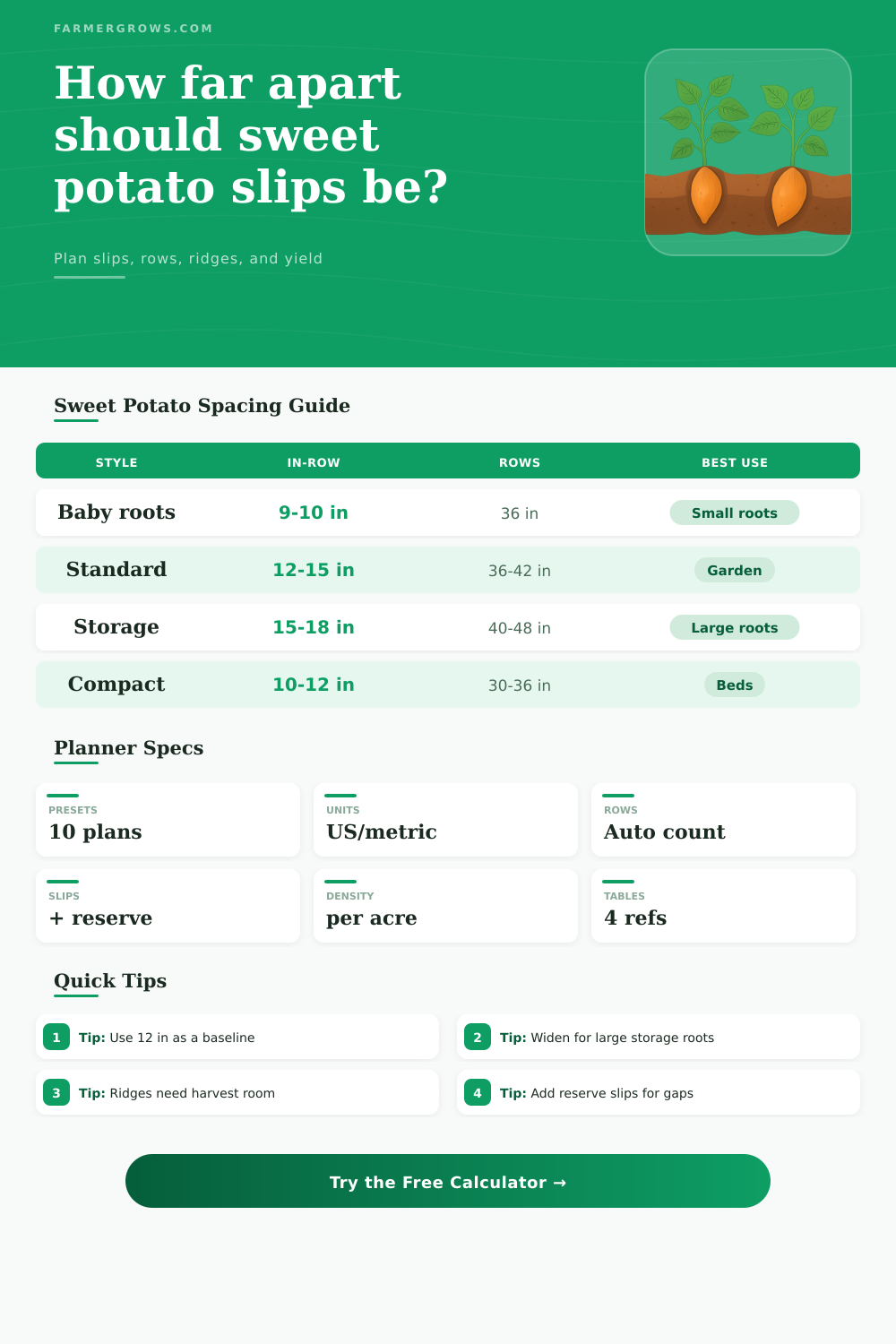
Sweet potatoes are spaced differently from Irish potatoes because the crop grows from rooted slips and sprawling vines. Use the tighter end for baby roots, compact vines, and short rows; use wider spacing for vigorous varieties, storage roots, and harvest lanes.
Sweet potato spacing results
Enter a bed size and spacing plan to estimate slips and row layout.
| Spacing style | In-row spacing | Row spacing | Root-size effect | Best use |
|---|---|---|---|---|
| Baby or early dig | 9 to 10 in | 34 to 38 in | More slips, smaller average roots | Short rows, young roots, quick kitchen use |
| Standard home garden | 12 to 15 in | 36 to 42 in | Balanced count and size | Beauregard, Jewel, Covington, Bonita |
| Storage crop | 15 to 18 in | 40 to 48 in | Fewer plants, more room to bulk | Roots intended for curing and storage |
| Compact-vine bed | 10 to 12 in | 30 to 36 in | Good bed use without long-vine crowding | Vardaman or other bushier selections |
| Long-vine specialty | 16 to 24 in | 42 to 60 in | Lower density, easier vine management | Murasaki, Okinawan, All Purple, warm sites |
| Row length | 9 in spacing | 12 in spacing | 15 in spacing | 18 in spacing |
|---|---|---|---|---|
| 10 ft row | 13 slips | 10 slips | 8 slips | 6 slips |
| 25 ft row | 33 slips | 25 slips | 20 slips | 16 slips |
| 50 ft row | 66 slips | 50 slips | 40 slips | 33 slips |
| 100 ft row | 133 slips | 100 slips | 80 slips | 66 slips |
| 30 m row | 131 slips | 98 slips | 78 slips | 65 slips |
| Row spacing x in-row | Plants per acre | Plants per 100 sq ft | Spacing character | Typical caution |
|---|---|---|---|---|
| 36 in x 9 in | 19,360 | 44.4 | Very dense | Watch undersized roots on dry sandy soil. |
| 36 in x 12 in | 14,520 | 33.3 | Common baseline | Good first estimate for many ridged rows. |
| 40 in x 12 in | 13,068 | 30.0 | Roomier row | Better harvest access than 36 inch rows. |
| 42 in x 15 in | 9,955 | 22.9 | Storage spacing | Can make large roots in fertile soil. |
| 48 in x 18 in | 7,260 | 16.7 | Wide vines | Lower count but easier vine and harvest work. |
| Garden layout | Assumed spacing | Slip count | Reserve slips | Best fit |
|---|---|---|---|---|
| 4 x 8 ft compact bed | 2 rows, 12 in slips | 16 slips | 18 slips | Vardaman, baby roots, container trial |
| 10 x 20 ft backyard strip | 3 rows, 12 in slips | 60 slips | 66 slips | Standard home garden crop |
| 12 x 40 ft storage patch | 4 rows, 15 in slips | 128 slips | 141 slips | Storage roots after curing |
| 30 in grow bag | Cluster spacing | 3 to 4 slips | 4 slips | Small-space trial, not field density |
| 1,000 sq ft field strip | 36 in x 12 in | 333 slips | 367 slips | Market garden or shared plot |
| Ridge and access item | Common target | Why it matters | Adjust wider when | Adjust tighter when |
|---|---|---|---|---|
| Ridge top | 10 to 12 in | Warms slips and drains crown zone | Soil is heavy or roots are large | Raised bed is narrow but loose |
| Ridge height | 8 to 10 in | Protects root zone from wet feet | Spring soil stays cool or wet | Soil is sandy and irrigated |
| Harvest lane | 18 to 30 in | Lets vines move and roots lift cleanly | Hand digging with fork or broadfork | Small bed with compact vines |
| Slip reserve | 5 to 15% | Covers weak slips and missing plants | Slips are shipped, dry, or delayed | Fresh local slips look uniform |
| Mother roots | 8 to 12 slips each | Estimates homegrown slip supply | Roots are small or first pull is early | Warm bed produces multiple pulls |
For many small roots, tighten in-row spacing. For storage roots, start wider and avoid pushing nitrogen so hard that vines run at the expense of marketable roots.
Sweet potato rows need space for the ridge, vines, and digging tool. A layout that fits on paper can still be cramped if the aisle disappears under vines.
Order or pull a small reserve. Replace slips that fail to stand up after establishment so the row does not carry long blank sections.
Very fertile ground can make oversized or rough roots at wide spacing. In sandy, dry soil, very close spacing can leave roots undersized.
A Spacing Calculator helps you figure out exactly where to plant your sweet potato plants, no more typical slip-garden mistakes! Because they root along their vines, these sweet potatoes wants to get around, and will have plenty of opportunity to do that if you don’t leave enough room between each one. Before you even pick up a trowel, it turns those vague “I think this is big enough” bed dimensions into rows. This help you figure out exactly what to expect when you order your slips online and whether or not you’ll have any left once you’re done.
The first decision (and one that impacts all subsequent decisions) is: What will be the size of the roots? Will they be larger storage roots (requiring more space to stretch out and not compete with their neighbors)? Or are they baby roots (which means you’ll have less space between them), destined to go into a salad or stir-fry rather than winter storage? That’s a square-footage question: The bigger the roots, the fewer plants you can accommodates in the same garden area, but the better your harvest will be.
How to Use a Spacing Calculator for Sweet Potatoes
Unless your soil isn’t good enough to support big roots, it’s a trade-off you make in favor of proper development of your tuber. When estimating yields, you take into account your soil type, since texture determines how much roots develops. Bigger roots develop on rich loamy soil even with some crowding. In sandy soils, thin roots can result from planting too widely apart. In heavy clay soil, wider ridges might be necessary to allow better drainage and get the ground warmed up come spring.
You enter the aisle width and ridge width so the plan accommodates your real-life garden layout. It provides enough space for you to have access to work the soil with a broadfork or a digging fork at harvest time. Because the tender plants are prone to killing heat, the calculator includes a buffer for the reserve slips. Usually it adds roughly a tenth, ten percent, to the grand tally so that there will be no lapses between slips when it comes time to plant. If you’re growing your own slips instead of buying them (from seed potatoes), it also calculates how many mother roots to order. Keeping your own stock of healthy plants save money over multiple years of gardening.
But there are also differences in growth habit among different varieties, and that’s why you choose the type that fits your space. For example, the long vine types such as Okinawa or Murasaki need more room then compact ones such as Vardaman, so you plant them farther apart. If you put a vigorous runner in a spot too close to its neighbors, it will want to run all over the place and you’ll spend the whole summer keeping up with it. So again, the calculator takes into account how bold the variety you’re planting is, and won’t let you treat every sweet potato like they all behave alike.
The spacing allows you to get a tool through so that you have safe reach during harvesting; otherwise you’ll dig up another row’s tubers. And the spacing between rows must accommodates your tools, too tight and you won’t be able to dig at all. The tool will show you how much area it’s taking to walk aisles versus grow potatoes, so you can see where every inch is being used. That helps you harvest more efficiently since crowding isn’t good for your plant health, either.
With sweet potatoes, the beauty is that you have some order over their tendency toward mess: Their growth habits (described in detail below) want to cover all things within reach. By laying out a clear plan before you begin planting, you’ll have the upper hand when it comes to how the sweet potatoes fit into the garden picture. Our calculator will turn your plant variety selection and bed dimensions into an exact map of rows to make, slips needed, and everything else. This includes a realistic yield estimate according to today’s growing practices… So you’ll know whether to prepare for a feast or famine.
“Don’t find out you have no more slips when it’s time to plant; order extras now.” Instead, plan your garden first (by the numbers), tinker based off your soil conditions and stick to the plan. Giving each root ample space to grow ensures a better harvest in the years ahead. The same holds true for preparing your ridges: Give yourself some wiggle room (literally!) and leave enough space for vines to create starchy, sweet roots that will keep all winter long. You should of planned better to ensure the best results.